
Sebastian Kohl – författare
Visar alla böcker från författaren Sebastian Kohl. Handla med fri frakt och snabb leverans.
3 produkter
3 produkter
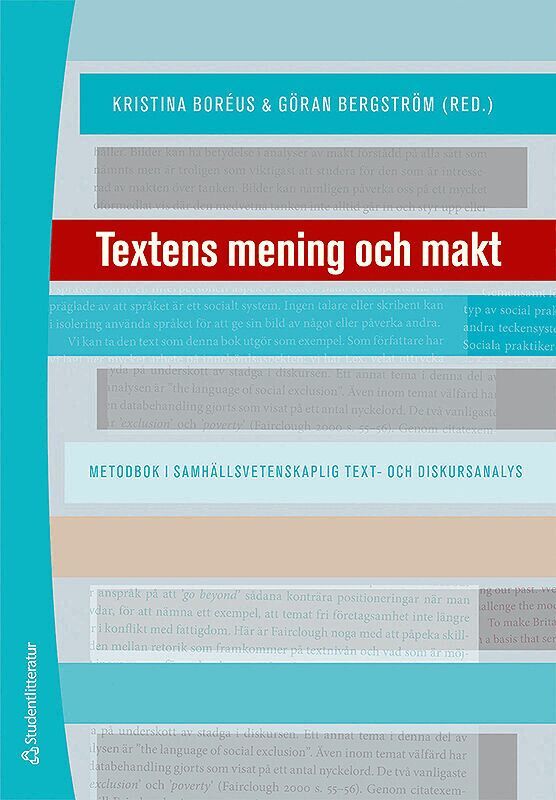
Textens mening och makt : metodbok i samhällsvetenskaplig text- och diskursanalys
Häftad, Svenska, 2018
444 kr
I moderna samhällen flödar texter och bilder. De är resultat av kommunikation mellan individer och grupper, men de är också centrala för hur vi förstår och agerar i samhället. Därför måste den som studerar samhället kunna analysera bildens och textens mening och makt.I denna fjärde omarbetade och aktualiserade upplaga av Textens mening och makt visar författarna hur man kan analysera texter och bilder med hjälp av:• innehållsanalys• argumentationsanalys• idé- och ideologianalys• begreppshistoria• narrativanalys• diskursteori, diskurspsykologi och WPR-ansatsen• kritisk diskursanalys (CDA)• visuell textanalys.Varje inriktning ges en teoretisk bakgrund, men boken är framför allt inriktad på hur man gör. Konkreta exempel ur aktuell forskning, liksom övningsuppgifter med utarbetade lösningsförslag, åtföljer varje inriktning. Till Textens mening och makt hör en digital del, med texter till övningsuppgifterna, åtkomlig med hjälp av koden på insidan av bokens omslag. I denna upplaga lyfts särskilt digital textanalys fram i flera av kapitlen. Boken vänder sig till metodintresserade samhällsvetare och humanister, framför allt studenter och forskarstuderande vid universitet och högskolor.
618 kr
Skickas inom 10-15 vardagar
On the eve of the financial crisis, the USA was inhabited by almost 70 percent homeowning households, in comparison to about 45 percent in Germany. Homeownership, Renting and Society presents new evidence showing that this homeownership gap already existed between American and German cities around 1900. Existing explanations based on culture, government housing policy or typical socio-economic factors have difficulties in accounting for these long-term cross-country differences.Using historical case studies on Germany and the USA, the book identifies three institutional domains on the supply-side of the housing market – urban land, housing finance and construction – that set countries on different housing trajectories and subsequently established differences that were hard to reverse in later periods. Further chapters generalize the argument across other OECD (Organisation for Economic Co-operation and Development) countries and extend the explanation to cover historical differences in homeownership ideology and horizontal property institutions. This enlightening volume also puts forward path-dependence theories in housing studies, connects housing with vast urban-history and political-economy literature and offers comprehensive insights about the case of a tenant’s country which contradicts the tendency towards universal homeownership.Providing an all-new historic-institutionalist explanation of the German–American homeownership gap, this title will be of interest to postgraduate students and scholars interested in fields including: Housing Studies, Sociology, Urban History, Political Economy, Social Policy and Geography. It may also be of interest to those working in housing field organizations and ministries.
2 113 kr
Skickas inom 10-15 vardagar
On the eve of the financial crisis, the USA was inhabited by almost 70 percent homeowning households, in comparison to about 45 percent in Germany. Homeownership, Renting and Society presents new evidence showing that this homeownership gap already existed between American and German cities around 1900. Existing explanations based on culture, government housing policy or typical socio-economic factors have difficulties in accounting for these long-term cross-country differences.Using historical case studies on Germany and the USA, the book identifies three institutional domains on the supply-side of the housing market – urban land, housing finance and construction – that set countries on different housing trajectories and subsequently established differences that were hard to reverse in later periods. Further chapters generalize the argument across other OECD (Organisation for Economic Co-operation and Development) countries and extend the explanation to cover historical differences in homeownership ideology and horizontal property institutions. This enlightening volume also puts forward path-dependence theories in housing studies, connects housing with vast urban-history and political-economy literature and offers comprehensive insights about the case of a tenant’s country which contradicts the tendency towards universal homeownership.Providing an all-new historic-institutionalist explanation of the German–American homeownership gap, this title will be of interest to postgraduate students and scholars interested in fields including: Housing Studies, Sociology, Urban History, Political Economy, Social Policy and Geography. It may also be of interest to those working in housing field organizations and ministries.