
Family Life through History - Böcker
Visar alla böcker i serien Family Life through History. Handla med fri frakt och snabb leverans.
4 produkter
4 produkter
833 kr
Skickas inom 10-15 vardagar
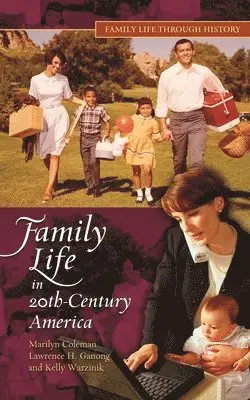
No other century promoted such rapid change in American families than the twentieth century did. Through most of the first half of the century families were two-parent plus children units, but by the 1980s and 1990s divorce was common in half of the homes and many families were single-parent or included step-parents, step-siblings and half-siblings. The major changes in opinions and even some laws on race, gender and sexuality during the 1960s and 1970s brought change to families as well. Some families were headed by gay parents, lived in communes or other non-traditional homes, were of mixed race, or had adopted children. Family life had changed dramatically in less than 50 years. The change in the core make-up of what was considered a family ushered in new celebrations and holidays, ways of cooking, eating, and entertainment, and even daily activities. In this detailed look at family life in America, Coleman, Ganong and Warzinick discuss home and work, family ceremonies and celebrations, parenting and children, divorce and single-parent homes, gay and lesbian families, as well as cooking and meals, urban vs. suburban homes, and ethnic and minority families. Reference resources include a timeline, sources for further reading, photographs and an index.Volumes in the Family Life in America series focus on the day-to-day lives and roles of families throughout history. The roles of all family members are defined and information on daily family life, the role of the family in society, and the ever-changing definition of the term family' are discussed. Discussion of the nuclear family, single parent homes, foster and adoptive families, stepfamilies, and gay and lesbian families are included where appropriate. Topics such as meal planning, homes, entertainment and celebrations, are discussed along with larger social issues that originate in the home like domestic violence, child abuse and neglect, and divorce. Ideal for students and general readers alike, books in this series bring the history of everyday people to life.
901 kr
Skickas inom 10-15 vardagar
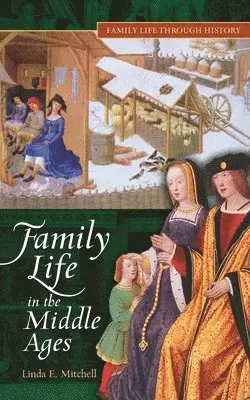
Mitchell takes a regional approach in exploring the lives of families in the Middle Ages. Starting with the late Roman families the first five chapters explore the roles of family members defined by tradition and law, what constituted a legal marriage and a family, to whom the children belonged, and who was included in the extended family. The remaining chapters delve into daily family life - homes of various social classes and the division of labor, both maintaining the home and family-based labor such as agriculture, banking, manufacturing of goods, and mercantile activity. Religious cultures of the medieval world varied but all often included oblation of children to monasteries, religious ceremonies for life stages, and family obligations in the religious culture. Birth, death and inheritance all affected the family and new families were often formed from previous generations and defunct family lines. Non-traditional families included family structures advocated by heretical groups - the Cathars and the Beguines, families created without marriage - concubinage relationships, and those that developed as a result of social and environmental stresses - the Black Death, war, and natural disasters. Perfect for students studying the Middle Ages and medieval life, this work provides a clear and engaging narrative on the day-to-day lives of the family. Reference resources include a timeline, sources for further reading, photographs and an index.Volumes in the Family Life Through History series focus on the day-to-day lives and roles of families. The roles of all family members are defined and information on daily family life, the role of the family in society, and the ever-changing definition of the term family' are discussed. Discussion of the nuclear family, single parent homes, foster and adoptive families, stepfamilies, and gay and lesbian families are included where appropriate. Topics such as meal planning, homes, entertainment and celebrations, are discussed along with larger social issues that originate in the home like domestic violence, child abuse and neglect, and divorce. Ideal for students and general readers alike, books in this series bring the history of everyday people to life.
875 kr
Skickas inom 10-15 vardagar
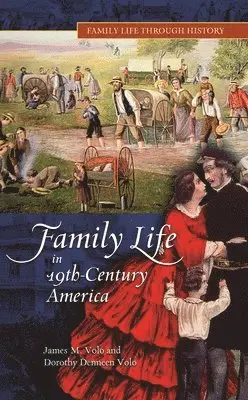
Nineteenth century families had to deal with enormous changes in almost all of life's categories. The first generation of nineteenth century Americans was generally anxious to remove the Anglo from their Anglo-Americanism. The generation that grew up in Jacksonian America matured during a period of nationalism, egalitarianism, and widespread reformism. Finally, the generation of the pre-war decades was innately diverse in terms of their ethnic backgrounds, employment, social class, education, language, customs, and religion. Americans were acutely aware of the need to create a stable and cohesive society firmly founded on the family and traditional family values. Yet the people of America were among the most mobile and diverse on earth. Geographically, socially, and economically, Americans (and those immigrants who wished to be Americans) were dedicated to change, movement, and progress. This dichotomy between tradition and change may have been the most durable and common of American traits, and it was a difficult quality to circumvent when trying to form a unified national persona.Volumes in the Family Life in America series focus on the day-to-day lives and roles of families throughout history. The roles of all family members are defined and information on daily family life, the role of the family in society, and the ever-changing definition of family are discussed. Discussion of the nuclear family, single parent homes, foster and adoptive families, stepfamilies, and gay and lesbian families are included where appropriate. Topics such as meal planning, homes, entertainment and celebrations, are discussed along with larger social issues that originate in the home like domestic violence, child abuse and neglect, and divorce. Ideal for students and general readers alike, books in this series bring the history of everyday people to life.
809 kr
Skickas inom 10-15 vardagar
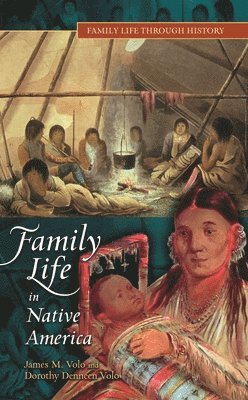
This volume provides insight into the family life of Native Americans of the northeast quadrant of the North American continent and those living in the adjacent coastal and piedmont regions. These Native Americans were among the most familiar to Euro-colonials for more than two centuries. From the tribes of the northeast woodlands came “great hunters, fishermen, farmers and fighters, as well as the most powerful and sophisticated Indian nation north of Mexico [the Iroquois Confederacy].