A. A. Kirillov - Böcker
Visar alla böcker från författaren A. A. Kirillov. Handla med fri frakt och snabb leverans.
4 produkter
4 produkter
906 kr
Skickas inom 10-15 vardagar
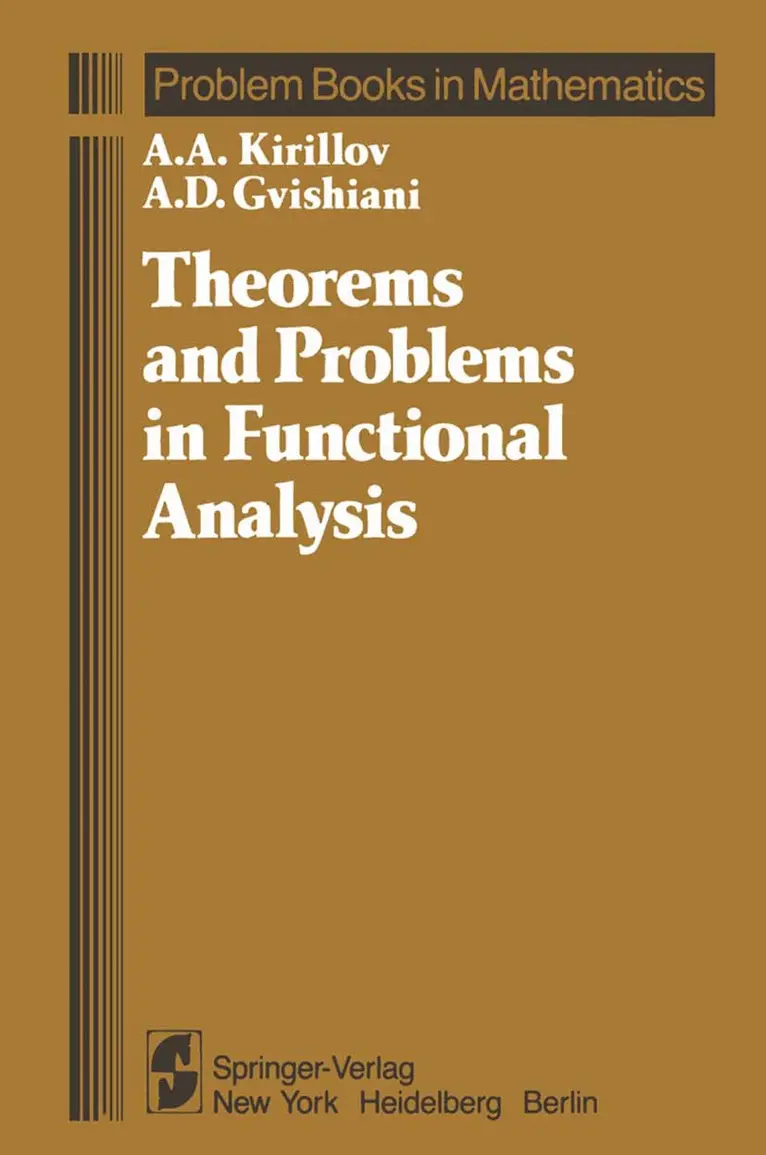
Even the simplest mathematical abstraction of the phenomena of reality the real line-can be regarded from different points of view by different mathematical disciplines. For example, the algebraic approach to the study of the real line involves describing its properties as a set to whose elements we can apply" operations," and obtaining an algebraic model of it on the basis of these properties, without regard for the topological properties. On the other hand, we can focus on the topology of the real line and construct a formal model of it by singling out its" continuity" as a basis for the model. Analysis regards the line, and the functions on it, in the unity of the whole system of their algebraic and topological properties, with the fundamental deductions about them obtained by using the interplay between the algebraic and topological structures. The same picture is observed at higher stages of abstraction. Algebra studies linear spaces, groups, rings, modules, and so on. Topology studies structures of a different kind on arbitrary sets, structures that give mathe matical meaning to the concepts of a limit, continuity, a neighborhood, and so on. Functional analysis takes up topological linear spaces, topological groups, normed rings, modules of representations of topological groups in topological linear spaces, and so on. Thus, the basic object of study in functional analysis consists of objects equipped with compatible algebraic and topological structures.
641 kr
Skickas inom 10-15 vardagar
Even the simplest mathematical abstraction of the phenomena of reality the real line-can be regarded from different points of view by different mathematical disciplines. For example, the algebraic approach to the study of the real line involves describing its properties as a set to whose elements we can apply" operations," and obtaining an algebraic model of it on the basis of these properties, without regard for the topological properties. On the other hand, we can focus on the topology of the real line and construct a formal model of it by singling out its" continuity" as a basis for the model. Analysis regards the line, and the functions on it, in the unity of the whole system of their algebraic and topological properties, with the fundamental deductions about them obtained by using the interplay between the algebraic and topological structures. The same picture is observed at higher stages of abstraction. Algebra studies linear spaces, groups, rings, modules, and so on. Topology studies structures of a different kind on arbitrary sets, structures that give mathe matical meaning to the concepts of a limit, continuity, a neighborhood, and so on. Functional analysis takes up topological linear spaces, topological groups, normed rings, modules of representations of topological groups in topological linear spaces, and so on. Thus, the basic object of study in functional analysis consists of objects equipped with compatible algebraic and topological structures.
1 006 kr
Skickas inom 7-10 vardagar
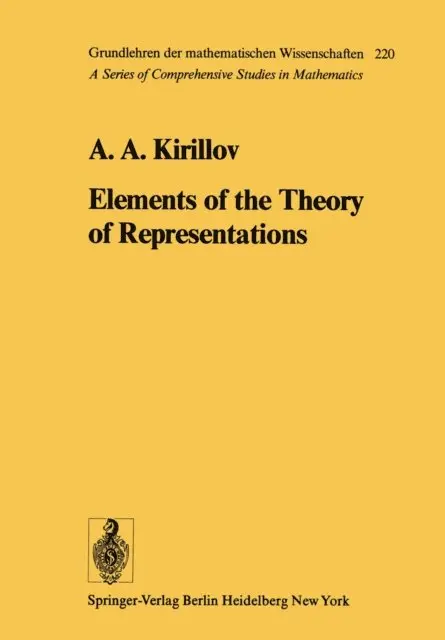
Isaac Newton encrypted his discoveries in analysis in the form of an anagram, which deciphers to the sentence ""It is worthwhile to solve differential equations"". Accordingly, one can express the main idea behind the Orbit Method by saying ""It is worthwhile to study coadjoint orbits"". The orbit method was introduced by the author, A. A. Kirillov, in the 1960s and remains a useful and powerful tool in areas such as Lie theory, group representations, integrable systems, complex and symplectic geometry, and mathematical physics. This book describes the essence of the orbit method for non-experts and gives the first systematic, detailed, and self-contained exposition of the method. It starts with a convenient ""User's Guide"" and contains numerous examples. It can be used as a text for a graduate course, as well as a handbook for non-experts and a reference book for research mathematicians and mathematical physicists.
Del 220 - Grundlehren der mathematischen Wissenschaften
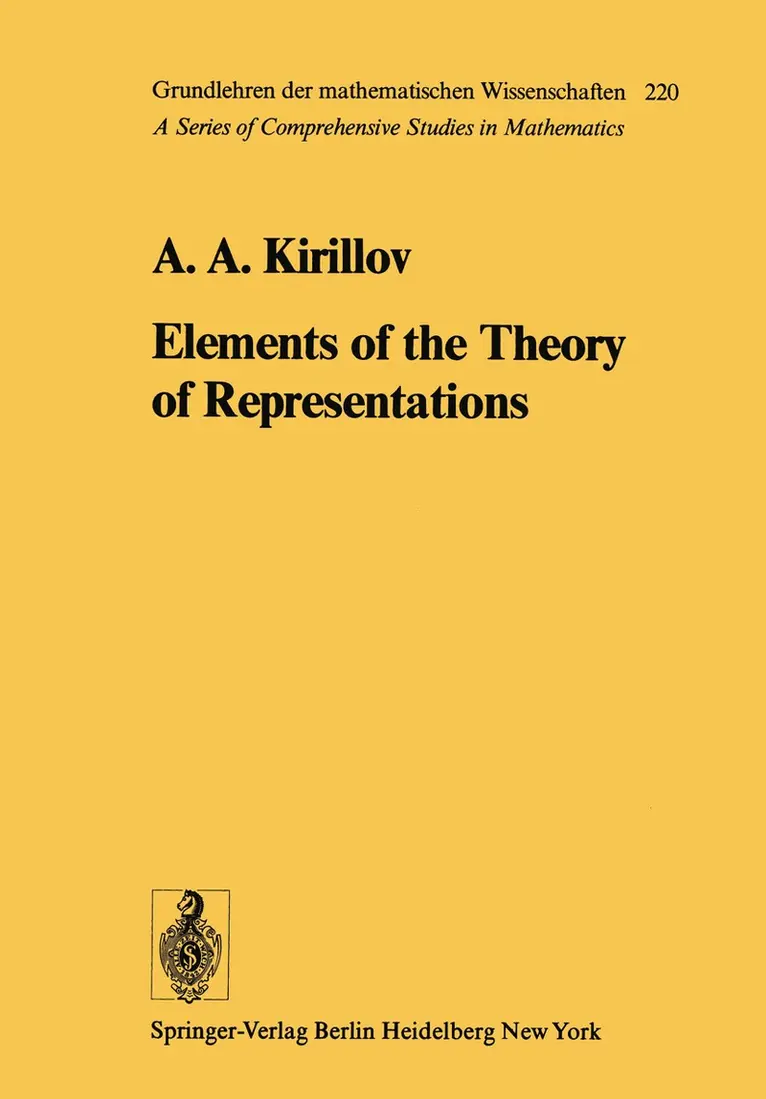
Elements of the Theory of Representations
Häftad, Engelska, 2011
1 381 kr
Skickas inom 10-15 vardagar
The translator of a mathematical work faces a task that is at once fascinating and frustrating. He has the opportunity of reading closely the work of a master mathematician. He has the duty of retaining as far as possible the flavor and spirit of the original, at the same time rendering it into a readable and idiomatic form of the language into which the translation is made. All of this is challenging. At the same time, the translator should never forget that he is not a creator, but only a mirror. His own viewpoints, his own preferences, should never lead him into altering the original, even with the best intentions. Only an occasional translator's note is permitted. The undersigned is grateful for the opportunity of translating Professor Kirillov's fine book on group representations, and hopes that it will bring to the English-reading mathematical public as much instruction and interest as it has brought to the translator. Deviations from the Russian text have been rigorously avoided, except for a number of corrections kindly supplied by Professor Kirillov. Misprints and an occasional solecism have been tacitly taken care of. The trans lation is in all essential respects faithful to the original Russian. The translator records his gratitude to Linda Sax, who typed the entire translation, to Laura Larsson, who prepared the bibliography (considerably modified from the original), and to Betty Underhill, who rendered essential assistance.