A. Barlotti – författare
Visar alla böcker från författaren A. Barlotti. Handla med fri frakt och snabb leverans.
12 produkter
12 produkter
E-bok
PDF, Engelska, 20111 371 kr
Läs direkt efter köp
Recent developments in all aspects of combinatorial and incidence geometry are covered in this volume, including their links with the foundations of geometry, graph theory and algebraic structures, and the applications to coding theory and computer science.Topics covered include Galois geometries, blocking sets, affine and projective planes, incidence structures and their automorphism groups. Matroids, graph theory and designs are also treated, along with weak algebraic structures such as near-rings, near-fields, quasi-groups, loops, hypergroups etc., and permutation sets and groups.The vitality of combinatorics today lies in its important interactions with computer science. The problems which arise are of a varied nature and suitable techniques to deal with them have to be devised for each situation; one of the special features of combinatorics is the often sporadic nature of solutions, stemming from its links with number theory. The branches of combinatorics are many and various, and all of them are represented in the 56 papers in this volume.
E-bok
PDF, Engelska, 1992756 kr
Läs direkt efter köp
This volume forms a valuable source of information on recent developments in research in combinatorics, with special regard to the geometric point of view. Topics covered include: finite geometries (arcs, caps, special varieties in a Galois space; generalized quadrangles; Benz planes; foundation of geometry), partial geometries, Buekenhout geometries, transitive permutation sets, flat-transitive geometries, design theory, finite groups, near-rings and semifields, MV-algebras, coding theory, cryptography and graph theory in its geometric and design aspects.
E-bok
PDF, Engelska, 2012703 kr
Läs direkt efter köp
Combinatorial and Geometric Structures and Their Applications
E-bok
PDF, Engelska, 1983678 kr
Läs direkt efter köp
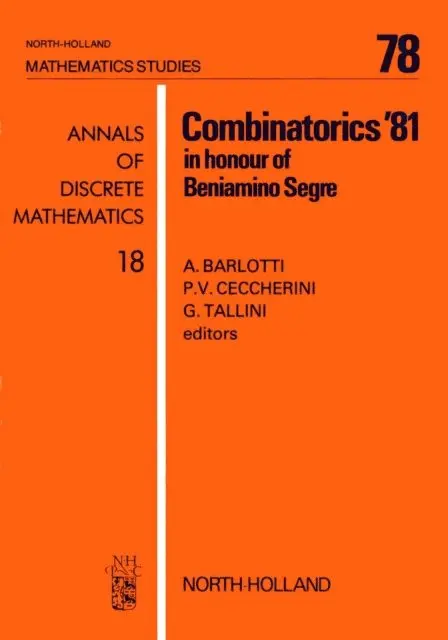
Combinatorics ''81
E-bok
PDF, Engelska, 1986672 kr
Läs direkt efter köp
Interest in combinatorial techniques has been greatly enhanced by the applications they may offer in connection with computer technology. The 38 papers in this volume survey the state of the art and report on recent results in Combinatorial Geometries and their applications.Contributors: V. Abatangelo, L. Beneteau, W. Benz, A. Beutelspacher, A. Bichara, M. Biliotti, P. Biondi, F. Bonetti, R. Capodaglio di Cocco, P.V. Ceccherini, L. Cerlienco, N. Civolani, M. de Soete, M. Deza, F. Eugeni, G. Faina, P. Filip, S. Fiorini, J.C. Fisher, M. Gionfriddo, W. Heise, A. Herzer, M. Hille, J.W.P. Hirschfield, T. Ihringer, G. Korchmaros, F. Kramer, H. Kramer, P. Lancellotti, B. Larato, D. Lenzi, A. Lizzio, G. Lo Faro, N.A. Malara, M.C. Marino, N. Melone, G. Menichetti, K. Metsch, S. Milici, G. Nicoletti, C. Pellegrino, G. Pica, F. Piras, T. Pisanski, G.-C. Rota, A. Sappa, D. Senato, G. Tallini, J.A. Thas, N. Venanzangeli, A.M. Venezia, A.C.S. Ventre, H. Wefelscheid, B.J. Wilson, N. Zagaglia Salvi, H. Zeitler.
Inbunden, Engelska, 1991
2 156 kr
Skickas inom 10-15 vardagar
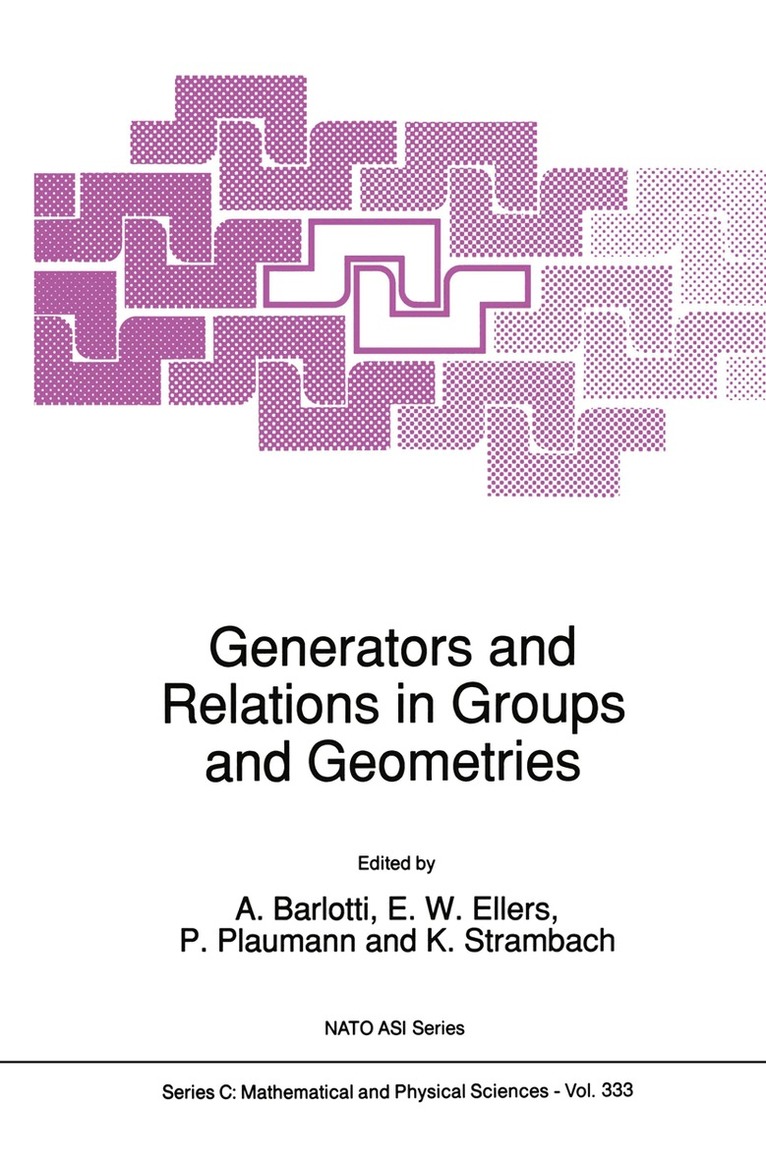
Every group is represented in many ways as an epimorphic image of a free group. It seems therefore futile to search for methods involving generators and relations which can be used to detect the structure of a group. Nevertheless, results in the indicated direction exist. The clue is to ask the right question. Classical geometry is a typical example in which the factorization of a motion into reflections or, more generally, of a collineation into central collineations, supplies valuable information on the geometric and algebraic structure. This mode of investigation has gained momentum since the end of last century. The tradition of geometric-algebraic interplay brought forward two branches of research which are documented in Parts I and II of these Proceedings. Part II deals with the theory of reflection geometry which culminated in Bachmann's work where the geometric information is encoded in properties of the group of motions expressed by relations in the generating involutions. This approach is the backbone of the classification of motion groups for the classical unitary and orthogonal planes. The axioms in this char acterization are natural and plausible. They provoke the study of consequences of subsets of axioms which also yield natural geometries whose exploration is rewarding. Bachmann's central axiom is the three reflection theorem, showing that the number of reflections needed to express a motion is of great importance.
Häftad, Engelska, 2011
383 kr
Skickas inom 10-15 vardagar
R.C. Bose: Graphs and designs.- R.H. Bruck: Construction problems in finite projective spaces.- R.H.F. Denniston: Packings of PG(3,q).- J. Doyen: Recent results on Steiner triple systems.- H. Lüneburg: Gruppen und endliche projektive Ebenen.- J.A. Thas: 4-gonal configurations.- H.P. Young: Affine triple systems.
E-bok
PDF, Engelska, 2011496 kr
Läs direkt efter köp
R.C. Bose: Graphs and designs.- R.H. Bruck: Construction problems in finite projective spaces.- R.H.F. Denniston: Packings of PG(3,q).- J. Doyen: Recent results on Steiner triple systems.- H. Lüneburg: Gruppen und endliche projektive Ebenen.- J.A. Thas: 4-gonal configurations.- H.P. Young: Affine triple systems.
Häftad, Engelska, 2010
490 kr
Skickas inom 10-15 vardagar
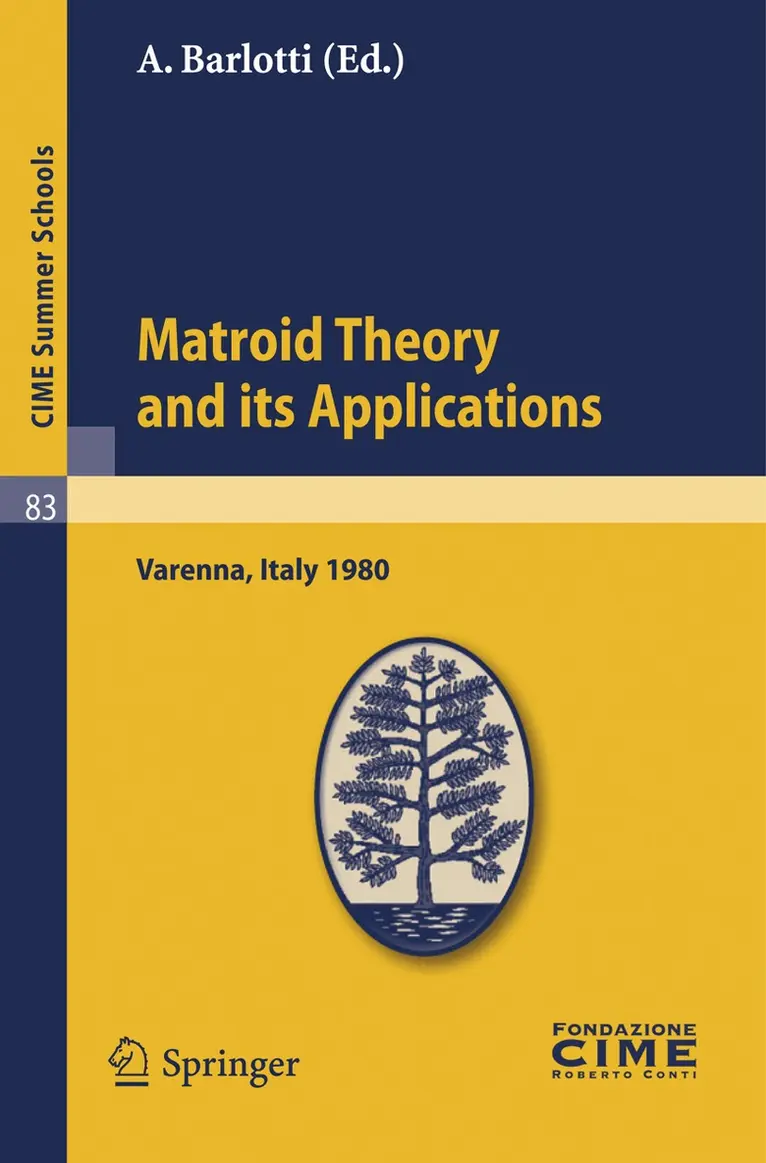
Lectures: T.H. Brylawski: The Tutte polynomial.- D.J.A. Welsh: Matroids and combinatorial optimisation.- Seminars: M. Barnabei, A. Brini, G.-C. Rota: Un’introduzione alla teoria delle funzioni di Möbius.- A. Brini: Some remarks on the critical problem.- J. Oxley: On 3-connected matroids and graphs.- R. Peele: The poset of subpartitions and Cayley’s formula for the complexity of a complete graph.- A. Recski: Engineering applications of matroids.- T. Zaslavisky: Voltage-graphic matroids.
E-bok
PDF, Engelska, 2011626 kr
Läs direkt efter köp
Lectures: T.H. Brylawski: The Tutte polynomial.- D.J.A. Welsh: Matroids and combinatorial optimisation.- Seminars: M. Barnabei, A. Brini, G.-C. Rota: Un’introduzione alla teoria delle funzioni di Möbius.- A. Brini: Some remarks on the critical problem.- J. Oxley: On 3-connected matroids and graphs.- R. Peele: The poset of subpartitions and Cayley’s formula for the complexity of a complete graph.- A. Recski: Engineering applications of matroids.- T. Zaslavisky: Voltage-graphic matroids.
Häftad, Engelska, 2012
2 138 kr
Skickas inom 10-15 vardagar
Every group is represented in many ways as an epimorphic image of a free group. It seems therefore futile to search for methods involving generators and relations which can be used to detect the structure of a group. Nevertheless, results in the indicated direction exist. The clue is to ask the right question. Classical geometry is a typical example in which the factorization of a motion into reflections or, more generally, of a collineation into central collineations, supplies valuable information on the geometric and algebraic structure. This mode of investigation has gained momentum since the end of last century. The tradition of geometric-algebraic interplay brought forward two branches of research which are documented in Parts I and II of these Proceedings. Part II deals with the theory of reflection geometry which culminated in Bachmann's work where the geometric information is encoded in properties of the group of motions expressed by relations in the generating involutions. This approach is the backbone of the classification of motion groups for the classical unitary and orthogonal planes. The axioms in this char acterization are natural and plausible. They provoke the study of consequences of subsets of axioms which also yield natural geometries whose exploration is rewarding. Bachmann's central axiom is the three reflection theorem, showing that the number of reflections needed to express a motion is of great importance.
E-bok
PDF, Engelska, 20122 741 kr
Läs direkt efter köp
Every group is represented in many ways as an epimorphic image of a free group. It seems therefore futile to search for methods involving generators and relations which can be used to detect the structure of a group. Nevertheless, results in the indicated direction exist. The clue is to ask the right question. Classical geometry is a typical example in which the factorization of a motion into reflections or, more generally, of a collineation into central collineations, supplies valuable information on the geometric and algebraic structure. This mode of investigation has gained momentum since the end of last century. The tradition of geometric-algebraic interplay brought forward two branches of research which are documented in Parts I and II of these Proceedings. Part II deals with the theory of reflection geometry which culminated in Bachmann''s work where the geometric information is encoded in properties of the group of motions expressed by relations in the generating involutions. This approach is the backbone of the classification of motion groups for the classical unitary and orthogonal planes. The axioms in this char acterization are natural and plausible. They provoke the study of consequences of subsets of axioms which also yield natural geometries whose exploration is rewarding. Bachmann''s central axiom is the three reflection theorem, showing that the number of reflections needed to express a motion is of great importance.