P. Plaumann – författare
Visar alla böcker från författaren P. Plaumann. Handla med fri frakt och snabb leverans.
10 produkter
10 produkter
Inbunden, Engelska, 1991
2 156 kr
Skickas inom 10-15 vardagar
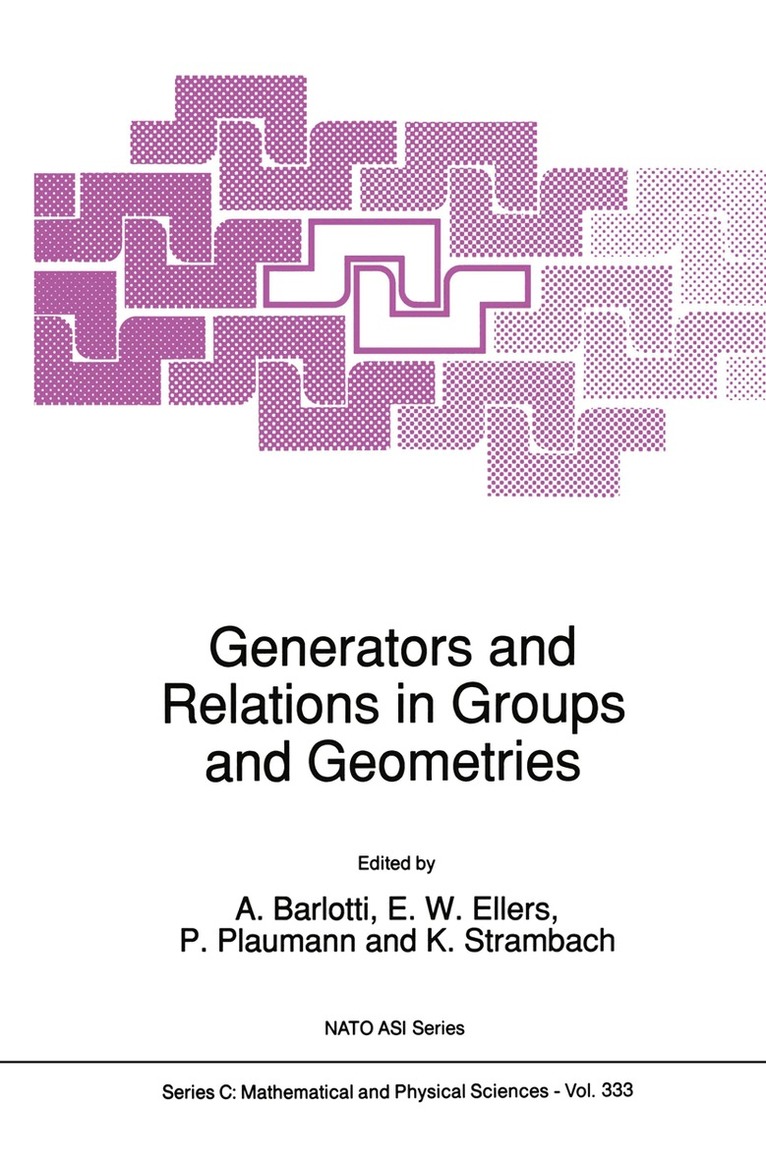
Every group is represented in many ways as an epimorphic image of a free group. It seems therefore futile to search for methods involving generators and relations which can be used to detect the structure of a group. Nevertheless, results in the indicated direction exist. The clue is to ask the right question. Classical geometry is a typical example in which the factorization of a motion into reflections or, more generally, of a collineation into central collineations, supplies valuable information on the geometric and algebraic structure. This mode of investigation has gained momentum since the end of last century. The tradition of geometric-algebraic interplay brought forward two branches of research which are documented in Parts I and II of these Proceedings. Part II deals with the theory of reflection geometry which culminated in Bachmann's work where the geometric information is encoded in properties of the group of motions expressed by relations in the generating involutions. This approach is the backbone of the classification of motion groups for the classical unitary and orthogonal planes. The axioms in this char acterization are natural and plausible. They provoke the study of consequences of subsets of axioms which also yield natural geometries whose exploration is rewarding. Bachmann's central axiom is the three reflection theorem, showing that the number of reflections needed to express a motion is of great importance.
Inbunden, Engelska, 1981
1 619 kr
Skickas inom 10-15 vardagar
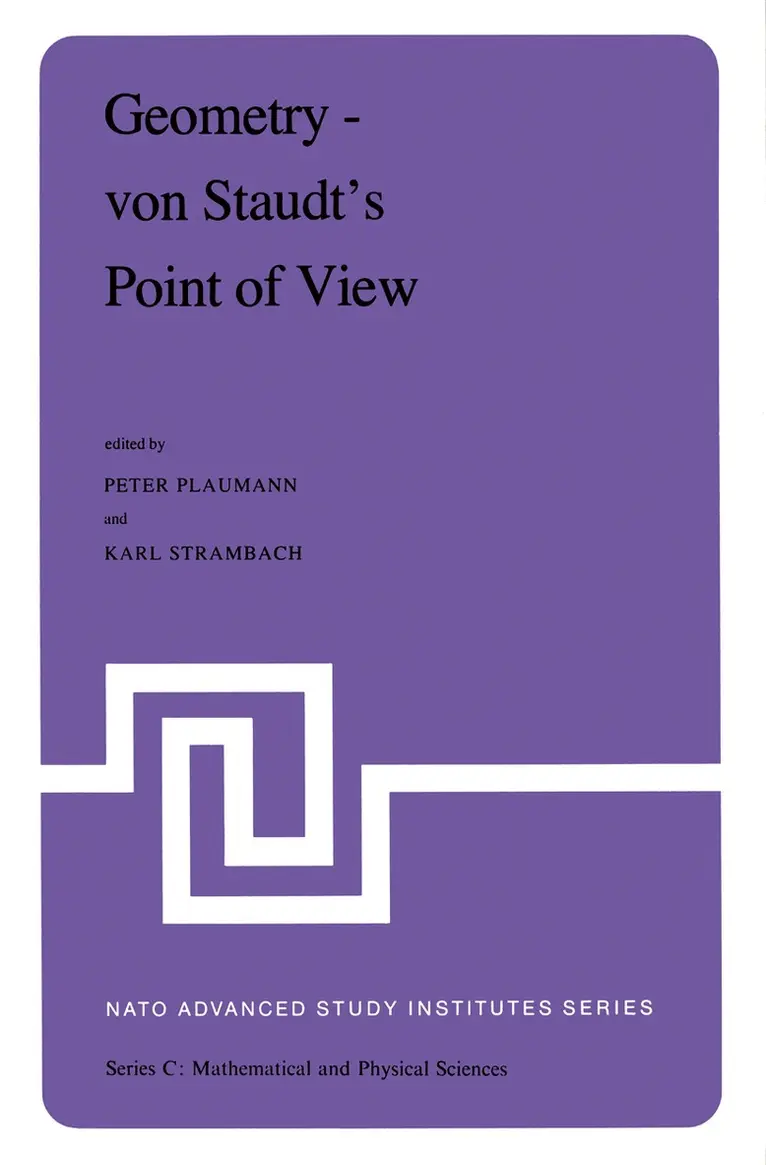
Ever since F. Klein designed his "Erlanger programm", geometries have been studied in close connection with their groups of automorphisms. It must be admitted that the presence of a large automorphismgroup does not always have strong implications for the incidence-th- retical behaviour of a geometry. For exampl~ O. H. Kegel and A. Schleiermacher [Geometriae Dedicata 2, 379 - 395 (1974)J constructed a projective plane with a transitive action of its collineation group on quadrangles, in which, nevertheless every four points generate a free subplane. However, there are several important special classes of geometries, in which strong implications are present. For instance, every finite projective plane with a doubly transitive collineation group is pappian (Theorem of Ostrom-Wagner), and every compact connected projective plane with a flag-transitive group of continuous collineations is a Moufang plane (H. Salzmann, Pac. J. Math. ~, 217 - 234 (1975)]. Klein's point of view has been very useful for numerous incidence structures and has established an intimate connection between group theory and geometry vii P. Plaumann and K. Strambach (eds.), Geometry - von Staudt's Point of View, vii-xi. Copyright (c) 1981 by D. Reidel Publishing Company. viii PREFACE 1. 1:1ich is a guidepost for every modern t:reat:ment of geometry. A few decades earlier than Klein's proposal, K. G. Ch. von Staudt stated a theorem which indicates a different point of view and is nowadays sometimes called the "Fundamental Theorem of Projective Geometry".
Inbunden, Engelska, 1985
3 231 kr
Skickas inom 10-15 vardagar
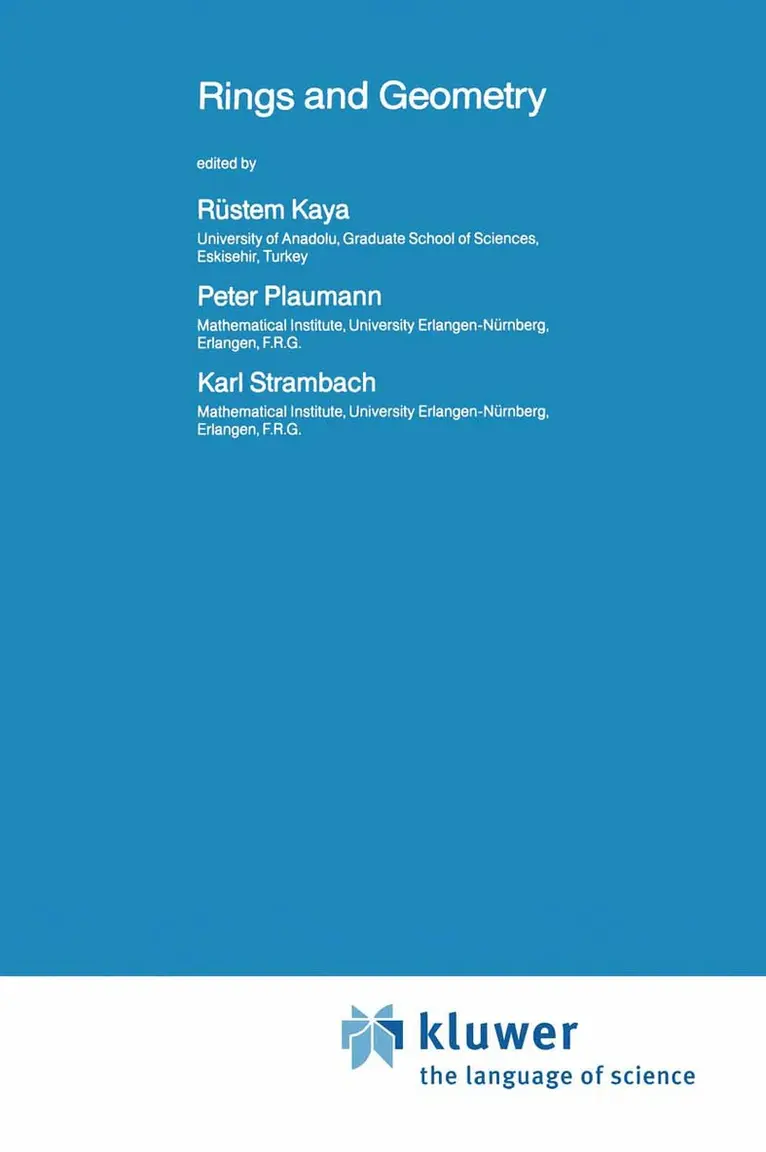
When looking for applications of ring theory in geometry, one first thinks of algebraic geometry, which sometimes may even be interpreted as the concrete side of commutative algebra.
E-bok
PDF, Engelska, 20124 015 kr
Läs direkt efter köp
When looking for applications of ring theory in geometry, one first thinks of algebraic geometry, which sometimes may even be interpreted as the concrete side of commutative algebra. However, this highly de veloped branch of mathematics has been dealt with in a variety of mono graphs, so that - in spite of its technical complexity - it can be regarded as relatively well accessible. While in the last 120 years algebraic geometry has again and again attracted concentrated interes- which right now has reached a peak once more - , the numerous other applications of ring theory in geometry have not been assembled in a textbook and are scattered in many papers throughout the literature, which makes it hard for them to emerge from the shadow of the brilliant theory of algebraic geometry. It is the aim of these proceedings to give a unifying presentation of those geometrical applications of ring theo~y outside of algebraic geometry, and to show that they offer a considerable wealth of beauti ful ideas, too. Furthermore it becomes apparent that there are natural connections to many branches of modern mathematics, e. g. to the theory of (algebraic) groups and of Jordan algebras, and to combinatorics. To make these remarks more precise, we will now give a description of the contents. In the first chapter, an approach towards a theory of non-commutative algebraic geometry is attempted from two different points of view.
Engelska, 2011
625 kr
Skickas inom 5-8 vardagar
E-bok
PDF, Engelska, 20121 977 kr
Läs direkt efter köp
Häftad, Engelska, 2011
1 605 kr
Skickas inom 10-15 vardagar
Ever since F. Klein designed his "Erlanger programm", geometries have been studied in close connection with their groups of automorphisms. It must be admitted that the presence of a large automorphismgroup does not always have strong implications for the incidence-th- retical behaviour of a geometry. For exampl~ O. H. Kegel and A. Schleiermacher [Geometriae Dedicata 2, 379 - 395 (1974)J constructed a projective plane with a transitive action of its collineation group on quadrangles, in which, nevertheless every four points generate a free subplane. However, there are several important special classes of geometries, in which strong implications are present. For instance, every finite projective plane with a doubly transitive collineation group is pappian (Theorem of Ostrom-Wagner), and every compact connected projective plane with a flag-transitive group of continuous collineations is a Moufang plane (H. Salzmann, Pac. J. Math. ~, 217 - 234 (1975)]. Klein's point of view has been very useful for numerous incidence structures and has established an intimate connection between group theory and geometry vii P. Plaumann and K. Strambach (eds.), Geometry - von Staudt's Point of View, vii-xi. Copyright (c) 1981 by D. Reidel Publishing Company. viii PREFACE 1. 1:1ich is a guidepost for every modern t:reat:ment of geometry. A few decades earlier than Klein's proposal, K. G. Ch. von Staudt stated a theorem which indicates a different point of view and is nowadays sometimes called the "Fundamental Theorem of Projective Geometry".
Häftad, Engelska, 2012
2 138 kr
Skickas inom 10-15 vardagar
Every group is represented in many ways as an epimorphic image of a free group. It seems therefore futile to search for methods involving generators and relations which can be used to detect the structure of a group. Nevertheless, results in the indicated direction exist. The clue is to ask the right question. Classical geometry is a typical example in which the factorization of a motion into reflections or, more generally, of a collineation into central collineations, supplies valuable information on the geometric and algebraic structure. This mode of investigation has gained momentum since the end of last century. The tradition of geometric-algebraic interplay brought forward two branches of research which are documented in Parts I and II of these Proceedings. Part II deals with the theory of reflection geometry which culminated in Bachmann's work where the geometric information is encoded in properties of the group of motions expressed by relations in the generating involutions. This approach is the backbone of the classification of motion groups for the classical unitary and orthogonal planes. The axioms in this char acterization are natural and plausible. They provoke the study of consequences of subsets of axioms which also yield natural geometries whose exploration is rewarding. Bachmann's central axiom is the three reflection theorem, showing that the number of reflections needed to express a motion is of great importance.
Häftad, Engelska, 2011
3 524 kr
Skickas inom 10-15 vardagar
When looking for applications of ring theory in geometry, one first thinks of algebraic geometry, which sometimes may even be interpreted as the concrete side of commutative algebra. However, this highly de veloped branch of mathematics has been dealt with in a variety of mono graphs, so that - in spite of its technical complexity - it can be regarded as relatively well accessible. While in the last 120 years algebraic geometry has again and again attracted concentrated interes- which right now has reached a peak once more - , the numerous other applications of ring theory in geometry have not been assembled in a textbook and are scattered in many papers throughout the literature, which makes it hard for them to emerge from the shadow of the brilliant theory of algebraic geometry. It is the aim of these proceedings to give a unifying presentation of those geometrical applications of ring theo~y outside of algebraic geometry, and to show that they offer a considerable wealth of beauti ful ideas, too. Furthermore it becomes apparent that there are natural connections to many branches of modern mathematics, e. g. to the theory of (algebraic) groups and of Jordan algebras, and to combinatorics. To make these remarks more precise, we will now give a description of the contents. In the first chapter, an approach towards a theory of non-commutative algebraic geometry is attempted from two different points of view.
E-bok
PDF, Engelska, 20122 741 kr
Läs direkt efter köp
Every group is represented in many ways as an epimorphic image of a free group. It seems therefore futile to search for methods involving generators and relations which can be used to detect the structure of a group. Nevertheless, results in the indicated direction exist. The clue is to ask the right question. Classical geometry is a typical example in which the factorization of a motion into reflections or, more generally, of a collineation into central collineations, supplies valuable information on the geometric and algebraic structure. This mode of investigation has gained momentum since the end of last century. The tradition of geometric-algebraic interplay brought forward two branches of research which are documented in Parts I and II of these Proceedings. Part II deals with the theory of reflection geometry which culminated in Bachmann''s work where the geometric information is encoded in properties of the group of motions expressed by relations in the generating involutions. This approach is the backbone of the classification of motion groups for the classical unitary and orthogonal planes. The axioms in this char acterization are natural and plausible. They provoke the study of consequences of subsets of axioms which also yield natural geometries whose exploration is rewarding. Bachmann''s central axiom is the three reflection theorem, showing that the number of reflections needed to express a motion is of great importance.