485 kr
Skickas
485 kr
Skickas
559 kr
Skickas
328 kr
Skickas
536 kr
Skickas inom 7-10 vardagar
“As an author, editor, and publisher, I never paid much attention to the competition—except in a few cases. This is one of those cases. The UNIX System Administration Handbook is one of the few books we ever measured ourselves against.”
—Tim O’Reilly, founder of O’Reilly Media
“This edition is for those whose systems live in the cloud or in virtualized data centers; those whose administrative work largely takes the form of automation and configuration source code; those who collaborate closely with developers, network engineers, compliance officers, and all the other worker bees who inhabit the modern hive.”
—Paul Vixie, Internet Hall of Fame-recognized innovator and founder of ISC and Farsight Security
“This book is fun and functional as a desktop reference. If you use UNIX and Linux systems, you need this book in your short-reach library. It covers a bit of the systems’ history but doesn’t bloviate. It’s just straight-forward information delivered in a colorful and memorable fashion.”
—Jason A. Nunnelley
UNIX® and Linux® System Administration Handbook, Fifth Edition, is today’s definitive guide to installing, configuring, and maintaining any UNIX or Linux system, including systems that supply core Internet and cloud infrastructure.
Updated for new distributions and cloud environments, this comprehensive guide covers best practices for every facet of system administration, including storage management, network design and administration, security, web hosting, automation, configuration management, performance analysis, virtualization, DNS, security, and the management of IT service organizations. The authors—world-class, hands-on technologists—offer indispensable new coverage of cloud platforms, the DevOps philosophy, continuous deployment, containerization, monitoring, and many other essential topics.
Whatever your role in running systems and networks built on UNIX or Linux, this conversational, well-written ¿guide will improve your efficiency and help solve your knottiest problems.
473 kr
Skickas inom 7-10 vardagar
285 kr
Skickas inom 7-10 vardagar
485 kr
Skickas inom 7-10 vardagar
306 kr
Skickas inom 7-10 vardagar
Awk was developed in 1977 at Bell Labs, and it's still a remarkably useful tool for solving a wide variety of problems quickly and efficiently. In this update of the classic Awk book, the creators of the language show you what Awk can do and teach you how to use it effectively.
Here's what programmers today are saying: "I love Awk." "Awk is amazing." "It is just so damn good." "Awk is just right." "Awk is awesome." "Awk has always been a language that I loved."
It's easy: "Simple, fast and lightweight." "Absolutely efficient to learn because there isn't much to learn." "3-4 hours to learn the language from start to finish." "I can teach it to new engineers in less than 2 hours."
It's productive: "Whenever I need to do a complex analysis of a semi-structured text file in less than a minute, Awk is my tool." "Learning Awk was the best bang for buck investment of time in my entire career." "Designed to chew through lines of text files with ease, with great defaults that minimize the amount of code you actually have to write to do anything."
It's always available: "AWK runs everywhere." "A reliable Swiss Army knife that is always there when you need it." "Many systems lack Perl or Python, but include Awk."
Register your book for convenient access to downloads, updates, and/or corrections as they become available. See inside book for details.
419 kr
Skickas inom 7-10 vardagar
716 kr
Skickas inom 11-20 vardagar
401 kr
Skickas inom 5-8 vardagar
628 kr
Skickas inom 3-6 vardagar
224 kr
Skickas inom 5-8 vardagar
217 kr
Skickas inom 7-10 vardagar
505 kr
Skickas inom 10-15 vardagar
565 kr
Skickas inom 10-15 vardagar
373 kr
Skickas inom 7-10 vardagar
"Not only for MacOS and Linux users, but also a great resource for Windows PS users." - Bruce Bergman
Learn PowerShell in a Month of Lunches: Covers Windows, Linux, and macOS is a task-focused tutorial for administering Linux and macOS systems using Microsoft PowerShell. Adapted by PowerShell team members Travis Plunk and Tyler Leonhardt from the bestselling Learn Windows PowerShell in a Month of Lunches by community legends Don Jones and Jeffrey Hicks, it features Linux-based examples covering core language features and admin tasks. Designed for busy IT professionals, this innovative guide will take you from the basics to PowerShell proficiency through 25 tutorials you can do in your lunch break.
about the technologyThe PowerShell scripting language and administrative shell was initially created for Windows, providing a high-quality command-line interface and awesome automation features. As part of Microsoft's ongoing strategy to support non-Windows platforms with its Azure cloud service and .NET Core framework, PowerShell now runs on Linux and macOS. Like Bash, PowerShell can execute and script nearly any aspect of Linux, so you can easily manage repetitive daily tasks, servers, Cloud resources, Continuous Integration pipelines, and more. Because PowerShell is a full-featured programming language, however, it provides capability well beyond traditional shell scripting languages, such as the ability to treat OS components as objects.
about the bookLearn PowerShell in a Month of Lunches: Covers Windows, Linux, and macOS is a user-friendly tutorial to managing Linux and macOS systems with PowerShell. It's based on the bestselling Learn Windows PowerShell in a Month of Lunches, which has introduced PowerShell to nearly 100,000 readers. You'll learn how PowerShell shapes up to Bash or Python scripting as you write and run simple scripts that automate boring daily tasks. As you progress through the book, you'll use PowerShell to write Continuous Integration Pipelines and manage cloud-based servers. Just set aside one hour a day for a month, and you'll be automating tasks faster than you ever thought possible!
what's inside- Why you should use PowerShell on Linux and macOS- Background jobs and automation techniques- Simple scripting to automate repetitive daily tasks- Common syntax and commands cheat sheet- Each lesson takes you an hour or less
about the readerFor IT professionals comfortable administering Windows or Linux. No previous experience with PowerShell or Bash required.
about the authorTravis Plunk has been a Software Engineer on various PowerShell teams since 2013, and at Microsoft since 1999. He was involved in open sourcing PowerShell and has worked on the project full time since shortly after the project was announced.
James Petty is a Microsoft MVP, and the CEO and Executive Director for the DevOps Collective and PowerShell.org.
Tyler Leonhardt has been a Software Engineer on the PowerShell team since 2017, and at Microsoft since 2016. He is a core maintainer of the PowerShell extension for Visual Studio Code.
Learn Windows PowerShell in a Month of Lunches was written by PowerShell community legends Don Jones and Jeffrey Hicks, who have years of experience as successful PowerShell trainers.
713 kr
Skickas inom 7-10 vardagar
Practical, in-depth knowledge of the system programming interfaces that drive the UNIX and Linux kernels
Building on W. Rich Stevens’ pioneering work, this third edition of the classic was updated by Steve Rago, a colleague of Stevens, to reflect technical advances and best practices aligning with Version 4 of the Single UNIX Specification.
This edition covers more than seventy interfaces including:
POSIX asynchronous I/O Spin locks Barriers POSIX semaphoresSteve carefully retains the spirit and approach that have made this book so valuable, starting with files, directories, and processes, carefully laying the groundwork for more advanced techniques, such as signal handling and terminal I/O. And he thoroughly covers threads and multithreaded programming, and socket-based IPC.
Filled with examples, case-studies, and access to thousands of lines of downloadable code, Advanced Programming in the UNIX® Environment has helped generations of programmers write code with exceptional power, performance, and reliability.
389 kr
Skickas inom 7-10 vardagar
420 kr
Skickas inom 7-10 vardagar
The definitive guide–fully updated for Windows 10 and Windows Server 2016
Delve inside Windows architecture and internals, and see how core components work behind the scenes. Led by a team of internals experts, this classic guide has been fully updated for Windows 10 and Windows Server 2016.
Whether you are a developer or an IT professional, you’ll get critical, insider perspectives on how Windows operates. And through hands-on experiments, you’ll experience its internal behavior firsthand–knowledge you can apply to improve application design, debugging, system performance, and support.
This book will help you:
· Understand the Window system architecture and its most important entities, such as processes and threads
· Examine how processes manage resources and threads scheduled for execution inside processes
· Observe how Windows manages virtual and physical memory
· Dig into the Windows I/O system and see how device drivers work and integrate with the rest of the system
· Go inside the Windows security model to see how it manages access, auditing, and authorization, and learn about the new mechanisms in Windows 10 and Server 2016
363 kr
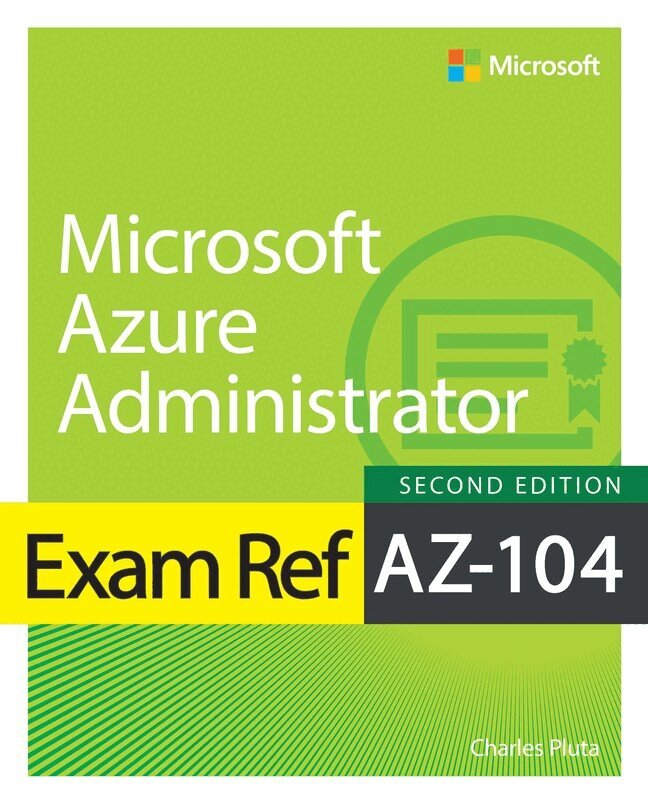
Prepare for Microsoft Exam AZ-104 and demonstrate your real-world mastery and knowledge of Microsoft Azure administration. Designed for working Azure administrators, this Exam Ref focuses on the critical thinking and decision-making acumen needed for success at the Microsoft Certified Solutions Associate level.
Focus on the expertise measured by these objectives:
Manage Azure identities and governance Implement and manage storage Deploy and manage Azure compute resources Implement and manage virtual networking Monitor and maintain Azure resourcesThis Microsoft Exam Ref:
Organizes its coverage by the Skills Measured list published for the exam Features strategic, what-if scenarios to challenge you Assumes you want to validate and demonstrate your command of managing Microsoft Azure cloud environmentsAbout the Exam
Exam AZ-104 focuses on knowledge needed to manage Microsoft Entra ID, RBAC, subscriptions, and governance; manage storage accounts and Azure Storage data; configure Azure files and blob storage; configure VMs for high availability and scalability; automate VM deployment and configuration; create and configure VMs, containers, and Web Apps; implement, manage, secure, monitor, and troubleshoot virtual networking; configure name resolution and load balancing; integrate on-premises networks; monitor resources with Azure Monitor; implement backup and recovery.
About Microsoft Certification
Passing this exam fulfills your requirements for the Microsoft Certified: Azure Administrator Associate credential, demonstrating your readiness to implement, manage, and monitor identity, governance, storage, compute, and virtual networks in a cloud environment, and to provision, size, monitor, and adjust resources as appropriate.
See full details at: microsoft.com/learn
1 239 kr
Skickas inom 7-10 vardagar
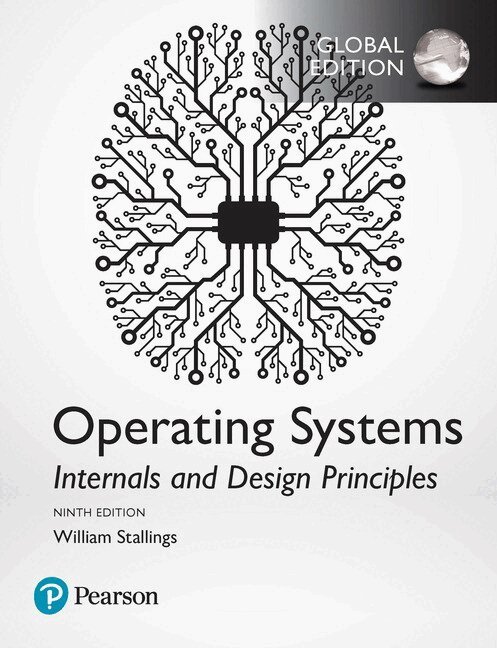
For one- or two-semester undergraduate courses in operating systems for computer science, computer engineering, and electrical engineering majors
An introduction to operating systems with up-to-date and comprehensive coverage
Now in its 9th Edition, Operating Systems: Internals and Design Principles provides a comprehensive, unified introduction to operating systems topics aimed at computer science, computer engineering, and electrical engineering majors. Author William Stallings emphasises both design issues and fundamental principles in contemporary systems, while providing readers with a solid understanding of the key structures and mechanisms of operating systems. He discusses design trade-offs and the practical decisions affecting design, performance and security. The text illustrates and reinforces design concepts, tying them to real-world design choices with case studies in Linux, UNIX, Android, and Windows 10.
With an unparalleled degree of support for integrating projects into the course, plus comprehensive coverage of the latest trends and developments in operating systems, including cloud computing and the Internet of Things (IoT), the text provides everything students and instructors need to keep pace with a complex and rapidly changing field. The 9th Edition has been extensively revised and contains new material, new projects, and updated chapters.
234 kr
Skickas inom 7-10 vardagar
568 kr
Skickas inom 7-10 vardagar
628 kr
Skickas inom 7-10 vardagar
272 kr
Skickas inom 3-6 vardagar
586 kr
Skickas inom 3-6 vardagar
560 kr
Skickas inom 7-10 vardagar
The most complete, authoritative technical guide to the FreeBSD kernel’s internal structure has now been extensively updated to cover all major improvements between Versions 5 and 11. Approximately one-third of this edition’s content is completely new, and another one-third has been extensively rewritten.
Three long-time FreeBSD project leaders begin with a concise overview of the FreeBSD kernel’s current design and implementation. Next, they cover the FreeBSD kernel from the system-call level down–from the interface to the kernel to the hardware. Explaining key design decisions, they detail the concepts, data structures, and algorithms used in implementing each significant system facility, including process management, security, virtual memory, the I/O system, filesystems, socket IPC, and networking.
This Second Edition
• Explains highly scalable and lightweight virtualization using FreeBSD jails, and virtual-machine acceleration with Xen and Virtio device paravirtualization
• Describes new security features such as Capsicum sandboxing and GELI cryptographic disk protection
• Fully covers NFSv4 and Open Solaris ZFS support
• Introduces FreeBSD’s enhanced volume management and new journaled soft updates
• Explains DTrace’s fine-grained process debugging/profiling
• Reflects major improvements to networking, wireless, and USB support
Readers can use this guide as both a working reference and an in-depth study of a leading contemporary, portable, open source operating system. Technical and sales support professionals will discover both FreeBSD’s capabilities and its limitations. Applications developers will learn how to effectively and efficiently interface with it; system administrators will learn how to maintain, tune, and configure it; and systems programmers will learn how to extend, enhance, and interface with it.
Marshall Kirk McKusick writes, consults, and teaches classes on UNIX- and BSD-related subjects. While at the University of California, Berkeley, he implemented the 4.2BSD fast filesystem. He was research computer scientist at the Berkeley Computer Systems Research Group (CSRG), overseeing development and release of 4.3BSD and 4.4BSD. He is a FreeBSD Foundation board member and a long-time FreeBSD committer. Twice president of the Usenix Association, he is also a member of ACM, IEEE, and AAAS.
George V. Neville-Neil hacks, writes, teaches, and consults on security, networking, and operating systems. A FreeBSD Foundation board member, he served on the FreeBSD Core Team for four years. Since 2004, he has written the “Kode Vicious” column for Queue and Communications of the ACM. He is vice chair of ACM’s Practitioner Board and a member of Usenix Association, ACM, IEEE, and AAAS.
Robert N.M. Watson is a University Lecturer in systems, security, and architecture in the Security Research Group at the University of Cambridge Computer Laboratory. He supervises advanced research in computer architecture, compilers, program analysis, operating systems, networking, and security. A FreeBSD Foundation board member, he served on the Core Team for ten years and has been a committer for fifteen years. He is a member of Usenix Association and ACM.
462 kr
Skickas inom 7-10 vardagar
421 kr
Skickas inom 7-10 vardagar