A. Grüntzig – författare
Visar alla böcker från författaren A. Grüntzig. Handla med fri frakt och snabb leverans.
4 produkter
4 produkter
Häftad, Engelska, 1978
1 115 kr
Skickas inom 10-15 vardagar
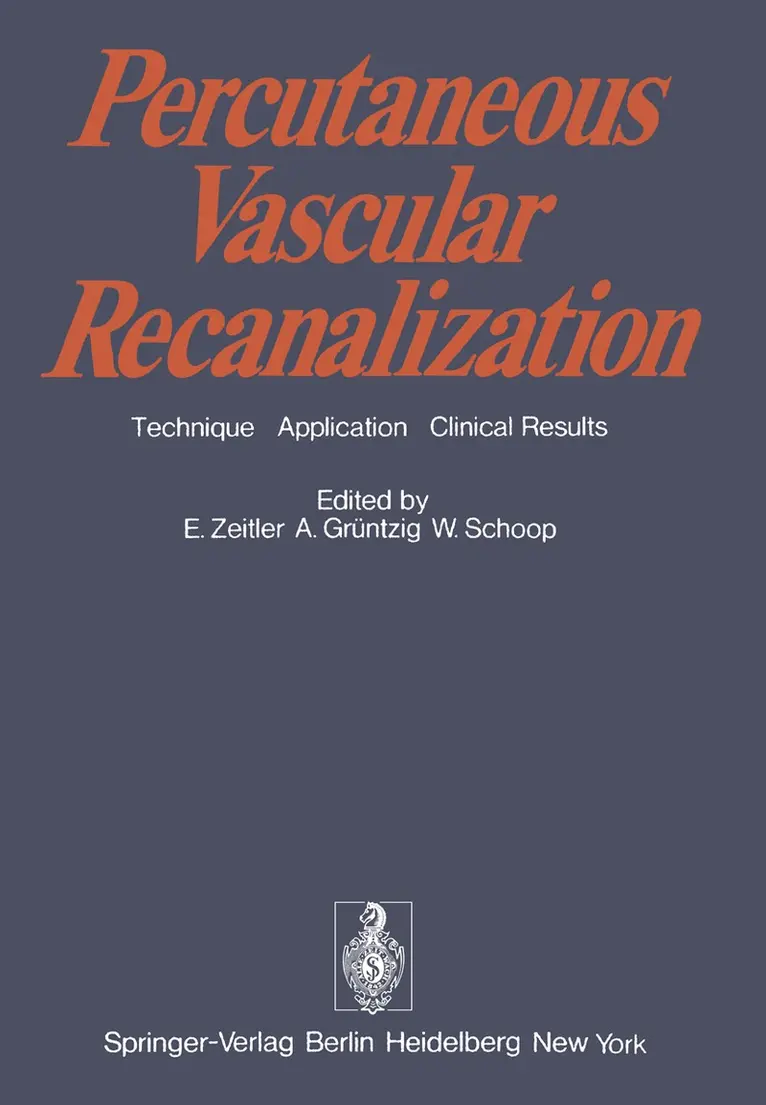
The number of patients with occlusive peripheral vascular disease of the lower ex- tremities is still growing as rapidly as the number of patients with coronary heart disease and cerebrovascular disease. Due to the increase in average life expectancy during the last few decades, more patients now need surgical vascular reconstruc- tion. This actually means a demand for more centers specializing in vascular surgery and equipped with intensive care facilities, since the number of patients with cardio- vascular and bronchopulmonary complications is increasing as well. In addition, the number of patients needing repeated vascular surgery has been growing. Therefore, the search for simple procedures to recanalize the arterial lumen which could be performed under local anesthesia is no surprise. Unfortunately peripheral vascular disease is still frequently treated by amputations. In 1967, the fIrst report in German on percutaneous recanalization of arteries with thrombotic occlusions and stenoses appeared in Rontgenfortschritte. The meth- od described in this report had been published by Dotter and Judkins in 1964.Today, 10 years after their report, more data have been systematically collected on this method in Europe than in the United States, where it was developed. Possibly an explanation of this state of affairs is that nonsurgical treatment is favored more in Europe than in the United States. The scientifIcally based angiology established by Ratschow served as the foun- dation for the development of diagnostic work-up and therapy in other directions beyond the questions of operability and surgical results.
E-bok
PDF, Engelska, 20121 459 kr
Läs direkt efter köp
With contributions by numerous experts
E-bok
PDF, Engelska, 20121 459 kr
Läs direkt efter köp
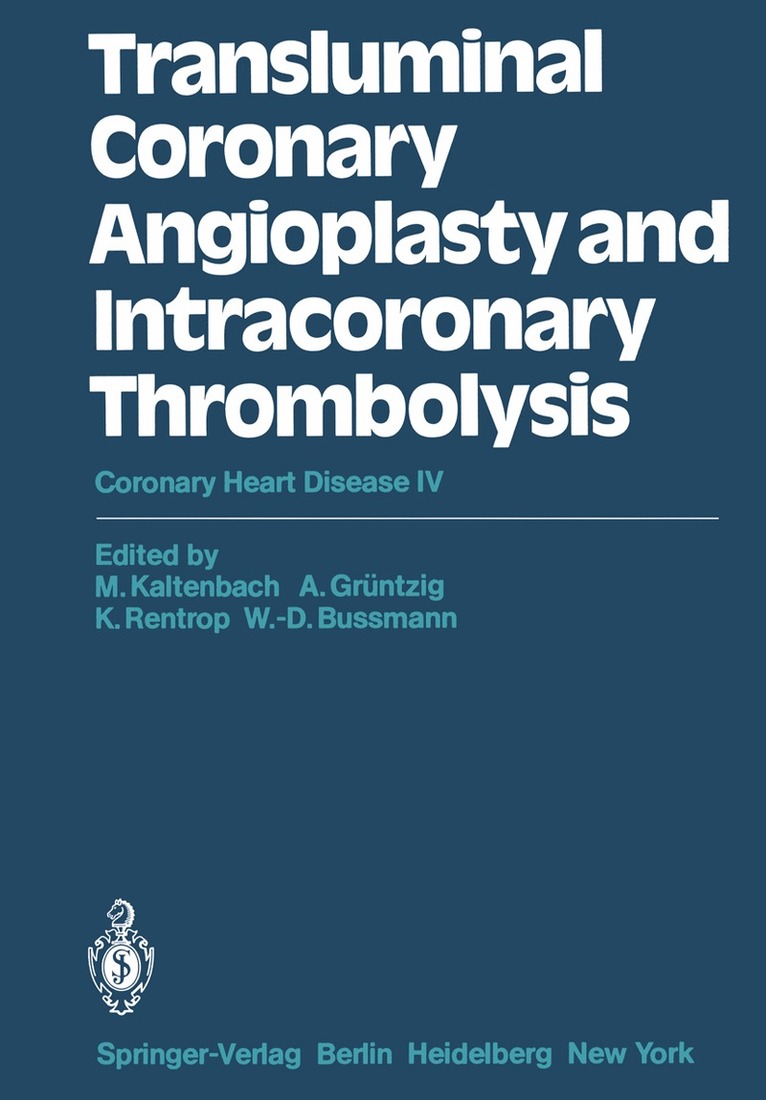
This volume contains the proceedings of the Fourth International Symposium on Coronary Heart Disease, held in Frankfurt/Federal Republic of Germany. In 1970, when the fIrst symposium was held, the whole range of diagnostic and therapeutic measures was covered, but since then interest in coronary heart disease has increased so considerably that the fourth symposium was restricted to only two therapeutic aspects, angioplasty and intracoronary thrombolysis. It can be noted with pleasure that European cardiologists, namely Andreas Griintzig and Peter Rentrop, have made essential contributions to the applicability of these modes of treatment. When angioplasty was fIrst discussed at the Third International Symposium (Coronary Heart Disease, Stuttgart, 1978) a great deal of astonishment was expressed. Today the procedure has gained an important place in the treatment of angina pecto ris. The proportion of candidates for coronary surgery in whom angioplasty can be attempted instead of operation is around 10%, in certain subgroups even higher. The most remarkable fmding of our 5-year experience with angioplasty are the extre mely good long-term results. Recurrences happen in about 15%-20% of cases within the fIrst 3 months; after this period of time, recurrences are very unusual and mostly due to progression of the disease at other sites. Angioplasty has thus also contributed to our understanding of the dynamics of the atherosclerotic process.
Häftad, Engelska, 2011
1 115 kr
Skickas inom 10-15 vardagar
This volume contains the proceedings of the Fourth International Symposium on Coronary Heart Disease, held in Frankfurt/Federal Republic of Germany. In 1970, when the fIrst symposium was held, the whole range of diagnostic and therapeutic measures was covered, but since then interest in coronary heart disease has increased so considerably that the fourth symposium was restricted to only two therapeutic aspects, angioplasty and intracoronary thrombolysis. It can be noted with pleasure that European cardiologists, namely Andreas Griintzig and Peter Rentrop, have made essential contributions to the applicability of these modes of treatment. When angioplasty was fIrst discussed at the Third International Symposium (Coronary Heart Disease, Stuttgart, 1978) a great deal of astonishment was expressed. Today the procedure has gained an important place in the treatment of angina pecto ris. The proportion of candidates for coronary surgery in whom angioplasty can be attempted instead of operation is around 10%, in certain subgroups even higher. The most remarkable fmding of our 5-year experience with angioplasty are the extre mely good long-term results. Recurrences happen in about 15%-20% of cases within the fIrst 3 months; after this period of time, recurrences are very unusual and mostly due to progression of the disease at other sites. Angioplasty has thus also contributed to our understanding of the dynamics of the atherosclerotic process.