A.A. Chernov - Böcker
Visar alla böcker från författaren A.A. Chernov. Handla med fri frakt och snabb leverans.
2 produkter
2 produkter
1 059 kr
Skickas inom 10-15 vardagar
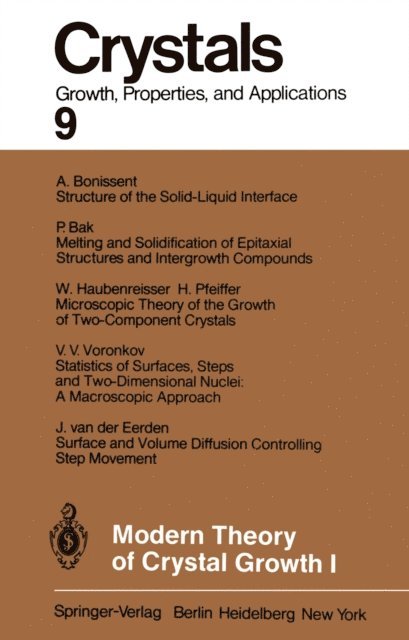
Our understanding of the basic processes of crystal growth has meanwhile reached the level of maturity at least in the phenomenological concepts. This concerns for example the growth of pure crystals from a low-density nutrient phase like vapor or dilute solution with various aspects of pattern formation like spiral and layer growth, facetting and roughening, and the stability of smooth macroscopic shapes, as well as basic mechanisms of impurity incorporation in melt growth of (in this sense) simple materials like silicon or organic model substances. In parallel the experimental techniques to quantitatively ana lyze the various growth mechanisms have also reached a high level of reproducibility and precision, giving reliable tests on theoretical predictions. These basic concepts and appli cations to experiments have been recently reviewed by one of us (A. A. C. ) in "Modern Crystallography III. Crystal Growth" (Springer Series on Solid State Sciences, 1983). It has to be emphasized, however, that for practical applications we are still unable to quantitatively calculate many important parameters like kinetic coefficients from first principles. For mixed systems such as complex oxides, solutions and systems with chemi cal reactions, our degree of understanding is even lower. As a few examples for present achievements we note that experiments with vapour and molecular beam condensation of alkali halides confirmed the qualitatively predicted mechanisms of screw dislocations and two-dimensional nucleation for layer-growth.
Del 36 - Springer Series in Solid-State Sciences
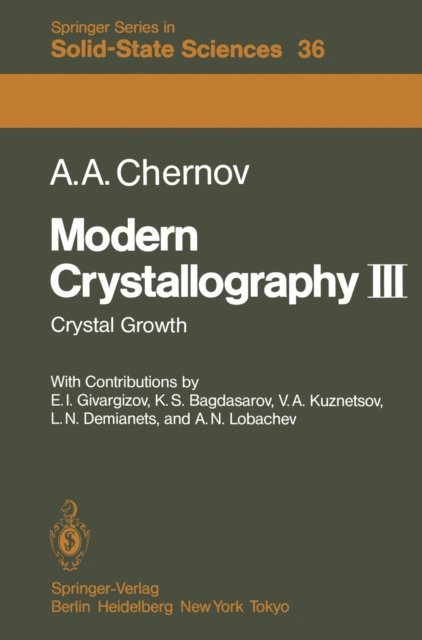
Modern Crystallography III
Crystal Growth
Häftad, Engelska, 2011
1 795 kr
Skickas inom 10-15 vardagar
Early in this century, the newly discovered x-ray diffraction by crystals made a complete change in crystallography and in the whole science of the atomic structure of matter, thus giving a new impetus to the development of solid-state physics. Crystallographic methods, pri marily x-ray diffraction analysis, penetrated into materials sciences, mol ecular physics, and chemistry, and also into many other branches of science. Later, electron and neutron diffraction structure analyses be came important since they not only complement x-ray data, but also supply new information on the atomic and the real structure of crystals. Electron microscopy and other modern methods of investigating mat ter-optical, electronic paramagnetic, nuclear magnetic, and other res onance techniques-yield a large amount of information on the atomic, electronic, and real crystal structures. Crystal physics has also undergone vigorous development. Many re markable phenomena have been discovered in crystals and then found various practical applications. Other important factors promoting the development of crystallog raphy were the elaboration of the theory of crystal growth (which brought crystallography closer to thermodynamics and physical chem istry) and the development of the various methods of growing synthetic crystals dictated by practical needs. Man-made crystals became increas ingly important for physical investigations, and they rapidly invaded technology. The production . of synthetic crystals made a tremendous impact on the traditional branches: the mechanical treatment of mate rials, precision instrument making, and the jewelry industry.