A.A. Zinov'ev – författare
Visar alla böcker från författaren A.A. Zinov'ev. Handla med fri frakt och snabb leverans.
5 produkter
5 produkter
1 062 kr
Skickas inom 10-15 vardagar
Del 9 - Boston Studies in the Philosophy and History of Science
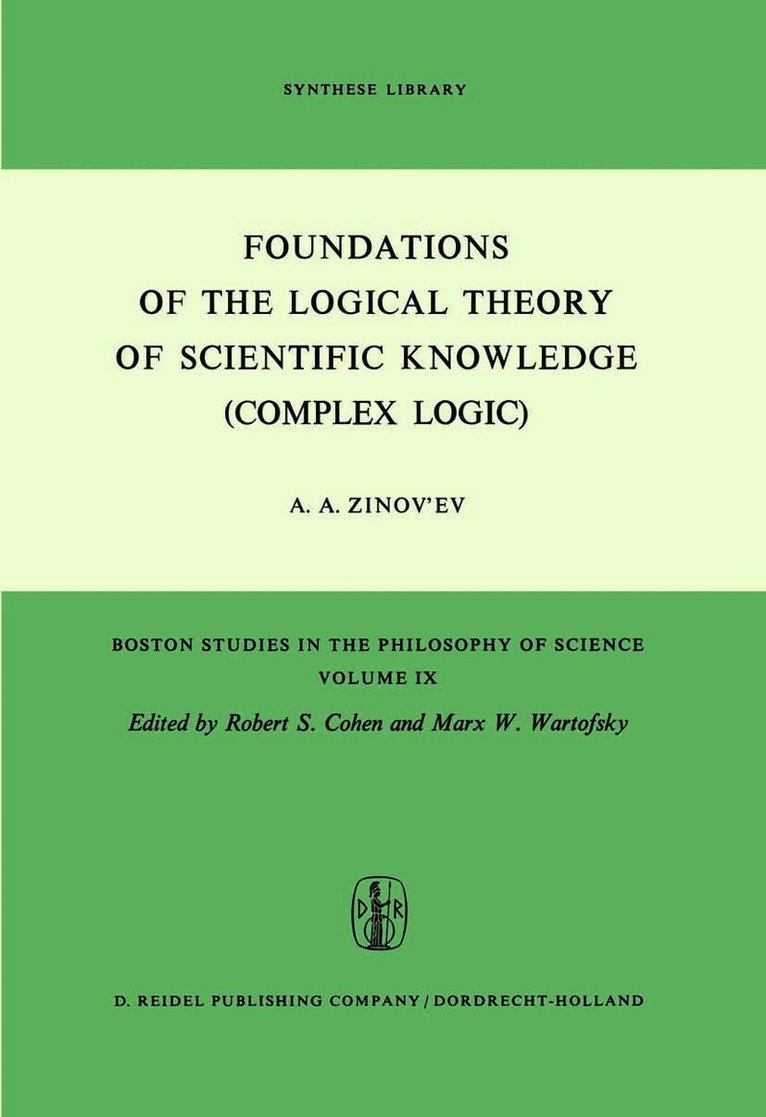
Foundations of the Logical Theory of Scientific Knowledge (Complex Logic)
Inbunden, Engelska, 1973
1 062 kr
Skickas inom 10-15 vardagar
Boston Studies in the Philosophy of Science are devoted to symposia, con gresses, colloquia, monographs and collected papers on the philosophical foundations of the sciences. It is now our pleasure to include A. A. Zi nov'ev's treatise on complex logic among these volumes. Zinov'ev is one of the most creative of modern Soviet logicians, and at the same time an innovative worker on the methodological foundations of science. More over, Zinov'ev, although still a developing scholar, has exerted a sub stantial and stimulating influence upon his colleagues and students in Moscow and within other philosophical and logical circles of the Soviet Union. Hence it may be helpful, in bringing this present work to an English-reading audience, to review briefly some contemporary Soviet investigations into scientific methodology. During the 1950's, a vigorous new research program in logic was under taken, and the initial published work -characteristic of most Soviet pub lications in the logic and methodology of the sciences - was a collection of essays, Logical Investigations (Moscow, 1959). Among the authors, in addition to Zinov'ev himself, were the philosophers A. Kol'man and P. V. Tavanec, and the mathematicians and linguists, S. A. Janovskaja, A. S. Esenin-Vol'pin, S. K. Saumjan, G. N. Povarov.
Del 9 - Boston Studies in the Philosophy and History of Science
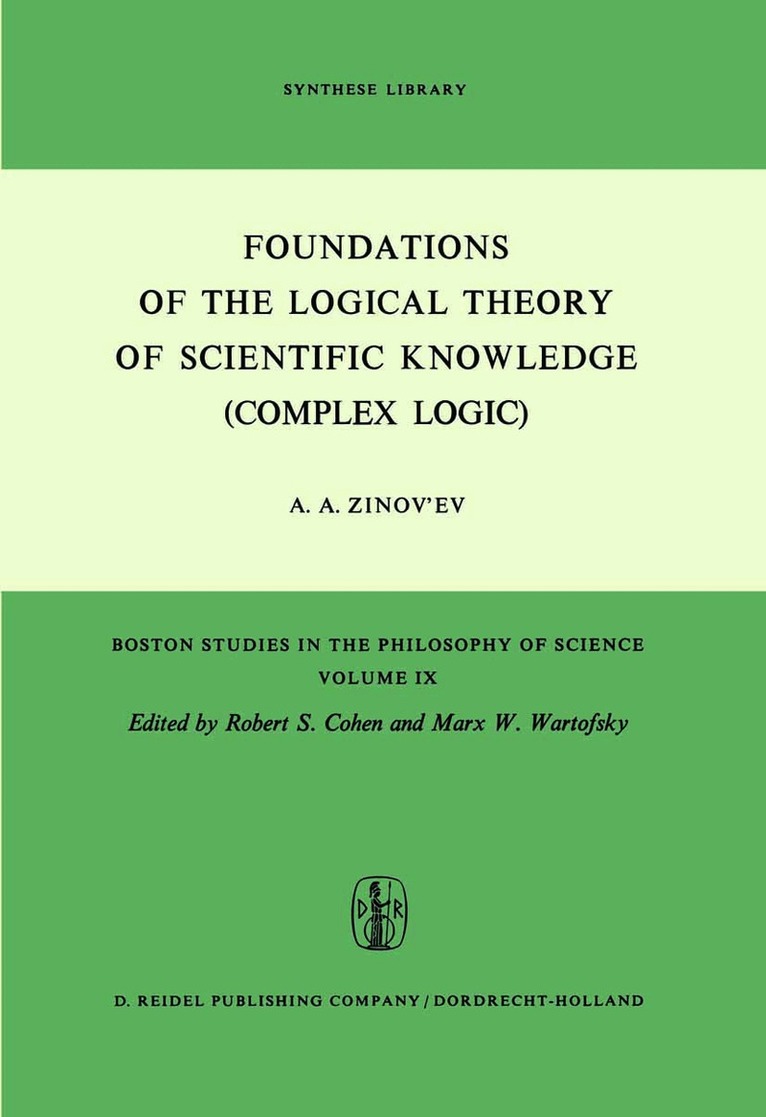
Foundations of the Logical Theory of Scientific Knowledge (Complex Logic)
Häftad, Engelska, 1973
1 062 kr
Skickas inom 10-15 vardagar
Boston Studies in the Philosophy of Science are devoted to symposia, con gresses, colloquia, monographs and collected papers on the philosophical foundations of the sciences. It is now our pleasure to include A. A. Zi nov'ev's treatise on complex logic among these volumes. Zinov'ev is one of the most creative of modern Soviet logicians, and at the same time an innovative worker on the methodological foundations of science. More over, Zinov'ev, although still a developing scholar, has exerted a sub stantial and stimulating influence upon his colleagues and students in Moscow and within other philosophical and logical circles of the Soviet Union. Hence it may be helpful, in bringing this present work to an English-reading audience, to review briefly some contemporary Soviet investigations into scientific methodology. During the 1950's, a vigorous new research program in logic was under taken, and the initial published work -characteristic of most Soviet pub lications in the logic and methodology of the sciences - was a collection of essays, Logical Investigations (Moscow, 1959). Among the authors, in addition to Zinov'ev himself, were the philosophers A. Kol'man and P. V. Tavanec, and the mathematicians and linguists, S. A. Janovskaja, A. S. Esenin-Vol'pin, S. K. Saumjan, G. N. Povarov.
Del 74 - Boston Studies in the Philosophy and History of Science
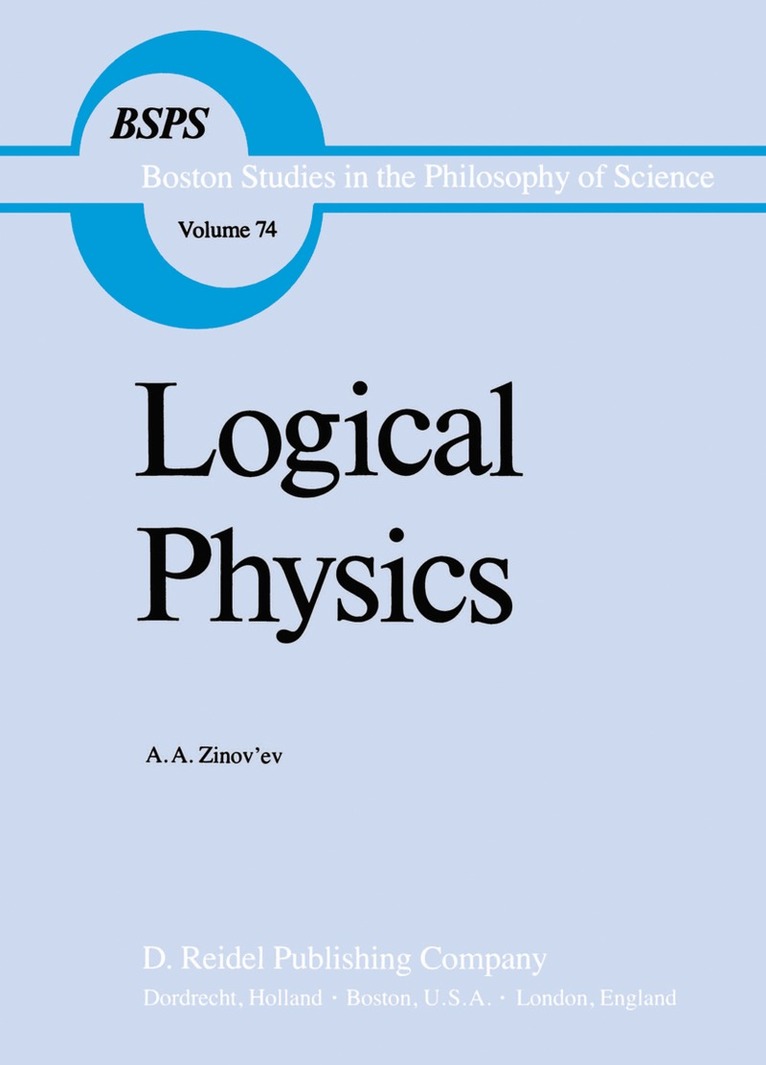
Logical Physics
Inbunden, Engelska, 1983
1 695 kr
Skickas inom 10-15 vardagar
In this stimulating study of the logical character of selected fundamental topics of physics, Zinov'ev has written the first, and major, stage of a general semantics of science. In that sense he has shown, by rigorous examples, that in certain basic and surprising respects we may envision a reducibility of science to logic; and further that we may detect and eliminate frequent confusion of abstract and empirical objects. In place of a near chaos of unplanned theoretical languages, we may look toward a unified and epistemologically clarified general scientific language. In the course of this work, Zinov'ev treats issues of continuing urgency: the non-trivial import of Zeno's paradoxes; the residually significant meaning of 'cause' in scientific explanation; the need for lucidity in the conceptions of 'wave' and 'particle', and his own account of these; the logic of fields and of field propagation; Kant's antimonies today; and, in a startling aper~u, an insightful note on 'measuring' consciousness. Logical physics, an odd-appearing field of investigation, is a part of logic; and as logic, logical physics deals with the linguistic expressions of time, space, particle, wave, field, causality, etc. How far this may be taken without explicit use of, or reference to, empirical statements is still to be clarified, but Zinov'ev takes a sympathetic reader well beyond a realist's expectation, beyond the classical conventionalist. Zinov'ev presents his investigations in four chapters and an appendix of technical elucidation.

Del 74 - Boston Studies in the Philosophy and History of Science
Logical Physics
Häftad, Engelska, 2011
1 695 kr
Skickas inom 10-15 vardagar
In this stimulating study of the logical character of selected fundamental topics of physics, Zinov'ev has written the first, and major, stage of a general semantics of science. In that sense he has shown, by rigorous examples, that in certain basic and surprising respects we may envision a reducibility of science to logic; and further that we may detect and eliminate frequent confusion of abstract and empirical objects. In place of a near chaos of unplanned theoretical languages, we may look toward a unified and epistemologically clarified general scientific language. In the course of this work, Zinov'ev treats issues of continuing urgency: the non-trivial import of Zeno's paradoxes; the residually significant meaning of 'cause' in scientific explanation; the need for lucidity in the conceptions of 'wave' and 'particle', and his own account of these; the logic of fields and of field propagation; Kant's antimonies today; and, in a startling aper~u, an insightful note on 'measuring' consciousness. Logical physics, an odd-appearing field of investigation, is a part of logic; and as logic, logical physics deals with the linguistic expressions of time, space, particle, wave, field, causality, etc. How far this may be taken without explicit use of, or reference to, empirical statements is still to be clarified, but Zinov'ev takes a sympathetic reader well beyond a realist's expectation, beyond the classical conventionalist. Zinov'ev presents his investigations in four chapters and an appendix of technical elucidation.