Aastha Gandhi – författare
Visar alla böcker från författaren Aastha Gandhi. Handla med fri frakt och snabb leverans.
5 produkter
5 produkter
10 286 kr
Skickas inom 10-15 vardagar
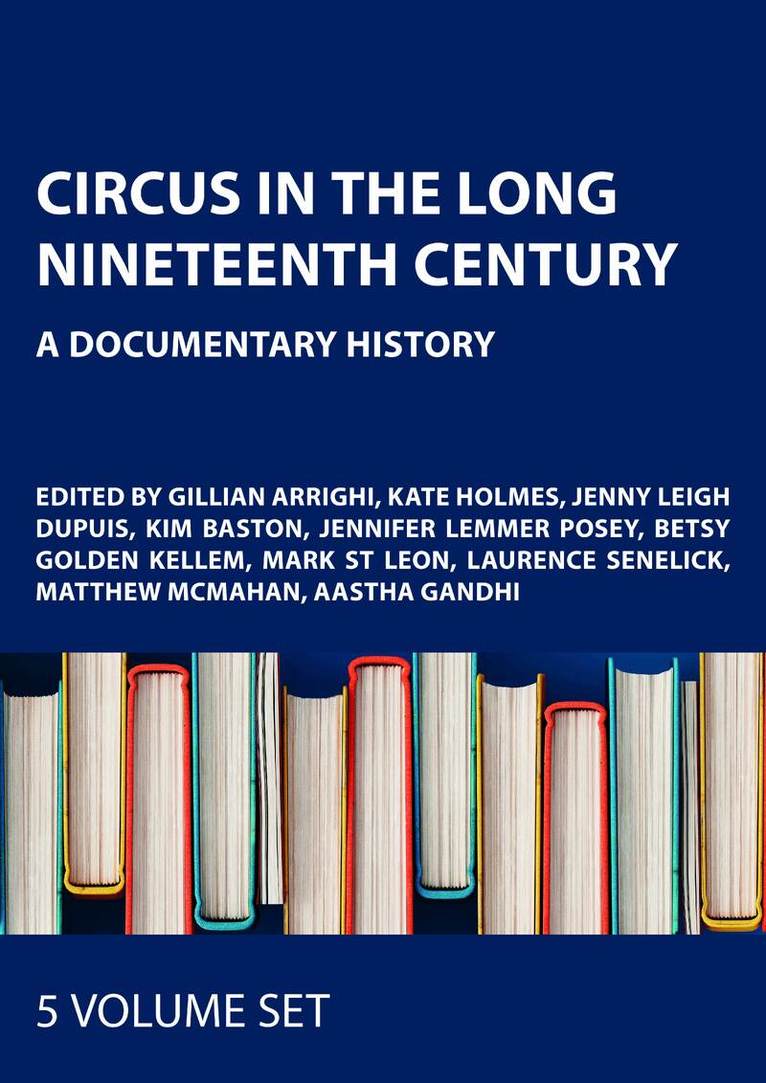
This collection of primary sources brings together a series of documents derived from archives, journals, newspapers, out-of-print books, memoirs, letters, and other written materials pertaining to the circus during the long nineteenth century (1789-1919). Historians concur that the ‘modern’ circus emerged in London in the late-eighteenth century, following the entrepreneurial initiatives of Philip Astley (1742-1814). It soon spread to Scotland, Ireland, France, Russia, Scandinavia, and other regions of Europe. Introduced to the United States by and English equestrian, John Bill Ricketts, in 1793, the modern circus transformed into a movable tent show by 1825. Following the Civil War and the development of railroad transport, the uniquely American circus transformed again into an ‘industrialized juggernaut’ capable of entertaining a large and diverse population from coast to coast. Transmitted across the globe through the British colonial project, the circus flourished in the colonies of Australasia, South Africa, South- and Southeast Asia, and was nourished by traditional performance forms of China, Japan, India, and Southeast Asia. The modern circus evolved through interaction with different geographies, socio-political contexts, new technologies, cultural heritage, and absorption of vernacular performance forms. Accompanied by extensive editorial commentary, and edited by an international team of scholars, this collection will be of great interest to students and researchers of circus studies, theatre and performance studies and cultural history.
Inbunden, Engelska, 2026
1 750 kr
Skickas inom 10-15 vardagar
From the early nineteenth century, Indian itinerant artists have been journeying to the imperial centers. The emerging Indian circus enabled a multitude of surplus labour and migrant artists to find their place within its rubric, subsequent to the encounters with the colonial circuses. The touring Indian circus along with its performers – both human and non-human – played a crucial role in the global circus networks, provoking a range of receptions and discourse. This collection features source materials, including advertisements, biographies, legal documents, news articles, playbills, posters, reviews, thereby filling a critical void in circus histories.
E-bok
PDF, Engelska, 2026970 kr
Läs direkt efter köp
This collection of primary sources brings together a series of documents derived from archives, journals, newspapers, out-of-print books, memoirs, letters, and other written materials pertaining to the circus during the long nineteenth century (1789-1919). Historians concur that the 'modern' circus emerged in London in the late-eighteenth century, following the entrepreneurial initiatives of Philip Astley (1742-1814). It soon spread to Scotland, Ireland, France, Russia, Scandinavia, and other regions of Europe. Introduced to the United States by and English equestrian, John Bill Ricketts, in 1793, the modern circus transformed into a movable tent show by 1825. Following the Civil War and the development of railroad transport, the uniquely American circus transformed again into an 'industrialized juggernaut' capable of entertaining a large and diverse population from coast to coast. Transmitted across the globe through the British colonial project, the circus flourished in the colonies of Australasia, South Africa, South- and Southeast Asia, and was nourished by traditional performance forms of China, Japan, India, and Southeast Asia. The modern circus evolved through interaction with different geographies, socio-political contexts, new technologies, cultural heritage, and absorption of vernacular performance forms. Accompanied by extensive editorial commentary, and edited by an international team of scholars, this collection will be of great interest to students and researchers of circus studies, theatre and performance studies and cultural history.
E-bok
Engelska, 2026970 kr
Läs direkt efter köp
This collection of primary sources brings together a series of documents derived from archives, journals, newspapers, out-of-print books, memoirs, letters, and other written materials pertaining to the circus during the long nineteenth century (1789-1919). Historians concur that the 'modern' circus emerged in London in the late-eighteenth century, following the entrepreneurial initiatives of Philip Astley (1742-1814). It soon spread to Scotland, Ireland, France, Russia, Scandinavia, and other regions of Europe. Introduced to the United States by and English equestrian, John Bill Ricketts, in 1793, the modern circus transformed into a movable tent show by 1825. Following the Civil War and the development of railroad transport, the uniquely American circus transformed again into an 'industrialized juggernaut' capable of entertaining a large and diverse population from coast to coast. Transmitted across the globe through the British colonial project, the circus flourished in the colonies of Australasia, South Africa, South- and Southeast Asia, and was nourished by traditional performance forms of China, Japan, India, and Southeast Asia. The modern circus evolved through interaction with different geographies, socio-political contexts, new technologies, cultural heritage, and absorption of vernacular performance forms. Accompanied by extensive editorial commentary, and edited by an international team of scholars, this collection will be of great interest to students and researchers of circus studies, theatre and performance studies and cultural history.
Inbunden, Engelska, 2026
1 927 kr
Kommande
This book maps the history of circus practice in colonial and post-colonial India, locating it as a unique genre within a larger field of cultural practice. It facilitates a close study of acts, performers, and performances, both historically and in the contemporary repertoire, with changing patterns of migration. At the centre of the research remains the debate which on the one hand labels the circus as ‘The Greatest Show on Earth’ against its contrasting narrative as a marginal form and even an exploitive entity towards animals and child performers. Cosmopolitanism, actor network theories, phenomenology, feminist, gender, and the postcolonial discourse are some of the theoretical frameworks which enable and inform this reading of the distinct circus practice in India.