Abraham J. Malherbe – författare
Visar alla böcker från författaren Abraham J. Malherbe. Handla med fri frakt och snabb leverans.
10 produkter
Letters to the Thessalonians
Häftad, 2004
541 kr
Lägg i varukorg
In A.D. 49, Paul traveled to Thessalonica, a major city in northern Greece, to preach the gospel. A small group of manual laborers responded positively to his message, resulting in the formation of a church. After spending less than three months with his converts, Paul left the city for southern …
Moral Exhortation
A Greco-Roman Sourcebook
Häftad, 1989
374 kr
Lägg i varukorg
This volume in the Library of Early Christianity series presents primary documents that reveal insights about the ethics and morality of Greco-Roman culture. In so doing, this book provides a foundation for understanding the ethical contexts in which the New Testament was crafted.The Library of …
Paul and the Popular Philosophers
Av Abraham J. Malherbe, Abraham J. Malherbe
Häftad, 2006
503 kr
Lägg i varukorg
Social Aspects of Early Christianity, Second Edition
E-bok, 2003
336 kr
Lägg i varukorg
Comments on the First Edition... Those concerned with Christian beginnings will find Malherbe stimulating and incisive on the New Testament. Robert M. Gratn, Journal of ReligionThe author is a scholar of great learning. I found the footnotes to be extremely useful, and the challenge of the book …
Paul and the Thessalonians
The Philosophic Tradition of Pastoral Care
E-bok, 2011
312 kr
Lägg i varukorg
"e;This book deals with Paul's practice rather than his theology. It especially traces the way in which Paul established a church in the important city of Thessalonica, the capital city of the Roman province of Macedonia, maintained contact with it in order to ensure its continuing nurture, and …
Early Church in Its Context
Essays in Honor of Everett Ferguson
Av Abraham J. Malherbe, Frederick W. Norris m. fl.
Inbunden, 1998
4338 kr
Lägg i varukorg
This volume honors Professor Everett Ferguson of Abilene Christian University on the occasion of his sixty-fifth birthday. Reflecting the interests of the honoree, the twenty-one contributions focus on various aspects of the early church and its environment. Together the articles form a broad …
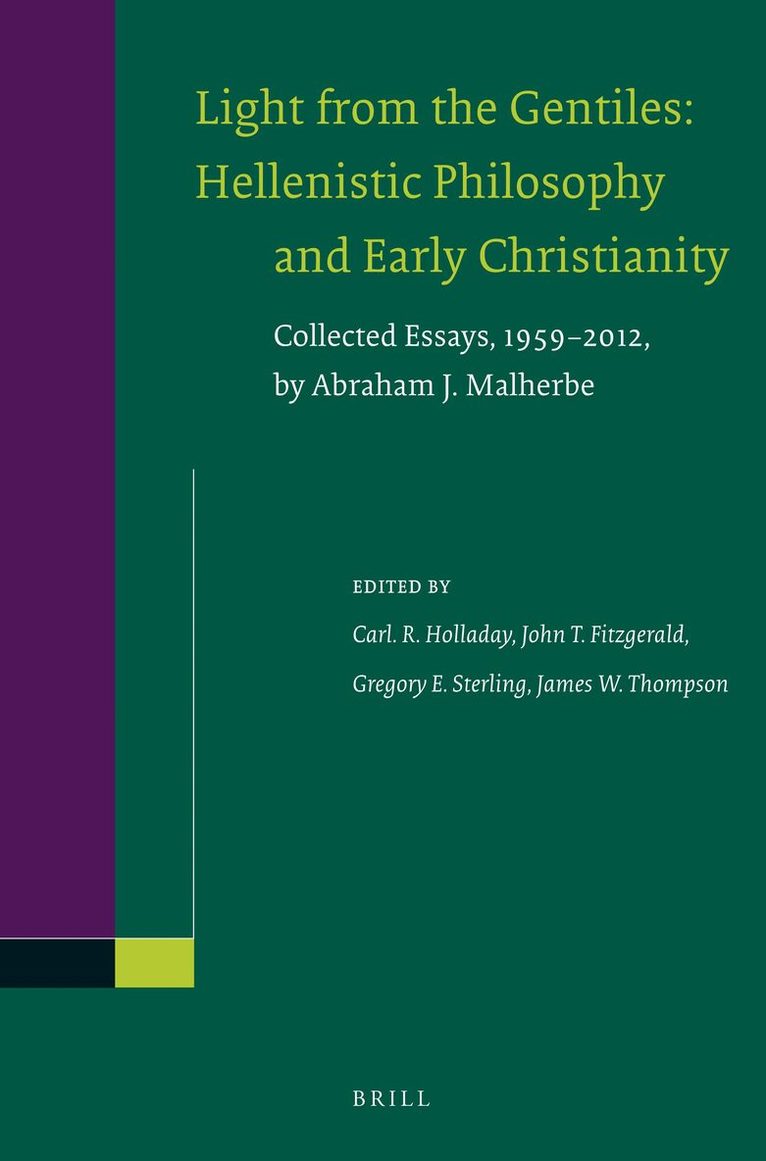
Light from the Gentiles: Hellenistic Philosophy and Early Christianity
Collected Essays, 1959–2012, by Abraham J. Malherbe
Av Abraham J. Malherbe, Carl Holladay m. fl.
Häftad, 2015
1647 kr
Lägg i varukorg
Rather than viewing the Graeco-Roman world as the “background” against which early Christian texts should be read, Abraham J. Malherbe saw the ancient Mediterranean world as a rich ecology of diverse intellectual traditions that interacted within specific social contexts. These essays, spanning …