Adam J. Silverstein - Böcker
Visar alla böcker från författaren Adam J. Silverstein. Handla med fri frakt och snabb leverans.
7 produkter
7 produkter
108 kr
Does history matter? This book argues not that history matters, but that Islamic history does. This Very Short Introduction introduces the story of Islamic history; the controversies surrounding its study; and the significance that it holds - for Muslims and for non-Muslims alike.Opening with a lucid overview of the rise and spread of Islam, from the seventh to twenty first century, the book charts the evolution of what was originally a small, localised community of believers into an international religion with over a billion adherents. Chapters are also dedicated to the peoples - Arabs, Persians, and Turks - who shaped Islamic history, and to three representative institutions - the mosque, jihad, and the caliphate - that highlight Islam's diversity over time.Finally, the roles that Islamic history has played in both religious and political contexts are analysed, while stressing the unique status that history enjoys amongst Muslims, especially compared to its lowly place in Western societies where history is often seen as little more than something that is not to be repeated.Some of the questions that will be answered are:· How did Islam arise from the obscurity of seventh century Arabia to the headlines of twenty first century media?· How do we know what we claim to know about Islam's rise and development?· Why does any of this matter, either to Muslims or to non-Muslims?ABOUT THE SERIES: The Very Short Introductions series from Oxford University Press contains hundreds of titles in almost every subject area. These pocket-sized books are the perfect way to get ahead in a new subject quickly. Our expert authors combine facts, analysis, perspective, new ideas, and enthusiasm to make interesting and challenging topics highly readable.
538 kr
Skickas inom 5-8 vardagar
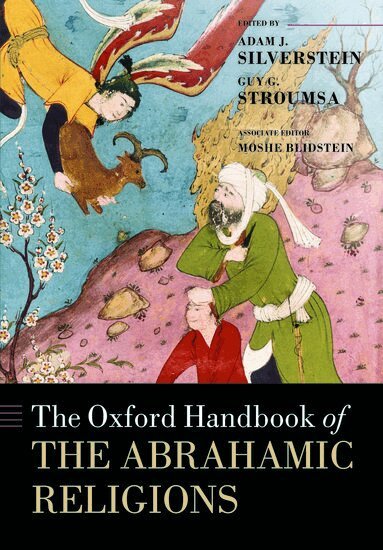
The Oxford Handbook of the Abrahamic Religions includes authoritative yet accessible studies on a wide variety of topics dealing comparatively with Judaism, Christianity, and Islam, as well as with the interactions between the adherents of these religions throughout history. The comparative study of the Abrahamic Religions has been undertaken for many centuries. More often than not, these studies reflected a polemical rather than an ecumenical approach to the topic. Since the nineteenth century, the comparative study of the Abrahamic Religions has not been pursued either intensively or systematically, and it is only recently that the comparative study of Judaism, Christianity, and Islam has received more serious attention. This volume contributes to the emergence and development of the comparative study of the Abrahamic religions, a discipline which is now in its formative stages. This Handbook includes both critical and supportive perspectives on the very concept of the Abrahamic religions and discussions on the role of the figure of Abraham in these religions. It features 32 essays, by the foremost scholars in the field, on the historical interactions between Abrahamic communities; on Holy Scriptures and their interpretation; on conceptions of religious history; on various topics and strands of religious thought, such as monotheism and mysticism; on rituals of prayer, purity, and sainthood, on love in the three religions and on fundamentalism. The volume concludes with three epilogues written by three influential figures in the Christian, Jewish, and Muslim communities, to provide a broader perspective on the comparative study of the Abrahamic religions. This ground-breaking work introduces readers to the challenges and rewards of studying these three religions together.
Veiling Esther, Unveiling Her Story
The Reception of a Biblical Book in Islamic Lands
Inbunden, Engelska, 2018
1 113 kr
Skickas inom 5-8 vardagar
Veiling Esther, Unveiling Her Story: The Reception of a Biblical Book in Islamic Lands examines the ways in which the Biblical Book of Esther was read, understood, and used in Muslim lands, from ancient to modern times. It focuses on case studies covering works from various periods and regions of the Muslim world, including the Qur'an, pre-modern historical chronicles and literary works, the writings of a nineteenth-century Shia feminist, a twentieth-century Iranian encyclopaedia, and others. These case studies demonstrate that Muslim sources contain valuable materials on Esther, which shed light both on the Esther story itself and on the Muslim peoples and cultures that received it. Adam J. Silverstein argues that Muslim sources preserve important pre-Islamic materials on Esther that have not survived elsewhere, some of which offer answers to ancient questions about Esther, such as the meaning of Haman's epithet in the Greek versions of the story, the reason why Mordecai refused to prostrate before Haman, and the literary context of the 'plot of the eunuchs' to kill the Persian king. Throughout the book, Silverstein shows how each author's cultural and religious background influenced his or her understanding and retelling of the Esther story. In particular, he highlights that Persian Muslims (and Jews) were often forced to reconcile or choose between the conflicting historical narratives provided by their religious and cultural heritages respectively.
441 kr
Skickas inom 7-10 vardagar
Adam Silverstein's book offers a fascinating account of the official methods of communication employed in the Near East from pre-Islamic times through the Mamluk period. Postal systems were set up by rulers in order to maintain control over vast tracts of land. These systems, invented centuries before steam-engines or cars, enabled the swift circulation of different commodities - from letters, people and horses to exotic fruits and ice. As the correspondence transported often included confidential reports from a ruler's provinces, such postal systems doubled as espionage-networks through which news reached the central authorities quickly enough to allow a timely reaction to events. The book sheds light not only on the role of communications technology in Islamic history, but also on how nomadic culture contributed to empire-building in the Near East. This is a long-awaited contribution to the history of pre-modern communications systems in the Near Eastern world.
1 295 kr
Skickas inom 7-10 vardagar
Adam Silverstein's book offers a fascinating account of the official methods of communication employed in the Near East from pre-Islamic times through the Mamluk period. Postal systems were set up by rulers in order to maintain control over vast tracts of land. These systems, invented centuries before steam-engines or cars, enabled the swift circulation of different commodities - from letters, people and horses to exotic fruits and ice. As the correspondence transported often included confidential reports from a ruler's provinces, such postal systems doubled as espionage-networks through which news reached the central authorities quickly enough to allow a timely reaction to events. The book sheds light not only on the role of communications technology in Islamic history, but also on how nomadic culture contributed to empire-building in the Near East. This is a long-awaited contribution to the history of pre-modern communications systems in the Near Eastern world.
341 kr
Skickas inom 7-10 vardagar
The first book-length study of the biblical villain Haman, examining his depiction across Judaism, Christianity, and IslamHaman, infamous as the antagonist in the book of Esther, appears as a villainous figure in virtually all varieties of Judaism, Christianity, and Islam. In this “biography” of Haman, Adam Silverstein traces the evolution of this villainous character from the ancient Near East to modern times, drawing on sources in a variety of languages and from diverse genres. Silverstein considers the evidence for a historical Haman and analyzes the abundance of material that documents what those who read the Bible and the Qur’ān have thought about him over the past two millennia.With this book, Silverstein offers an essential and original account of the rich diversity and openness of Abrahamic civilizations throughout history. Taking Haman as a case study, Silverstein guides the reader through diverse intellectual terrains, covering ancient Near Eastern cultures, pre-Islamic Iranian literature, Abrahamic scriptures and their interpretation, late antiquity, Islamic history, and interfaith relations. He shows how the figure of Haman has both united and divided Jewish, Christian, and Muslim communities, who collaborated fruitfully in their efforts to grasp the meaning and significance of their holy books, but who also deployed the “Haman” label polemically against each other. Silverstein also considers Haman’s prebiblical origins, raising the possibility that the book of Esther was receiving and reconfiguring Haman no less than later works were, with Esther’s villain taking his place in a long line of reimagined Hamans.Haman: A Biography is the first book-length study to contextualize an Abrahamic character not only within Jewish and Christian traditions but also with reference to the character’s prebiblical background and reception in Islamic cultures.
1 513 kr
Skickas inom 3-6 vardagar
In the past four decades, as the field of late antique studies has begun to gather real momentum, scholars have debated the place of early Islam within the late antique world, particularly in relation to the issue of where and when ‘Late Antiquity’ ends. Although the Sasanian empire (in what is now modern Iran) became as powerful as the Byzantine empire, and the two often forged their characters and practices on the basis of their relations with each other, that has rarely translated into equal coverage for the eastern part of the late antique world in studies of the period. Late Antiquity: Eastern Perspectives aims to redress this balance and situate Iran with the broader world of this era. Eight papers serve as case studies for considering narratives and perspectives other than those emanating from Byzantium or, more generally, ‘the West’. They demonstrate the potential of eastern source-material, particularly James Howard-Johnston’s double-length article which produces a detailed reconstruction of the Sasanian army.