Adrienne Héritier – författare
Visar alla böcker från författaren Adrienne Héritier. Handla med fri frakt och snabb leverans.
4 produkter
4 produkter
Inbunden, Engelska, 1999
630 kr
Skickas inom 7-10 vardagar
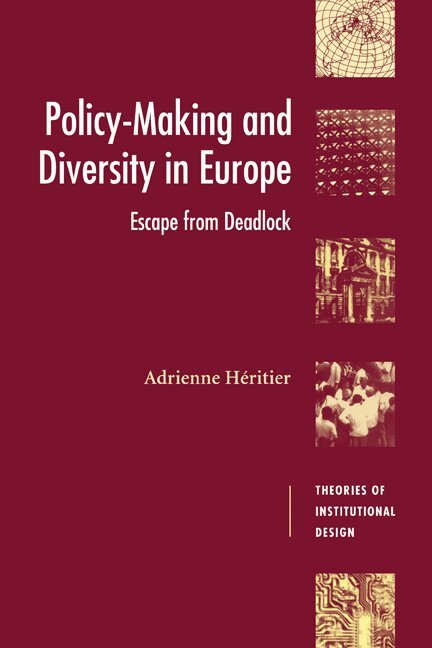
Policy-Making and Diversity in Europe examines the European polity and its policy-making processes. In particular, it asks how an institution which is so riddled with veto points manages to be such an active and aggressive policy maker. Héritier argues that the diversity of actors' interests and the consensus-forcing nature of European institutions would almost inevitably stall the decision-making process, were it not for the existence of creative informal strategies and policy-making patterns. Termed by the author 'subterfuge', these strategies prevent political impasses and 'make Europe work'. The book examines the presence of subterfuge in the policy domains of market-making, the provision of collective goods, redistribution and distribution. Subterfuge is seen to reinforce the primary functions of the European polity: the accommodation of diversity, policy innovation and democratic legitimation. Professor Héritier concludes that the use of subterfuge to reconcile unity with diversity and competition with co-operation is the greatest challenge facing European policy-making.
Häftad, Engelska, 1999
267 kr
Skickas inom 7-10 vardagar
Policy-Making and Diversity in Europe examines the European polity and its policy-making processes. In particular, it asks how an institution which is so riddled with veto points manages to be such an active and aggressive policy maker. Héritier argues that the diversity of actors' interests and the consensus-forcing nature of European institutions would almost inevitably stall the decision-making process, were it not for the existence of creative informal strategies and policy-making patterns. Termed by the author 'subterfuge', these strategies prevent political impasses and 'make Europe work'. The book examines the presence of subterfuge in the policy domains of market-making, the provision of collective goods, redistribution and distribution. Subterfuge is seen to reinforce the primary functions of the European polity: the accommodation of diversity, policy innovation and democratic legitimation. Professor Héritier concludes that the use of subterfuge to reconcile unity with diversity and competition with co-operation is the greatest challenge facing European policy-making.
Inbunden, Engelska, 2027
1 174 kr
Kommande
Since the EU has been confronted with multiple crises, scholars have debated the consequences from the viewpoint of integration, disintegration, or differentiated integration. This book takes a different perspective. Rather than focusing on macro-structures, it highlights the ongoing contestation and balancing of power in everyday policymaking. These processes lead to incremental, often hidden informal institutional change rather than overall Treaty amendments. They unfold in European legislation under the Community Method, in intergovernmental politics, administrative policymaking, and court proceedings and often link all these venues. The book analyses and empirically describes different conflicts, strategies, and processes through which actors respond to power imbalances in policymaking and seek to reshape rules and patterns of interaction. The authors argue that this enduring balancing of power is essential to the EU's resilience, as it compels actors to respond to challenges and find institutional solutions, particularly in a fast-changing international order.
Häftad, Engelska, 2027
424 kr
Kommande
Since the EU has been confronted with multiple crises, scholars have debated the consequences from the viewpoint of integration, disintegration, or differentiated integration. This book takes a different perspective. Rather than focusing on macro-structures, it highlights the ongoing contestation and balancing of power in everyday policymaking. These processes lead to incremental, often hidden informal institutional change rather than overall Treaty amendments. They unfold in European legislation under the Community Method, in intergovernmental politics, administrative policymaking, and court proceedings and often link all these venues. The book analyses and empirically describes different conflicts, strategies, and processes through which actors respond to power imbalances in policymaking and seek to reshape rules and patterns of interaction. The authors argue that this enduring balancing of power is essential to the EU's resilience, as it compels actors to respond to challenges and find institutional solutions, particularly in a fast-changing international order.