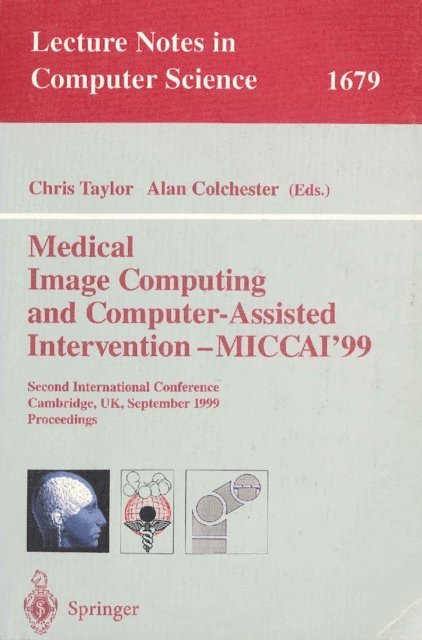
Alan Colchester - Böcker
Visar alla böcker från författaren Alan Colchester. Handla med fri frakt och snabb leverans.
2 produkter
2 produkter
647 kr
Skickas inom 10-15 vardagar
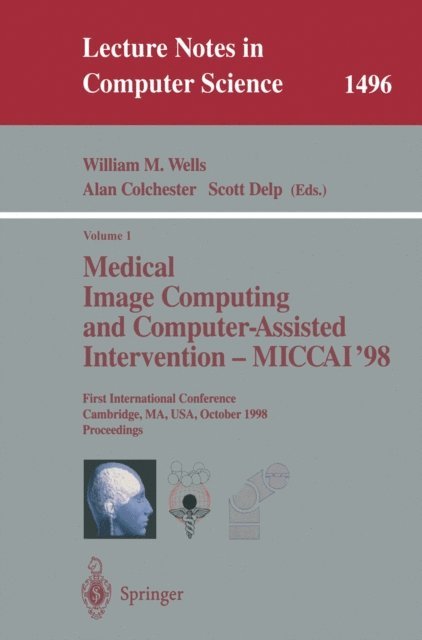
This book constitutes the refereed proceedings of the First International Conference on Medical Image Computing and Computer-Assisted Intervention, MICCAI'98, held in Cambridge, MA, USA, in October 1998.The 134 revised papers presented were carefully selected from a total of 243 submissions. The book is divided into topical sections on surgical planning, surgical navigation and measurements, cardiac image analysis, medical robotic systems, surgical systems and simulators, segmentation, computational neuroanatomy, biomechanics, detection in medical images, data acquisition and processing, neurosurgery and neuroscience, shape analysis, feature extraction, registration, and ultrasound.
647 kr
Skickas inom 10-15 vardagar
Abnormal white matter of the brain is common to patients with one of s- eral di?erent diseases (including multiple sclerosis (MS) and Alzheimer's d- ease (AD)) and also appears in normal (asymptomatic) aging (NA) subjects. Better characterization of the nature of these white matter changes can help to improve our understanding of the biological processes at work. Clinically, it is interesting to be able to di?erentiate between di?erent disease states and to ?nd markerswhich allowearlydiagnosis.Conventionalspin echo magnetic resonance imaging is sensitive to these white matter changes. MRI studies of patients and volunteershaveindicatedthatthepatternsofbrainchangeassociatedwiththese processes are di?erent. An important goal is to be able to quantitatively study these di?erences. Many automated and semi-automated segmentation algorithms for quan- tatively assessing these brain changes have been developed and validated. Most of these algorithms have aimed at determining a binary characterization of each voxelas one of a groupof possible tissue classes.This approachhas been limited bytwofactors.First,abnormalwhitematter isoftenisointensewithnormalgrey matter and previous studies have been limited by the inability to discriminate between some abnormal white matter and normal grey matter [1,2].Secondly, white matter damage appears as an heterogenous region of abnormal signal - tensity but binarization of the segmentation treats all levels of signal intensity abnormality equally.