Alan E. Bayer - Böcker
Visar alla böcker från författaren Alan E. Bayer. Handla med fri frakt och snabb leverans.
2 produkter
2 produkter
406 kr
Skickas inom 5-8 vardagar
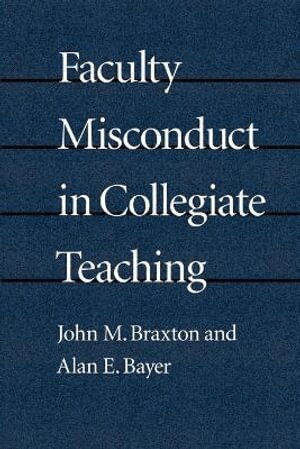
In Faculty Misconduct in Collegiate Teaching, higher education researchers John Braxton and Alan Bayer address issues of impropriety and misconduct in the teaching role at the postsecondary level. Braxton and Bayer define and examine norms of teaching behavior: what they are, how they come to exist, and how transgressions are detected and addressed. Do faculty members across various collegiate settings, for example, share views about appropriate and inappropriate teaching behaviors, as they share expectations regarding actions related to research? And what mechanisms are utilized to correct inappropriate behavior on the part of college and university teachers? The authors' work is based on survey results obtained from faculty members at research universities, liberal arts colleges, and two-year community, junior, and technical colleges. Braxton and Bayer's focus is on undergraduate teaching in four disciplines: biology, history, mathematics, and psychology. In their analyses, the authors examine how individual, disciplinary, and institutional differences influence professorial behavior.In contrast to the more explicitly understood and enforced rules of conduct in research, the authors find that teaching norms are informally defined and observed. They argue that a formal code of ethics for undergraduate teaching would serve the dual purpose of improving undergraduate education and elevating the status of college teaching. A groundbreaking study of contemporary academe, Faculty Misconduct in Collegiate Teaching is required reading for all university and college instructors and administrators
456 kr
Tillfälligt slut
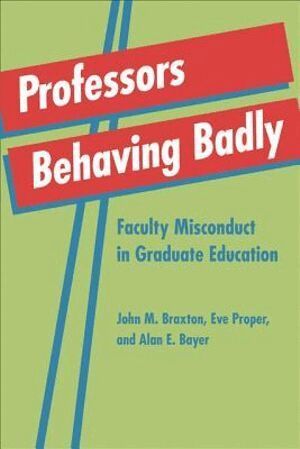
* A faculty member publishes an article without offering coauthorship to a graduate assistant who has made a substantial conceptual or methodological contribution to the article. * A professor does not permit graduate students to express viewpoints different from her own. * A graduate student close to finishing his dissertation cannot reach his traveling advisor, a circumstance that jeopardizes his degree. This book discusses these and other examples of faculty misconduct-and how to avoid them. Using data collected through faculty surveys, the authors describe behaviors associated with graduate teaching which are considered inappropriate and in violation of good teaching practices. They derive a normative structure that consists of five inviolable and eight admonitory proscriptive criteria to help graduate faculty make informed and acceptable professional choices. The authors discuss the various ways in which faculty members acquire the norms of teaching and mentoring, including the graduate school socialization process, role models, disciplinary codes of ethics, and scholarship about the professoriate and professional performance.Analyzing the rich data gleaned from the faculty surveys, they track how these norms are understood and interpreted across academic disciplines and are influenced by such factors as gender, citizenship, age, academic rank, tenure, research activity, and administrative experience.