Alan L. Boegehold - Böcker
Visar alla böcker från författaren Alan L. Boegehold. Handla med fri frakt och snabb leverans.
3 produkter
3 produkter
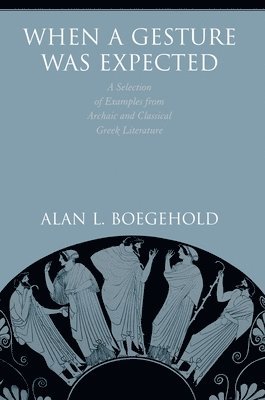
When a Gesture Was Expected
A Selection of Examples from Archaic and Classical Greek Literature
Inbunden, Engelska, 1999
1 003 kr
Skickas inom 7-10 vardagar
When a Gesture Was Expected encourages a deeper appreciation of ancient Greek poetry and prose by showing where a nod of the head or a wave of the hand can complete meaning in epic poetry and in tragedy, comedy, oratory, and in works of history and philosophy. All these works anticipated performing readers, and, as a result, they included prompts, places where a gesture could complete a sentence or amplify or comment on the written words. In this radical and highly accessible book, Alan Boegehold urges all readers to supplement the traditional avenues of classical philology with an awareness of the uses of nonverbal communication in Hellenic antiquity. This additional resource helps to explain some persistently confusing syntaxes and to make translations more accurate. It also imparts a living breath to these immortal texts. Where part of a work appears to be missing, or the syntax is irregular, or the words seem contradictory or perverse--without evidence of copyists' errors or physical damage--an ancient author may have been assuming that a performing reader would make the necessary clarifying gesture.Boegehold offers analyses of many such instances in selected passages ranging from Homer to Aeschylus to Plato. He also presents a review of sources of information about such gestures in antiquity as well as thirty illustrations, some documenting millennia-long continuities in nonverbal communication.
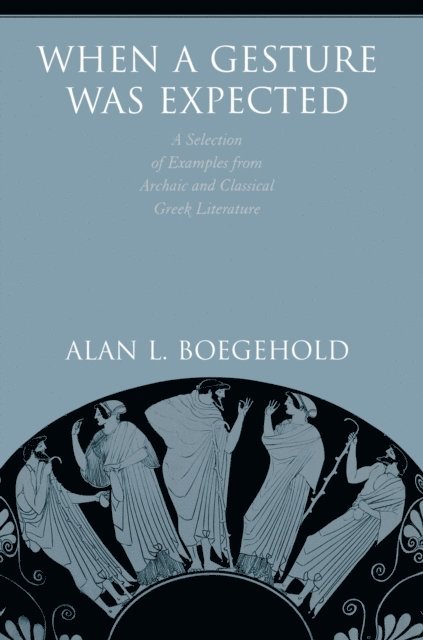
When a Gesture Was Expected
A Selection of Examples from Archaic and Classical Greek Literature
Häftad, Engelska, 2022
442 kr
Skickas inom 7-10 vardagar
A boldly innovative study of nonverbal communication in the poetry and prose of Hellenic antiquityWhen a Gesture Was Expected encourages a deeper appreciation of ancient Greek poetry and prose by showing where a nod of the head or a wave of the hand can complete meaning in epic poetry and in tragedy, comedy, oratory, and in works of history and philosophy. All these works anticipated performing readers, and, as a result, they included prompts, places where a gesture could complete a sentence or amplify or comment on the written words. In this radical and highly accessible book, Alan Boegehold urges all readers to supplement the traditional avenues of classical philology with an awareness of the uses of nonverbal communication in Hellenic antiquity. This additional resource helps to explain some persistently confusing syntaxes and to make translations more accurate. It also imparts a living breath to these immortal texts.Where part of a work appears to be missing, or the syntax is irregular, or the words seem contradictory or perverse—without evidence of copyists' errors or physical damage—an ancient author may have been assuming that a performing reader would make the necessary clarifying gesture. Boegehold offers analyses of many such instances in selected passages ranging from Homer to Aeschylus to Plato. He also presents a review of sources of information about such gestures in antiquity as well as thirty illustrations, some documenting millennia-long continuities in nonverbal communication.
446 kr
Skickas inom 5-8 vardagar
In Athenian Identity and Civic Ideology, Alan Boegehold and Adele Scafuro bring together a distinguished group of scholars who explore the nature and meaning of Athenian citizenship. Departing from the narrow perspective of constitutional historians and also embracing sociological concerns, the editors' range of topics attests to a broad vision of the concepts of citizenship and civic ideology in a society in which the boundary between public and private, sacred and secular, is not always clear. Among the contributors, Philip Brook Manville and W. Robert Connor offer fresh critiques of the study of citizenship, while Frank J. Frost examines pre-Cleisthenic notions of citizenship. Alan Boegehold looks at social and economic motivations for the passage of Perikles's citizenship law of 451/0 B.C. Focusing on the fifth and fourth centuries, Ian Morris discusses changes in the visual manifestation of civic ideology in funeral monuments, while Josiah Ober offers an interpretation of Thucydides's history as a discourse that actively resists hegemonic public discourse. Robert W.Wallace examines what might be perceived as contradictions within civic ideology, namely, alleged infringements of intellectual freedom. In the final essays, with their focus on the fourth and third centuries, Adele Scafuro discusses the process of citizen identification in Athenian society; Cynthia Patterson examines the position of women in the maintenance of civic ideology; and David Konstan considers the relationship between sexual attitudes and civic status.