Albert Berry - Böcker
Visar alla böcker från författaren Albert Berry. Handla med fri frakt och snabb leverans.
5 produkter
5 produkter
1 208 kr
Skickas inom 7-10 vardagar
Land concentration has been a central feature of the history of nearly all empires, regions, and countries, and has underpinned the creation of the state and of inegalitarian and elitist societies. It is the key feature of the "monopolization model", whereby a small group attains access to the great bulk of available land, labor, and capital to achieve a high level of income and wealth. The degree and means of land concentration, as well as the elite control of labor, have varied across cultures and time, but are responsible for an enormous amount of economic and social damage. In The Great Curse, Albert Berry reviews the main episodes of agrarian reform undertaken in the twentieth century to remedy land concentration, including those of major communist and capitalist countries. He provides an understanding of when landholding inequality arises, what implications it has for development in the short and long term, and what potential policies can fix it. Berry makes the case that agrarian reform has resulted in enormous benefits, from the lowering of income inequality and social depravation to a rise in total agricultural output and faster overall growth. Despite the benefits, he finds that most reforms fell far short of their desired outcomes due to conflict and partial or ineffective implementation. In some cases, large communal or state farms were created rather than small private family farms, and in other cases, too little land was redistributed or land was allotted to the wrong groups. Finally, Berry draws on various land reform policies in Sub-Saharan Africa--the only part of the developing world where over half of the labor force is still found in agriculture--with a view to providing useful lessons for its present and future policy in this domain.
1 630 kr
Skickas inom 10-15 vardagar
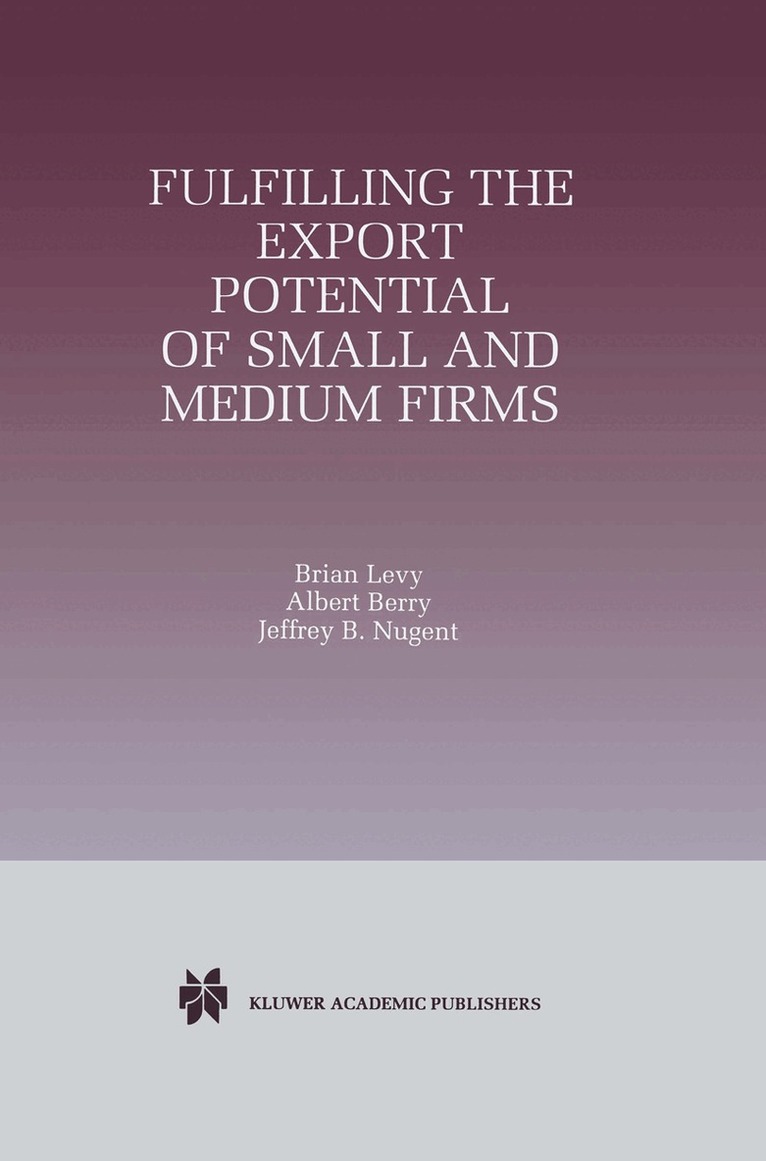
The main purpose of this book is to address the question, "How can economic policy contribute to a strong export performance by small and medium enterprises (SMEs) in developing countries?" In today's increasingly integrated world economy, such a performance can make a significant difference to the growth, employment creation and income distribution of many developing countries. The study uses information from specifically designed surveys of SME exporters in Japan, Indonesia, Korea and Colombia, together with a range of evidence from other sources, to ascertain what types of support within the areas of technology, marketing and finance are most useful to SME exporters and how such support can best be provided to them. The quality of the support systems is found to vary widely among the four countries. Finally, a number of policy conclusions are put forward.
692 kr
Skickas inom 10-15 vardagar
Most developing countries face significant and sometimes dramatic challenges in generating stable jobs that provide reasonable incomes and decent working conditions. For developing countries that have undergone lengthy periods of economic stagnation, these challenges are especially acute, and popular dissatisfaction correspondingly marked.Paraguay is a case in point. It is unlikely that any "employment policy" could lead to a major improvement in the quality of labor market outcomes unless designed and implemented in a sophisticated and coherent way. Such an approach has been infrequent in developing countries in general, and especially so in those that, like Paraguay, also suffer severe institutional weaknesses of governance. Paraguay's past failure in employment creation is mainly the result of a number of structural weaknesses described in this volume. Its current crisis is also the accumulated legacy of over a quarter century of economic stagnation and political failure fl owing from those weaknesses. The new reformist administration of President Fernando Lugo has raised hopes that the future might be better than the past.This study aims to contribute to improved policy making by analyzing the source of the problems and providing policy recommendations. The chapters describe the potential contribution of various policy areas in the face of a dauntingly negative track record and identify a number of steps that have to be taken if success is to be achieved. They put into perspective the reforms that have been undertaken to date by the country's previous administration.Paraguay's experience offers insight into the problems faced by other developing countries in today's global economy. The central message is that policy improvements must be made in a number of areas and implemented in a coordinated fashion for there to be any reasonable hope of success.
2 153 kr
Skickas inom 10-15 vardagar
Most developing countries face significant and sometimes dramatic challenges in generating stable jobs that provide reasonable incomes and decent working conditions. For developing countries that have undergone lengthy periods of economic stagnation, these challenges are especially acute, and popular dissatisfaction correspondingly marked.Paraguay is a case in point. It is unlikely that any "employment policy" could lead to a major improvement in the quality of labor market outcomes unless designed and implemented in a sophisticated and coherent way. Such an approach has been infrequent in developing countries in general, and especially so in those that, like Paraguay, also suffer severe institutional weaknesses of governance. Paraguay's past failure in employment creation is mainly the result of a number of structural weaknesses described in this volume. Its current crisis is also the accumulated legacy of over a quarter century of economic stagnation and political failure fl owing from those weaknesses. The new reformist administration of President Fernando Lugo has raised hopes that the future might be better than the past.This study aims to contribute to improved policy making by analyzing the source of the problems and providing policy recommendations. The chapters describe the potential contribution of various policy areas in the face of a dauntingly negative track record and identify a number of steps that have to be taken if success is to be achieved. They put into perspective the reforms that have been undertaken to date by the country's previous administration.Paraguay's experience offers insight into the problems faced by other developing countries in today's global economy. The central message is that policy improvements must be made in a number of areas and implemented in a coordinated fashion for there to be any reasonable hope of success.
1 630 kr
Skickas inom 10-15 vardagar
Fulfilling the Export Potential of Small and Medium Firms addresses the question, `How can economic policy contribute to a strong export performance by small and medium enterprises (SMEs) in developing countries?' In today's increasingly integrated world economy, such a performance can make a significant difference to the growth, employment creation and income distribution of many developing countries. The study uses information from specifically designed surveys of SME exporters in Japan, Indonesia, Korea and Colombia, together with a range of evidence from other sources, to ascertain what types of support within the areas of technology, marketing and finance are most useful to SME exporters and how such support can best be provided to them. The quality of the support systems is found to vary widely among the four countries. Finally, a number of policy conclusions are put forward.