
Alexander A. Kirillov, Jr. – författare
Visar alla böcker från författaren Alexander A. Kirillov, Jr.. Handla med fri frakt och snabb leverans.
3 produkter
3 produkter
Häftad, Engelska, 2000
799 kr
Skickas inom 5-8 vardagar
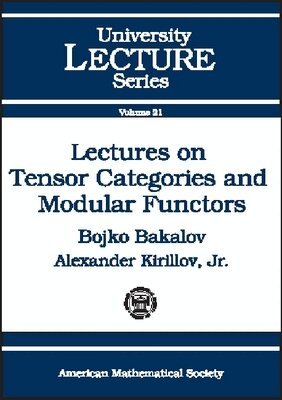
This book gives an exposition of the relations among the following three topics: monoidal tensor categories (such as a category of representations of a quantum group), 3-dimensional topological quantum field theory, and 2-dimensional modular functors (which naturally arise in 2-dimensional conformal field theory). The following examples are discussed in detail the category of representations of a quantum group at a root of unity and the Wess-Zumino-Witten modular functor. The idea that these topics are related first appeared in the physics literature in the study of quantum field theory. Pioneering works of Witten and Moore-Seiberg triggered an avalanche of papers, both physical and mathematical, exploring various aspects of these relations.Upon preparing to lecture on the topic at MIT, however, the authors discovered that the existing literature was difficult and that there were gaps to fill. The text is wholly expository and finely succinct. It gathers results, fills existing gaps, and simplifies some proofs. The book makes an important addition to the existing literature on the topic. It would be suitable as a course text at the advanced-graduate level.
Inbunden, Engelska, 2026
1 667 kr
Kommande
The aim of this book is to give a comprehensive treatment of the majority of important classical field theory from the mathematics perspective. The opening Part 1 gives the exposition of classical mechanics and special relativity that are based on the Hamiltonian approach and emphasizes the Hamiltonian action of the relevant Lie groups. Part 2 bridges classical mechanics and classical field theory. The authors develop all necessary tools: Lagrangian formulation of classical field theory, conservation laws, the Noether theorem, and Hamiltonian formulation. They present all necessary facts about jet bundles, multivariable calculus of variations, etc. Part 3 discusses gauge field theory: Maxwell's theory with the abelian structure group $U(1)$, and Yang-Mills theory with the structure group being semisimple compact Lie groups. For the convenience of the reader, the authors collect all necessary facts about connections and curvature in vector and principal bundles. In Part 4 the authors briefly discuss the theory of gravity, i.e., Einstein's general relativity. The goal here is to give a coherent mathematical exposition of the basic notions. After careful discussion of properties of the spacetime in general relativity and a standard derivation of Einstein's field equations with matter, the authors discuss the so-called Palatini formalism, an approach to Hilbert-Einstein action when 10 matrix elements of the metric tensor and 40 components of the symmetric Christoffel symbols are independent variables. They also briefly discuss Hamiltonian formalism for Einstein equations and their special solutions, with and without the cosmological constant. Each chapter in the book concludes with exercises aimed at developing deeper insights into topics discussed in the chapter. Also, each part concludes with a ""Notes and References"" chapter, which provides references to necessary mathematics background and physics sources.
Häftad, Engelska, 2026
1 095 kr
Kommande
The aim of this book is to give a comprehensive treatment of the majority of important classical field theory from the mathematics perspective. The opening Part 1 gives the exposition of classical mechanics and special relativity that are based on the Hamiltonian approach and emphasizes the Hamiltonian action of the relevant Lie groups. Part 2 bridges classical mechanics and classical field theory. The authors develop all necessary tools: Lagrangian formulation of classical field theory, conservation laws, the Noether theorem, and Hamiltonian formulation. They present all necessary facts about jet bundles, multivariable calculus of variations, etc. Part 3 discusses gauge field theory: Maxwell's theory with the abelian structure group $U(1)$, and Yang-Mills theory with the structure group being semisimple compact Lie groups. For the convenience of the reader, the authors collect all necessary facts about connections and curvature in vector and principal bundles. In Part 4 the authors briefly discuss the theory of gravity, i.e., Einstein's general relativity. The goal here is to give a coherent mathematical exposition of the basic notions. After careful discussion of properties of the spacetime in general relativity and a standard derivation of Einstein's field equations with matter, the authors discuss the so-called Palatini formalism, an approach to Hilbert-Einstein action when 10 matrix elements of the metric tensor and 40 components of the symmetric Christoffel symbols are independent variables. They also briefly discuss Hamiltonian formalism for Einstein equations and their special solutions, with and without the cosmological constant. Each chapter in the book concludes with exercises aimed at developing deeper insights into topics discussed in the chapter. Also, each part concludes with a ""Notes and References"" chapter, which provides references to necessary mathematics background and physics sources.