
Leon A. Takhtajan – författare
Visar alla böcker från författaren . Handla med fri frakt och snabb leverans.
3 produkter
3 produkter
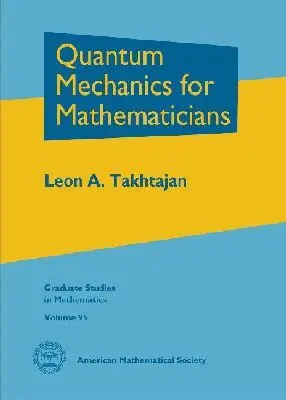
Inbunden, Engelska, 2008
1 583 kr
Skickas inom 5-8 vardagar
This book provides a comprehensive treatment of quantum mechanics from a mathematics perspective and is accessible to mathematicians starting with second-year graduate students. It addition to traditional topics, like classical mechanics, mathematical foundations of quantum mechanics, quantization, and the Schrodinger equation, this book gives a mathematical treatment of systems of identical particles with spin, and it introduces the reader to functional methods in quantum mechanics. This includes the Feynman path integral approach to quantum mechanics, integration in functional spaces, the relation between Feynman and Wiener integrals, Gaussian integration and regularized determinants of differential operators, fermion systems and integration over anticommuting (Grassmann) variables, supersymmetry and localization in loop spaces, and supersymmetric derivation of the Atiyah-Singer formula for the index of the Dirac operator. Prior to this book, mathematicians could find these topics only in physics textbooks and in specialized literature. This book is written in a concise style with careful attention to precise mathematics formulation of methods and results.Numerous problems, from routine to advanced, help the reader to master the subject. In addition to providing a fundamental knowledge of quantum mechanics, this book could also serve as a bridge for studying more advanced topics in quantum physics, among them quantum field theory. Prerequisites include standard first-year graduate courses covering linear and abstract algebra, topology and geometry, and real and complex analysis.
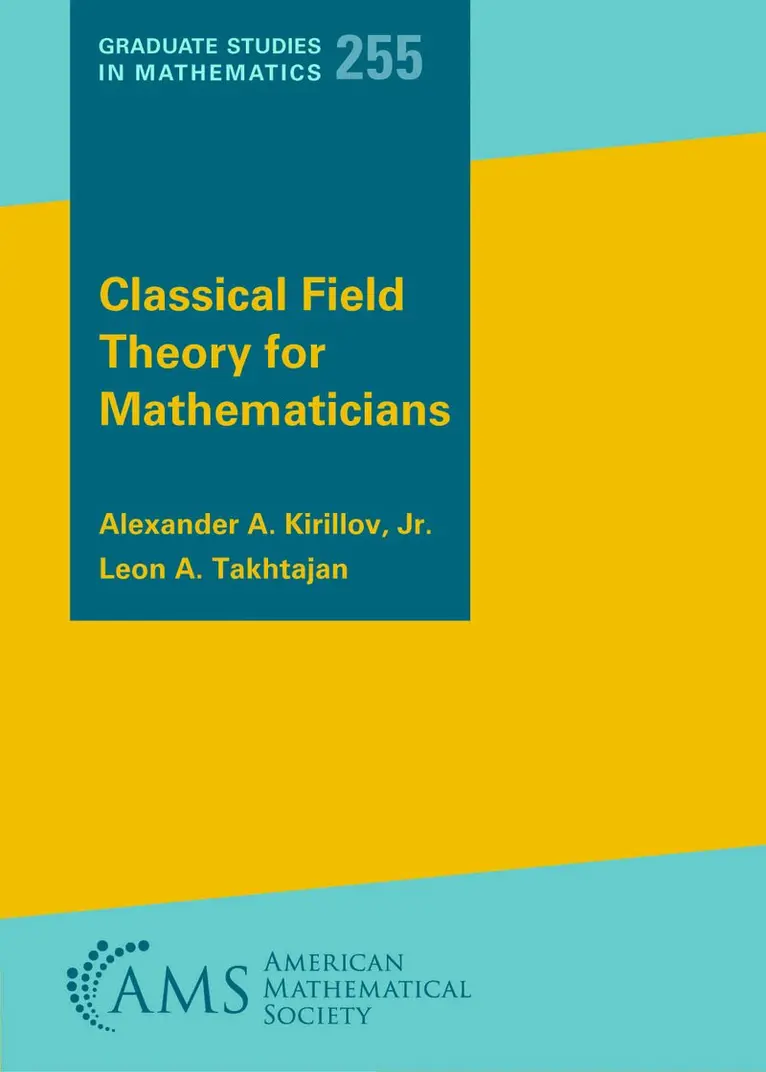
Inbunden, Engelska, 2026
1 728 kr
Kommande
The aim of this book is to give a comprehensive treatment of the majority of important classical field theory from the mathematics perspective. The opening Part 1 gives the exposition of classical mechanics and special relativity that are based on the Hamiltonian approach and emphasizes the Hamiltonian action of the relevant Lie groups. Part 2 bridges classical mechanics and classical field theory. The authors develop all necessary tools: Lagrangian formulation of classical field theory, conservation laws, the Noether theorem, and Hamiltonian formulation. They present all necessary facts about jet bundles, multivariable calculus of variations, etc. Part 3 discusses gauge field theory: Maxwell's theory with the abelian structure group $U(1)$, and Yang-Mills theory with the structure group being semisimple compact Lie groups. For the convenience of the reader, the authors collect all necessary facts about connections and curvature in vector and principal bundles. In Part 4 the authors briefly discuss the theory of gravity, i.e., Einstein's general relativity. The goal here is to give a coherent mathematical exposition of the basic notions. After careful discussion of properties of the spacetime in general relativity and a standard derivation of Einstein's field equations with matter, the authors discuss the so-called Palatini formalism, an approach to Hilbert-Einstein action when 10 matrix elements of the metric tensor and 40 components of the symmetric Christoffel symbols are independent variables. They also briefly discuss Hamiltonian formalism for Einstein equations and their special solutions, with and without the cosmological constant. Each chapter in the book concludes with exercises aimed at developing deeper insights into topics discussed in the chapter. Also, each part concludes with a ""Notes and References"" chapter, which provides references to necessary mathematics background and physics sources.

Häftad, Engelska, 2026
1 134 kr
Kommande
The aim of this book is to give a comprehensive treatment of the majority of important classical field theory from the mathematics perspective. The opening Part 1 gives the exposition of classical mechanics and special relativity that are based on the Hamiltonian approach and emphasizes the Hamiltonian action of the relevant Lie groups. Part 2 bridges classical mechanics and classical field theory. The authors develop all necessary tools: Lagrangian formulation of classical field theory, conservation laws, the Noether theorem, and Hamiltonian formulation. They present all necessary facts about jet bundles, multivariable calculus of variations, etc. Part 3 discusses gauge field theory: Maxwell's theory with the abelian structure group $U(1)$, and Yang-Mills theory with the structure group being semisimple compact Lie groups. For the convenience of the reader, the authors collect all necessary facts about connections and curvature in vector and principal bundles. In Part 4 the authors briefly discuss the theory of gravity, i.e., Einstein's general relativity. The goal here is to give a coherent mathematical exposition of the basic notions. After careful discussion of properties of the spacetime in general relativity and a standard derivation of Einstein's field equations with matter, the authors discuss the so-called Palatini formalism, an approach to Hilbert-Einstein action when 10 matrix elements of the metric tensor and 40 components of the symmetric Christoffel symbols are independent variables. They also briefly discuss Hamiltonian formalism for Einstein equations and their special solutions, with and without the cosmological constant. Each chapter in the book concludes with exercises aimed at developing deeper insights into topics discussed in the chapter. Also, each part concludes with a ""Notes and References"" chapter, which provides references to necessary mathematics background and physics sources.