Alexander Vucinich - Böcker
Visar alla böcker från författaren Alexander Vucinich. Handla med fri frakt och snabb leverans.
7 produkter
7 produkter
811 kr
Skickas inom 3-6 vardagar
Darwin in Russian Thought delves into the profound impact of Darwin's theory of evolution on Russian intellectual culture from the 1860s to the October Revolution. This meticulously researched work explores the diversity of Russian responses to Darwinism, highlighting its role in shaping scientific discourse and modern rationalist traditions in imperial Russia. The book offers a comprehensive chronological and thematic analysis, covering the initial reception of Darwin's ideas, their widespread influence across sciences, the waves of criticism they faced, and the rise of alternative evolutionary theories such as neo-Lamarckism and neo-Darwinism.With dedicated chapters on figures defending Darwinian orthodoxy, the various strands of anti-Darwinian thought, and attempts to integrate Darwinism with experimental biology, the study paints a vivid picture of the intellectual landscape. It also examines the radical intelligentsia’s ideological interpretations of Darwin's work and commemorations of his legacy, providing readers with a panoramic view of Russian Darwinism. This book is an essential resource for those interested in the intersections of science, philosophy, and culture in Russia’s pre-revolutionary period.This title is part of UC Press's Voices Revived program, which commemorates University of California Press’s mission to seek out and cultivate the brightest minds and give them voice, reach, and impact. Drawing on a backlist dating to 1893, Voices Revived makes high-quality, peer-reviewed scholarship accessible once again using print-on-demand technology. This title was originally published in 1988.
835 kr
Skickas inom 3-6 vardagar
Empire of Knowledge: The Academy of Sciences of the USSR (1917-1970) explores the unparalleled scope and influence of the Soviet Academy of Sciences, an institution that served as both the pinnacle of Soviet scholarly achievement and a crucial mechanism for integrating science with state ideology. Spanning its origins in 1917 to its role in the post-Stalinist era, the book delves into the Academy's evolution amidst dramatic political, social, and technological changes. By 1970, the Academy encompassed 240 research bodies, employed over 35,000 individuals, and played a pivotal role in shaping Soviet science policy. The study highlights its dual identity: as a government agency driving the integration of Marxist ideology into scientific exploration and as a microcosm of the global scientific community, striving to maintain intellectual autonomy and uphold the universal ethos of science.This comprehensive account examines the Academy's institutional dynamics, including its pivotal role in the decentralization of research, its response to Stalinist policies, and the subsequent efforts to reconcile science with political authority. The narrative illuminates the tension between the state's ideological demands and the scientific community's commitment to intellectual freedom. By investigating the Academy's historical trajectory, the book offers insights into the broader relationship between knowledge production, political authority, and cultural values. Readers will find a nuanced exploration of how an institution can simultaneously foster groundbreaking scientific innovation and serve as a tool for ideological conformity, revealing the intricate interplay of science, politics, and society in the Soviet Union.This title is part of UC Press's Voices Revived program, which commemorates University of California Press’s mission to seek out and cultivate the brightest minds and give them voice, reach, and impact. Drawing on a backlist dating to 1893, Voices Revived makes high-quality, peer-reviewed scholarship accessible once again using print-on-demand technology. This title was originally published in 1984.
753 kr
Skickas inom 7-10 vardagar
Darwin in Russian Thought delves into the profound impact of Darwin's theory of evolution on Russian intellectual culture from the 1860s to the October Revolution. This meticulously researched work explores the diversity of Russian responses to Darwinism, highlighting its role in shaping scientific discourse and modern rationalist traditions in imperial Russia. The book offers a comprehensive chronological and thematic analysis, covering the initial reception of Darwin's ideas, their widespread influence across sciences, the waves of criticism they faced, and the rise of alternative evolutionary theories such as neo-Lamarckism and neo-Darwinism.With dedicated chapters on figures defending Darwinian orthodoxy, the various strands of anti-Darwinian thought, and attempts to integrate Darwinism with experimental biology, the study paints a vivid picture of the intellectual landscape. It also examines the radical intelligentsia’s ideological interpretations of Darwin's work and commemorations of his legacy, providing readers with a panoramic view of Russian Darwinism. This book is an essential resource for those interested in the intersections of science, philosophy, and culture in Russia’s pre-revolutionary period.This title is part of UC Press's Voices Revived program, which commemorates University of California Press’s mission to seek out and cultivate the brightest minds and give them voice, reach, and impact. Drawing on a backlist dating to 1893, Voices Revived makes high-quality, peer-reviewed scholarship accessible once again using print-on-demand technology. This title was originally published in 1988.
1 513 kr
Skickas inom 3-6 vardagar
Empire of Knowledge: The Academy of Sciences of the USSR (1917-1970) explores the unparalleled scope and influence of the Soviet Academy of Sciences, an institution that served as both the pinnacle of Soviet scholarly achievement and a crucial mechanism for integrating science with state ideology. Spanning its origins in 1917 to its role in the post-Stalinist era, the book delves into the Academy's evolution amidst dramatic political, social, and technological changes. By 1970, the Academy encompassed 240 research bodies, employed over 35,000 individuals, and played a pivotal role in shaping Soviet science policy. The study highlights its dual identity: as a government agency driving the integration of Marxist ideology into scientific exploration and as a microcosm of the global scientific community, striving to maintain intellectual autonomy and uphold the universal ethos of science.This comprehensive account examines the Academy's institutional dynamics, including its pivotal role in the decentralization of research, its response to Stalinist policies, and the subsequent efforts to reconcile science with political authority. The narrative illuminates the tension between the state's ideological demands and the scientific community's commitment to intellectual freedom. By investigating the Academy's historical trajectory, the book offers insights into the broader relationship between knowledge production, political authority, and cultural values. Readers will find a nuanced exploration of how an institution can simultaneously foster groundbreaking scientific innovation and serve as a tool for ideological conformity, revealing the intricate interplay of science, politics, and society in the Soviet Union.This title is part of UC Press's Voices Revived program, which commemorates University of California Press’s mission to seek out and cultivate the brightest minds and give them voice, reach, and impact. Drawing on a backlist dating to 1893, Voices Revived makes high-quality, peer-reviewed scholarship accessible once again using print-on-demand technology. This title was originally published in 1984.
857 kr
Skickas inom 10-15 vardagar
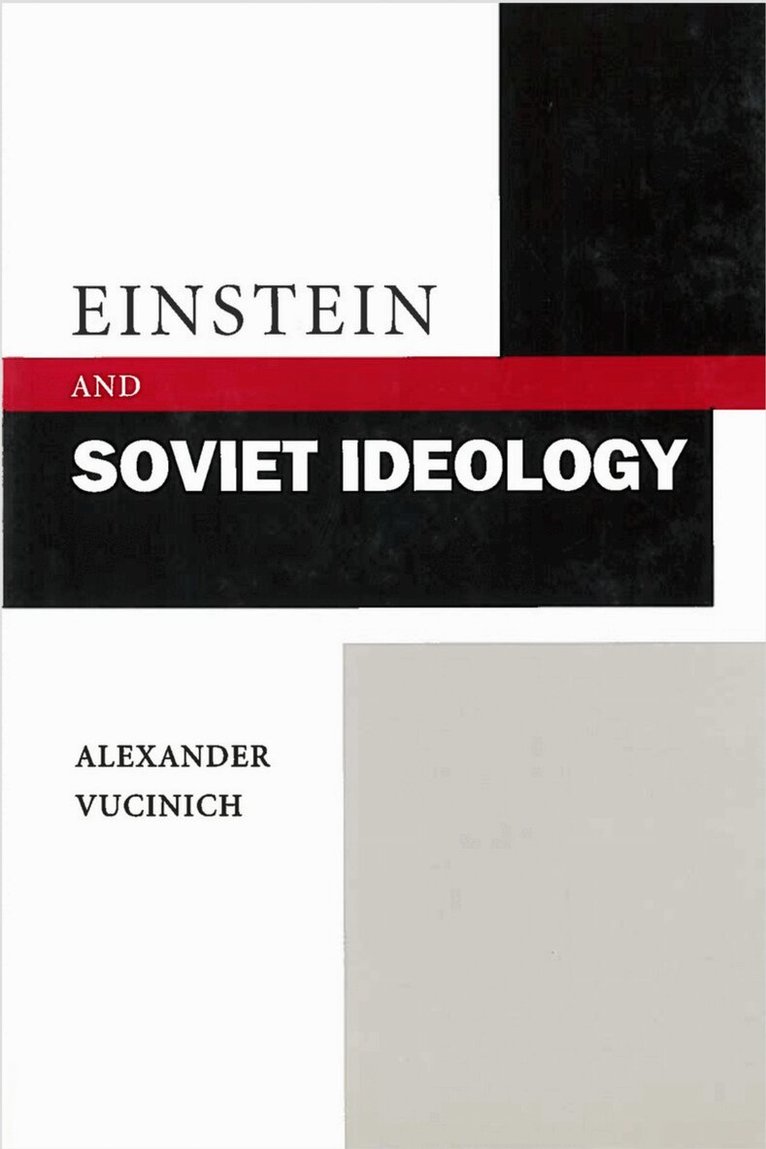
This book traces the historical trajectory of one of the most momentous confrontations in the intellectual life of the Soviet Union—the conflict between Einstein's theory of relativity and official Soviet ideology embodied in dialectical materialism.Soviet attitudes toward Einstein's scientific and philosophical thought passed through several stages. During the pre-Stalin era, Marxist philosophers clashed over the problem of defining dialectical materialism in relation to the ongoing revolution in science. This controversy produced a full spectrum of Marxist attitudes toward the theory of relativity, ranging from complete acceptance to total rejection. Disunity also prevented Marxist writers from interfering with the work of those Soviet physicists who produced a rich literature extolling the theory of relativity.During the Stalin era (1929-1953), conflicting forces in Marxist thinking were eliminated, and complete unity was established and firmly guarded by the state. Marxist theorists declared war on "idealistic" principles built into Einstein's scientific work. State harassment of leading physicists accused of idealistic digressions persisted throughout the Stalinist era. Several leading proponents of Einstein's ideas perished in political prisons. Despite all these pressures, some leading physicists used every opportunity to reaffirm their fundamental agreement with the theory of relativity as one of the fundamental contributions to twentieth-century scientific thought.The post-Stalinist period (1953-1985) gradually evolved into a profound transformation of every domain of social and cultural life, and Einstein's scientific and philosophical legacy was no exception. Whereas Stalinist writers tried to reformulate Einstein's principles to accommodate dialectical materialism, post-Stalinist thinkers, much more familiar with modern physics than their predecessors, attempted to make Marxist philosophy sufficiently flexible to absorb the guiding principles of the theory of relativity. A wide range of Einstein's ideas, previously regarded as symptoms of bourgeois decadence, was now hailed as a cornerstone of the Marxist philosophy of science. The post-Stalinist era also produced an extensive and appreciative literature on the humanistic aspect of Einstein's thought.The short-lived period of perestroika (1985-1991) accelerated the de-Stalinization process, post-Stalinist gains were solidified, and the theory of relativity was increasingly shorn of ideological burdens, thus removing one of the last remnants of the Stalinist war on science.
447 kr
Skickas inom 5-8 vardagar
336 kr
Skickas inom 5-8 vardagar