Alfred E. Kellerman - Böcker
Visar alla böcker från författaren Alfred E. Kellerman. Handla med fri frakt och snabb leverans.
2 produkter
2 produkter
1 463 kr
Skickas inom 10-15 vardagar
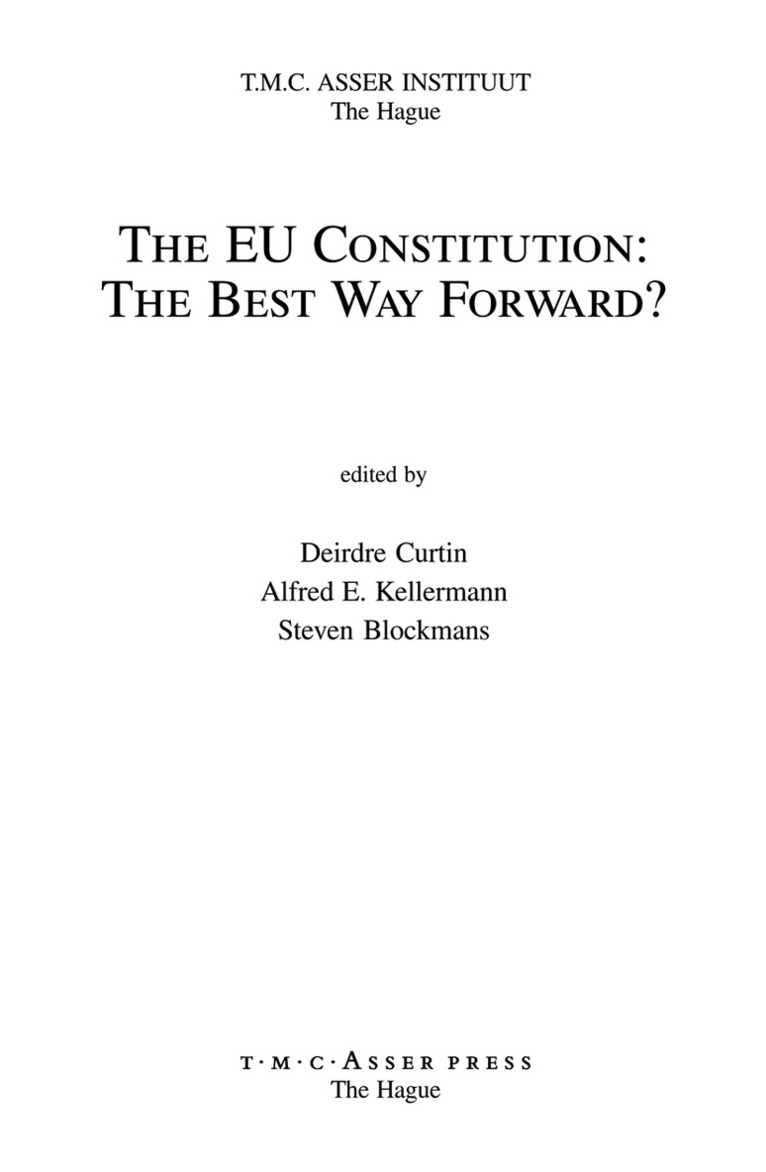
With a foreword by Atzo Nicolaï, Minister for European Affairs of the Kingdom of the Netherlands On 29 October 2004, the Treaty Establishing a Constitution for Europe was signed by the leaders of the 25 Member States of the European Union. This event marked the end of the discussion rounds to amend the treaties on which the European Union is founded. Yet, the debate on the Constitution was far from over when on 29 May and 1 June 2005 the French and the Dutch voters rejected the Treaty. Politicians and lawyers are now confronted with the question of how to proceed and how to go forward. In October 2004, the T.M.C. Asser Institute in The Hague, The Netherlands, organized the 34th Session of its Asser Institute Colloquium on European Law, which was entitled ‘The EU Constitution: The best way forward?’. During the Conference some 50 experts from the 25 Member States, from candidate, potential candidate and neighbouring countries, as well as from the US and Russia focused on key topics like: the process and impact of EU constitution-making, the democratic life of the EU, improving the efficiency and quality of legislation in the EU, the expansion of executive, judicial and legislative powers, and the access to justice. In anticipation of the developments after the signing of the Treaty, three eminent speakers – Prof. Joseph Weiler (New York University), Professor Bruno de Witte (European Institute in Florence) and Professor Jo Shaw (University of Manchester), elaborated on many answers in case of a ratification crisis. This book contains the proceedings of the three-day Conference and includes, next to the papers of the speakers and commentators, reports of the discussions on each topic and the texts of two keynote speeches. A keyword Index and a List of Articles (of the Treaty Establishing a Constitution for Europe, the Treaty on European Union and the Treaty Establishing the European Community) greatly enhance the accessibility of the rich materials. The book will be of great help and interest to political leaders, members of parliament, international lawyers and European citizens in formulating answers to the questions that have risen after the rejection of the Treaty by the French and Dutch voters and give powerful impulses to the continuing debate and efforts to arrive at a generally accepted Constitution for Europe. Deirdre Curtin is Professor of European and International Governance at Utrecht School of Governance, Utrecht, The Netherlands. Alfred E. Kellermann is Senior Legal and Policy Advisor and Visiting Professor in the law of the EU at the T.M.C. Asser Institute and Steven Blockmans is a Senior Researcher in the law of the EU at the T.M.C. Asser Institute, The Hague, The Netherlands.
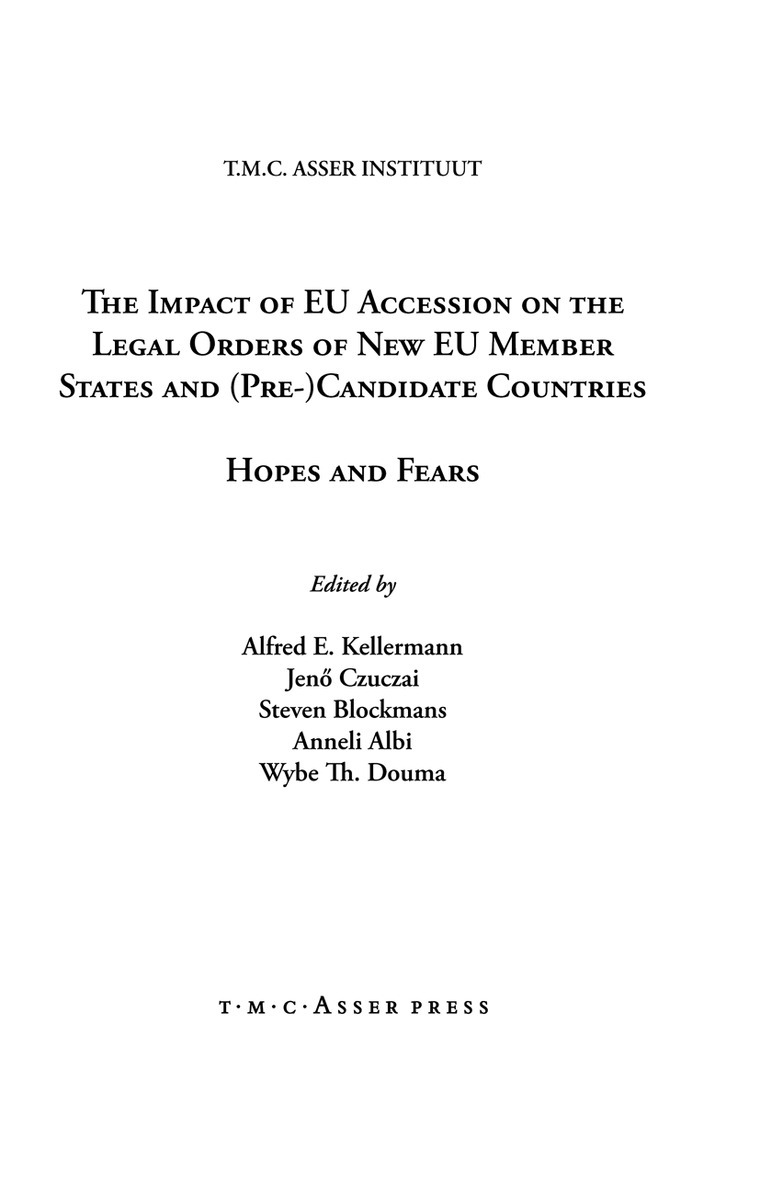
Impact of EU Accession on the Legal Orders of New EU Member States and (Pre-) Candidate Countries
Hopes and Fears
Inbunden, Engelska, 2006
987 kr
Skickas inom 10-15 vardagar
With a Foreword by Jaap de ZwaanOn 1 May 2004, ten countries joined the European Union as Member States. In that same year, five other countries (Bulgaria, Croatia, Romania, Serbia and Montenegro, and Turkey) had or received (pre-)candidate country status. EU accession requires a great number of adaptations in the laws and policies of a country. In order to analyse the impact of these developments and support the countries concerned, the T.M.C. Asser Institute in The Hague initiated a project originally entitled ‘The impact of EU accession for the acceding Member States and (pre-)candidate countries’. The project, which was approved by the Dutch Ministry of Foreign Affairs and financed under the Ministry’s Matra Programme, started at the beginning of 2003 and concluded during the Dutch EU presidency with a final conference in The Hague in October 2004.In preparation for this conference, a group of distinguished experts from the fifteenparticipating countries analysed, according to identical guidelines, the impact of accession on the organization of their national governments, parliaments and judiciaries, as well as on their national constitutions. Their research activities resulted in fifteen country reports offering a multitude of interesting insights, views and experiences. In 2005, the reports were updated by the authors and editors of this book, so that they could be made available to the wider public. As a comparative study of fifteen countries, it is an excellent guide for the preparation of the national legal orders for EU accession, for briefing and training civil servants, judges, practitioners, officials of international organizations and academics, and for post-graduate students.The multi-country research project was carried out by, and under the guidance of, Alfred E. Kellermann, T.M.C. Asser Institute, Jenö Czuczai, European Law Academy Budapest, Steven Blockmans,T.M.C. Asser Institute, and Anneli Albi, University of Kent. They also formed the editing team of the book, which was further complemented by Wybe Th. Douma, T.M.C. Asser Institute.