Alisha Rankin - Böcker
Visar alla böcker från författaren Alisha Rankin. Handla med fri frakt och snabb leverans.
5 produkter
5 produkter
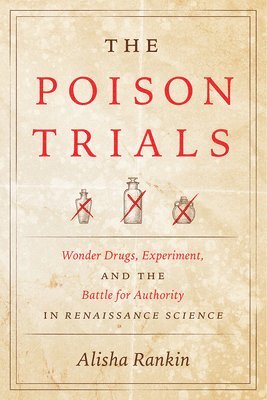
Poison Trials
Wonder Drugs, Experiment, and the Battle for Authority in Renaissance Science
Inbunden, Engelska, 2021
1 053 kr
Skickas inom 7-10 vardagar
In 1524, Pope Clement VII gave two condemned criminals to his physician to test a promising new antidote. After each convict ate a marzipan cake poisoned with deadly aconite, one of them received the antidote, and lived—the other died in agony. In sixteenth-century Europe, this and more than a dozen other accounts of poison trials were committed to writing. Alisha Rankin tells their little-known story.At a time when poison was widely feared, the urgent need for effective cures provoked intense excitement about new drugs. As doctors created, performed, and evaluated poison trials, they devoted careful attention to method, wrote detailed experimental reports, and engaged with the problem of using human subjects for fatal tests. In reconstructing this history, Rankin reveals how the antidote trials generated extensive engagement with “experimental thinking” long before the great experimental boom of the seventeenth century and investigates how competition with lower-class healers spurred on this trend.The Poison Trials sheds welcome and timely light on the intertwined nature of medical innovations, professional rivalries, and political power.
Poison Trials
Wonder Drugs, Experiment, and the Battle for Authority in Renaissance Science
Häftad, Engelska, 2021
353 kr
Skickas inom 7-10 vardagar
In 1524, Pope Clement VII gave two condemned criminals to his physician to test a promising new antidote. After each convict ate a marzipan cake poisoned with deadly aconite, one of them received the antidote, and lived—the other died in agony. In sixteenth-century Europe, this and more than a dozen other accounts of poison trials were committed to writing. Alisha Rankin tells their little-known story.At a time when poison was widely feared, the urgent need for effective cures provoked intense excitement about new drugs. As doctors created, performed, and evaluated poison trials, they devoted careful attention to method, wrote detailed experimental reports, and engaged with the problem of using human subjects for fatal tests. In reconstructing this history, Rankin reveals how the antidote trials generated extensive engagement with “experimental thinking” long before the great experimental boom of the seventeenth century and investigates how competition with lower-class healers spurred on this trend.The Poison Trials sheds welcome and timely light on the intertwined nature of medical innovations, professional rivalries, and political power.
606 kr
Skickas inom 11-20 vardagar
"Panaceia's Daughters" provides the first book-length study of noblewomen's healing activities in early modern Europe. Drawing on rich archival sources, Alisha Rankin demonstrates that numerous German noblewomen were deeply involved in making medicines and recommending them to patients, and many gained widespread fame for their remedies. Turning a common historical argument on its head, Rankin maintains that noblewomen's pharmacy came to prominence not in spite of their gender but because of it. Rankin demonstrates the ways in which noblewomen's pharmacy was bound up in notions of charity, class, religion, and household roles, as well as in expanding networks of knowledge and early forms of scientific experimentation. The opening chapters place noblewomen's healing within the context of cultural exchange, experiential knowledge, and the widespread search for medicinal recipes in early modern Europe.Case studies of renowned healers Dorothea of Mansfeld and Anna of Saxony then demonstrate the value their pharmacy held in their respective roles as elderly widow and royal consort, while a study of the long-suffering Duchess Elisabeth of Rochlitz emphasizes the importance of experiential knowledge and medicinal remedies to the patient's experience of illness.
2 165 kr
Skickas inom 10-15 vardagar
Secrets played a central role in transformations in medical and scientific knowledge in early modern Europe. As a new fascination with novelty began to take hold from the late fifteenth century, Europeans thirsted for previously unknown details about the natural world: new plants, animals, and other objects from nature, new recipes for medical and alchemical procedures, new knowledge about the human body, and new facts about the way nature worked. These 'secrets' became popular items of commerce and trade, as the quest for new and exclusive bits of information met the vibrant early modern marketplace. Whether disclosed widely in print or kept more circumspect in manuscripts, secrets helped drive an expanding interest in acquiring knowledge throughout early modern Europe. Bringing together international scholars, this volume provides a pan-European and interdisciplinary overview on the topic. Each essay offers significant new interpretations of the role played by secrets in their area of specialization. Chapters address key themes in early modern history and the history of medicine, science and technology including: the possession, circulation and exchange of secret knowledge across Europe; alchemical secrets and laboratory processes; patronage and the upper-class market for secrets; medical secrets and the emerging market for proprietary medicines; secrets and cosmetics; secrets and the body and finally gender and secrets.
563 kr
Skickas inom 10-15 vardagar
Secrets played a central role in transformations in medical and scientific knowledge in early modern Europe. As a new fascination with novelty began to take hold from the late fifteenth century, Europeans thirsted for previously unknown details about the natural world: new plants, animals, and other objects from nature, new recipes for medical and alchemical procedures, new knowledge about the human body, and new facts about the way nature worked. These 'secrets' became popular items of commerce and trade, as the quest for new and exclusive bits of information met the vibrant early modern marketplace. Whether disclosed widely in print or kept more circumspect in manuscripts, secrets helped drive an expanding interest in acquiring knowledge throughout early modern Europe. Bringing together international scholars, this volume provides a pan-European and interdisciplinary overview on the topic. Each essay offers significant new interpretations of the role played by secrets in their area of specialization. Chapters address key themes in early modern history and the history of medicine, science and technology including: the possession, circulation and exchange of secret knowledge across Europe; alchemical secrets and laboratory processes; patronage and the upper-class market for secrets; medical secrets and the emerging market for proprietary medicines; secrets and cosmetics; secrets and the body and finally gender and secrets.