Alta L. Price - Böcker
Visar alla böcker från författaren Alta L. Price. Handla med fri frakt och snabb leverans.
3 produkter
3 produkter
240 kr
Skickas inom 7-10 vardagar
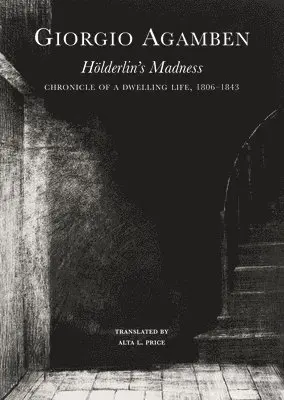
One of Europe’s greatest living philosophers, Giorgio Agamben, analyzes the life and work of one of Europe’s greatest poets, Friedrich Hölderlin.What does it mean to inhabit a place or a self? What is a habit? And, for human beings, doesn’t living mean—first and foremost—inhabiting? Pairing a detailed chronology of German poet Friedrich Hölderlin’s years of purported madness with a new examination of texts often considered unreadable, Giorgio Agamben's new book aims to describe and comprehend a life that the poet himself called habitual and inhabited. Hölderlin’s life was split neatly in two: his first 36 years, from 1770 to 1806; and the 36 years from 1807 to 1843, which he spent as a madman holed up in the home of Ernst Zimmer, a carpenter. The poet lived the first half of his existence out and about in the broader world, relatively engaged with current events, only to then spend the second half entirely cut off from the outside world. Despite occasional visitors, it was as if a wall separated him from all external events and relationships. For reasons that may well eventually become clear, Hölderlin chose to expunge all character—historical, social, or otherwise—from the actions and gestures of his daily life. According to his earliest biographer, he often stubbornly repeated, “nothing happens to me.” Such a life can only be the subject of a chronology—not a biography, much less a clinical or psychological analysis. Nevertheless, this book suggests that this is precisely how Hölderlin offers humanity an entirely other notion of what it means to live. Although we have yet to grasp the political significance of his unprecedented way of life, it now clearly speaks directly to our own.
162 kr
Skickas inom 7-10 vardagar
A book about bitter fates—both already known and yet to unfold—and the many kinds of organized machinery built to destroy people.Alexander Kluge’s work has long grappled with the Third Reich and its aftermath, and the extermination of the Jews forms its gravitational center. Kluge is forever reminding us to keep our present catastrophes in perspective—“calibrated”—against this historical monstrosity. Kluge’s newest work is a book about bitter fates, both already known and yet to unfold. Above all, it is about the many kinds of organized machinery built to destroy people. These forty-eight stories of justice and injustice are dedicated to the memory of Fritz Bauer, a determined fighter for justice and district attorney of Hesse during the Auschwitz Trials. “The moment they come into existence, monstrous crimes have a unique ability,” Bauer once said, “to ensure their own repetition.” Kluge takes heed, and in these pages reminds us of the importance of keeping our powers of observation and memory razor sharp.
157 kr
Skickas inom 7-10 vardagar
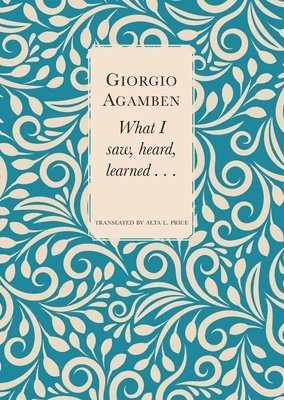
An engaging collection of late-life reflections and quick thoughts, a book unlike any other Agamben book.What can the senses of an attentive philosopher see, hear, and learn that can, in turn, teach us about living better lives? Perhaps it’s less a matter of asking what and more a matter of asking how. These latest reflections from Italy’s foremost philosopher form a sort of travelogue that chronicles Giorgio Agamben’s profound interior journey. Here, with unprecedented immediacy, Agamben shares his final remarks, late-life observations, and reflections about his life that flashed before his eyes. What did he see in that brief flash? What did he stay faithful to? What remains of all those places, friends, and teachers?