Öner Tulum - Böcker
Visar alla böcker från författaren Öner Tulum. Handla med fri frakt och snabb leverans.
3 produkter
3 produkter
From Financialisation to Innovation in UK Big Pharma
AstraZeneca and GlaxoSmithKline
Häftad, Engelska, 2022
223 kr
Skickas
The tension between innovation and financialisation is central to the business corporation. Innovation entails a 'retain-and-reinvest' allocation regime that can form a foundation for stable and equitable economic growth. Driven by shareholder-value ideology, financialisation entails a shift to 'downsize-and-distribute'. This Element investigates this tension in global pharmaceuticals, focusing on the two leading UK companies AstraZeneca and GlaxoSmithKline. In the 2000s both adopted US-style governance, including stock buybacks and stock-based executive pay. Over the past decade, however, first AstraZeneca and then GlaxoSmithKline transitioned to innovation. Critical was the cessation of buybacks to refocus capabilities on investing in an innovative drugs pipeline. Enabling this shift were UK corporate-governance institutions that mitigated US-style shareholder-value maximisation. Reinventing capitalism for the sake of stable and equitable economic growth means eliminating value destruction caused by financialisation and supporting value creation through collective and cumulative innovation. This title is also available as Open Access on Cambridge Core.
215 kr
Skickas inom 7-10 vardagar
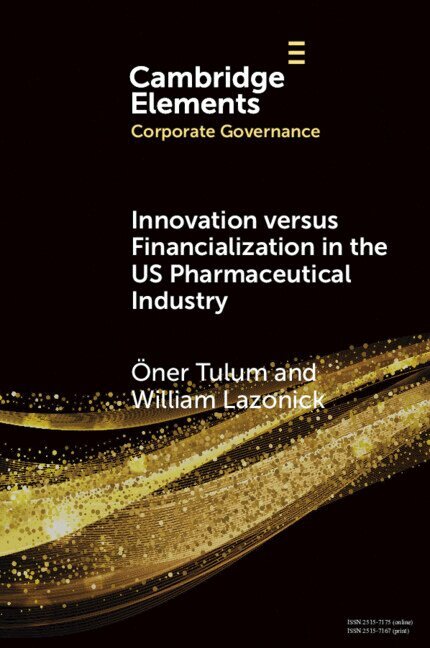
Mandated by the Inflation Reduction Act of 2022, the US government is negotiating with pharmaceutical companies over the 'maximum fair price' of ten drugs widely used by Medicare patients. The pharmaceutical companies contend that a 'fair' price is a 'value-based price' that enables their shareholders to capture the value the drug creates for society and warn that lowering drug prices will reduce investments in new drugs. This Element responds to these arguments by showing that pharmaceutical companies (a) should have their drug prices regulated, given scale economies in supplying drugs and price inelasticity of drug demand; (b) use their profits from unregulated drug prices to distribute cash dividends and stock buybacks to shareholders; (c) do not typically rely upon investment by shareholders to fund drug innovation; and (d) benefit from 'collective and cumulative learning' in foundational and translational research that is antecedent and external to their investments in clinical research.
692 kr
Skickas inom 7-10 vardagar
Mandated by the Inflation Reduction Act of 2022, the US government is negotiating with pharmaceutical companies over the 'maximum fair price' of ten drugs widely used by Medicare patients. The pharmaceutical companies contend that a 'fair' price is a 'value-based price' that enables their shareholders to capture the value the drug creates for society and warn that lowering drug prices will reduce investments in new drugs. This Element responds to these arguments by showing that pharmaceutical companies (a) should have their drug prices regulated, given scale economies in supplying drugs and price inelasticity of drug demand; (b) use their profits from unregulated drug prices to distribute cash dividends and stock buybacks to shareholders; (c) do not typically rely upon investment by shareholders to fund drug innovation; and (d) benefit from 'collective and cumulative learning' in foundational and translational research that is antecedent and external to their investments in clinical research.