Andrea L. Bonnicksen - Böcker
Visar alla böcker från författaren Andrea L. Bonnicksen. Handla med fri frakt och snabb leverans.
5 produkter
5 produkter
535 kr
Skickas inom 3-6 vardagar
Few recent technologies have attracted as much attention as In Vitro Fertilization (IVF), a technique in which ova are fertilized in a glass dish and transferred to the prospective mother. Despite a large body of literature and much recent publicity on the ethics of new re-productive technologies, however, we are far from understanding what actually goes on in the nation's 138 in vitro fertilization centers, and even farther from possessing a clear public policy regarding this controversial technology. In this book the author examines two different, and often opposing worlds of in vitro fertilization: the public's political, legal and ethical concerns surrounding the technique, and the personal, pragmatic world of the individual patients who come to the centers seeding a cure for infertility. The crux of this analysis revolves around the intersection, and sometimes the antagonism, between these two worlds. While use of the centers is growing extremely fast, there is an absence of any federal-level policy to monitor this technique. To fill this vacuum, individual practitioners of IVF and other new reproductive technologies.The author investigates the current effects of these guidelines in interviews with physicians, scientists, policy makers, and patients at IVF centers, and argues that in this case, the public policy we implement should take its direction from the self-regulation that is already occurring on a local level and which is so well-developed that it has in effect taken the place of a formal federal policy. For all those interested in, or contemplating the rapidly growing field of in vitro fertilization, this is an objective analysis which answers many perplexing questions.
Emerging Issues in Biomedical Policy: An Annual Review
Setting Allocation Priorities
Häftad, Engelska, 1993
347 kr
Skickas inom 7-10 vardagar
Volume 1 discusses the problems inherent in allocating limited biomedical technologies: whose needs take precedence, what individual rights and responsibilities are involved, and when societal good justifies restricting individual good. Volume Two focuses on two substantive areas of biomedical policy beset by conflicts. Physicians, patients, and public officials are locked in new battles over whether and when life-extending technologies should be used or withdrawn. Meanwhile, researchers, government officials, and patients struggle to determine who will receive experimental medical treatment, and what procedures should be instituted to protect the recipients.
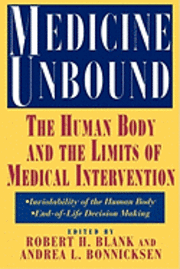
Medicine Unbound
The Human Body and the Limits of Medical Intervention: Emerging Issues in Biomedical Policy
Häftad, Engelska, 1994
685 kr
Skickas inom 3-6 vardagar
This volume focuses on issues involving the inviolability of the human body and the decision to end life. The contributors explore the difficulties in framing a public policy that legalizes aid in dying, and return to the more general question of what is the most fair and effective relationship between private medical authority and public policy. In Part 1, biologists, ethicists, theologians and political scientists examine the issue of whether there ought to be limits to medical intervention. Although medicine has continually stretched the boundaries of intervention in the human body, new technologies of organ transplantation and genetics and the emergence of revolutionary drugs raise ethical concerns over how far we should go in moving from therapeutics to enhancement of the human body. Questions of inviolability also arise in situations where treatment of the foetus requires intrusion into the bodily integrity of the pregnant woman. The contributors debate what is meant by inviolability and where, if ever, it should be a matter of public policy.Part 2 brings together authors from bioethics, medicine, psychology, journalism and politics to examine the intensifying debate over the empowerment of patients in making decisions to end life.
427 kr
Skickas inom 5-8 vardagar
986 kr
Skickas inom 3-6 vardagar
In his 2006 State of the Union speech, President George W. Bush asked the U.S. Congress to prohibit the 'most egregious abuses of medical research', such as the 'creation of animal-human hybrids'. The president's message echoed that of a 2004 report by the President's Council on Bioethics, which recommended that hybrid human-animal embryos be banned by Congress. Discussions of early interspecies research, in which cells or DNA are interchanged between humans and nonhumans at early stages of development, can often devolve into sweeping statements, colorful imagery, and confusing policy. Although today's policy advisory groups are becoming more informed, debate is still limited by the interchangeable use of terms such as chimeras and hybrids, a tendency to treat all forms of interspecies alike, the failure to distinguish between laboratory research and procreation, and not enough serious policy justification. Andrea Bonnicksen seeks to understand reasons behind support of and disdain for interspecies research in such areas as chimerism, hybridization, interspecies nuclear transfer, cross-species embryo transfer, and transgenics.She highlights two claims critics make against early interspecies studies: that the research will violate human dignity and that it can lead to procreation. Are these claims sufficient to justify restrictive policy? Bonnicksen carefully illustrates the challenges of making policy for sensitive and often sensationalized research - research that touches deep-seated values and that probes the boundary between human and nonhuman animals.