Andreas Philippopoulos-Mihalopoulos – författare
785 kr
Skickas inom 10-15 vardagar
2 083 kr
Skickas inom 10-15 vardagar
422 kr
Skickas inom 10-15 vardagar
2 240 kr
Skickas inom 10-15 vardagar
812 kr
Skickas
773 kr
Skickas inom 10-15 vardagar
669 kr
Skickas inom 10-15 vardagar
913 kr
Läs direkt efter köp
Niklas Luhmann: Law, Justice, Society presents the work of sociologist Niklas Luhmann in a radical new light. Luhmann’s theory is here introduced both in terms of society at large and the legal system specifically, and for the first time, Luhmann’s texts are systematically read together with theoretical insights from post-structuralism, deconstruction, phenomenology, radical ethics, feminism and post-ecologism. In his far-reaching book, Andreas Philippopoulos-Mihalopoulos distances Luhmann’s theory from its misrepresentations as conservative, rigorously positivist and disconnected from empirical reality, and firmly locates it in a sphere of post-ideological jurisprudence.
The book operates both as a detailed explanation of the theory’s concepts and as the locus of a critique which brings forth Luhmann’s radical credentials. The focal points are Luhmann’s concept of society and the law’s paradoxical connection to justice. However, these concepts are also transgressed in order to show how the law deals with the illusion of its identity, and more broadly how the theory itself deals with its limitations. This is illustrated by examples drawn from human rights, constitutional theory and ecological thinking. On the whole, Niklas Luhmann: Law, Justice, Society serves both as an introductory text and as a critical response to Luhmann’s theory, and is recommended reading for students and researchers in sociology, law, social sciences, politics and whoever is interested in seeing the influential work of Niklas Luhmann from a critical new perspective.
913 kr
Läs direkt efter köp
Niklas Luhmann: Law, Justice, Society presents the work of sociologist Niklas Luhmann in a radical new light. Luhmann’s theory is here introduced both in terms of society at large and the legal system specifically, and for the first time, Luhmann’s texts are systematically read together with theoretical insights from post-structuralism, deconstruction, phenomenology, radical ethics, feminism and post-ecologism. In his far-reaching book, Andreas Philippopoulos-Mihalopoulos distances Luhmann’s theory from its misrepresentations as conservative, rigorously positivist and disconnected from empirical reality, and firmly locates it in a sphere of post-ideological jurisprudence.
The book operates both as a detailed explanation of the theory’s concepts and as the locus of a critique which brings forth Luhmann’s radical credentials. The focal points are Luhmann’s concept of society and the law’s paradoxical connection to justice. However, these concepts are also transgressed in order to show how the law deals with the illusion of its identity, and more broadly how the theory itself deals with its limitations. This is illustrated by examples drawn from human rights, constitutional theory and ecological thinking. On the whole, Niklas Luhmann: Law, Justice, Society serves both as an introductory text and as a critical response to Luhmann’s theory, and is recommended reading for students and researchers in sociology, law, social sciences, politics and whoever is interested in seeing the influential work of Niklas Luhmann from a critical new perspective.
928 kr
Läs direkt efter köp
Law and the City offers a lateral, critical and often unexpected description of some of the most important cities in the world, including Moscow, Istanbul, Berlin, Singapore, Athens, Mexico City, Toronto, Sydney, Johannesburg: each one from a distinctive legal perspective.
An invaluable ''guide'' to adopting a different approach to the city and its history, culture and everyday experience, Law and the City is not simply an exploration of the relationship between these two spheres.
It details:
a flourishing of law’s spatiality and urban legal localityan unfolding of both the juridical urban body and the city’s legal dreams, of both the ‘urban law’ and the ‘juridical polis’.Enlightening and at the same time problematizing the reader, this volume is an innovative collection of truly global dimensions that will prove compelling reading both for specialists and for critical travellers.
928 kr
Läs direkt efter köp
Law and the City offers a lateral, critical and often unexpected description of some of the most important cities in the world, including Moscow, Istanbul, Berlin, Singapore, Athens, Mexico City, Toronto, Sydney, Johannesburg: each one from a distinctive legal perspective.
An invaluable ''guide'' to adopting a different approach to the city and its history, culture and everyday experience, Law and the City is not simply an exploration of the relationship between these two spheres.
It details:
a flourishing of law’s spatiality and urban legal localityan unfolding of both the juridical urban body and the city’s legal dreams, of both the ‘urban law’ and the ‘juridical polis’.Enlightening and at the same time problematizing the reader, this volume is an innovative collection of truly global dimensions that will prove compelling reading both for specialists and for critical travellers.
464 kr
Läs direkt efter köp
Offering a novel, transdisciplinary approach to environmental law, its principles, mechanics and context, as tested in its application to the urban environment, this book traces the conceptual and material absence of communication between the human and the natural and controversially includes such an absence within a system of law and a system of geography which effectively remain closed to environmental considerations.
The book looks at Niklas Luhmann''s theory of autopoiesis. Introducing the key concepts and operations, contextualizing them and opening them up to critical analysis. Indeed, in contrast to most discussions on autopoiesis, it proposes a radically different reading of the theory, in line with critical legal, political, sociological, urban and ecological theories, while drawing from writings by Husserl and Derrida, as well as Latour, Blanchot, Haraway, Agamben and Nancy.
It explores a range of topics in the areas of environmental law and urban geography, including:
environmental risk, environmental rights, the precautionary principle, intergenerational equity and urban waste discourses on community, nature, science and identity.The author redefines the traditional foundations of environmental law and urban geography and suggests a radical way of dealing with scientific ignorance, cultural differences and environmental degradation within the perceived need for legal delivery of certainty.
464 kr
Läs direkt efter köp
Offering a novel, transdisciplinary approach to environmental law, its principles, mechanics and context, as tested in its application to the urban environment, this book traces the conceptual and material absence of communication between the human and the natural and controversially includes such an absence within a system of law and a system of geography which effectively remain closed to environmental considerations.
The book looks at Niklas Luhmann''s theory of autopoiesis. Introducing the key concepts and operations, contextualizing them and opening them up to critical analysis. Indeed, in contrast to most discussions on autopoiesis, it proposes a radically different reading of the theory, in line with critical legal, political, sociological, urban and ecological theories, while drawing from writings by Husserl and Derrida, as well as Latour, Blanchot, Haraway, Agamben and Nancy.
It explores a range of topics in the areas of environmental law and urban geography, including:
environmental risk, environmental rights, the precautionary principle, intergenerational equity and urban waste discourses on community, nature, science and identity.The author redefines the traditional foundations of environmental law and urban geography and suggests a radical way of dealing with scientific ignorance, cultural differences and environmental degradation within the perceived need for legal delivery of certainty.
2 195 kr
Skickas inom 10-15 vardagar
755 kr
Skickas inom 10-15 vardagar
3 383 kr
Skickas inom 10-15 vardagar
758 kr
Läs direkt efter köp
This handbook sets out an innovative approach to the theory of law, reconceptualising it in a material, embodied, socially contextualised and politically radical way. The book consists of original contributions authored by prominent academics, all of whom provide a valuable overview of legal theory as a discipline.
The book contains five sections:
• Spatiotemporal
• Sense
• Body
• Text
• Matter
Through this structure, the handbook brings the law into active discussion with other disciplines, as well as supra-disciplinary debates on the areas of spatiality, temporality, materiality, corporeality and sensorial studies, capturing the most exciting developments in current legal theory, and anticipating future research in the area.
The handbook is essential reading for scholars and students of jurisprudence, sociology of law, critical legal studies, socio-legal theory and interdisciplinary legal studies, as well as those people from other disciplines interested in the way the law converses with interdisciplinarity.
Chapter 12 of this book is freely available as a downloadable Open Access PDF at http://www.taylorfrancis.com under a Creative Commons Attribution-Non Commercial-No Derivatives (CC-BY-NC-ND) 4.0 license.
758 kr
Läs direkt efter köp
This handbook sets out an innovative approach to the theory of law, reconceptualising it in a material, embodied, socially contextualised and politically radical way. The book consists of original contributions authored by prominent academics, all of whom provide a valuable overview of legal theory as a discipline.
The book contains five sections:
• Spatiotemporal
• Sense
• Body
• Text
• Matter
Through this structure, the handbook brings the law into active discussion with other disciplines, as well as supra-disciplinary debates on the areas of spatiality, temporality, materiality, corporeality and sensorial studies, capturing the most exciting developments in current legal theory, and anticipating future research in the area.
The handbook is essential reading for scholars and students of jurisprudence, sociology of law, critical legal studies, socio-legal theory and interdisciplinary legal studies, as well as those people from other disciplines interested in the way the law converses with interdisciplinarity.
Chapter 12 of this book is freely available as a downloadable Open Access PDF at http://www.taylorfrancis.com under a Creative Commons Attribution-Non Commercial-No Derivatives (CC-BY-NC-ND) 4.0 license.
860 kr
Läs direkt efter köp
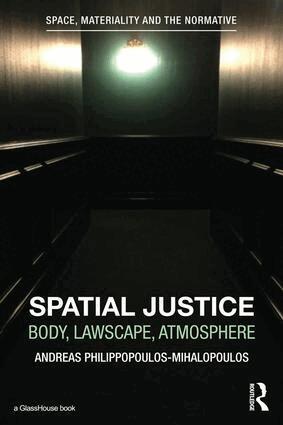
There can be no justice that is not spatial. Against a recent tendency to despatialise law, matter, bodies and even space itself, this book insists on spatialising them, arguing that there can be neither law nor justice that are not articulated through and in space.
Spatial Justice presents a new theory and a radical application of the material connection between space – in the geographical as well as sociological and philosophical sense – and the law – in the broadest sense that includes written and oral law, but also embodied social and political norms. More specifically, it argues that spatial justice is the struggle of various bodies – human, natural, non-organic, technological – to occupy a certain space at a certain time. Seen in this way, spatial justice is the most radical offspring of the spatial turn, since, as this book demonstrates, spatial justice can be found in the core of most contemporary legal and political issues – issues such as geopolitical conflicts, environmental issues, animality, colonisation, droning, the cyberspace and so on. In order to ague this, the book employs the lawscape, as the tautology between law and space, and the concept of atmosphere in its geological, political, aesthetic, legal and biological dimension.
Written by a leading theorist in the area, Spatial Justice: Body, Lawscape, Atmosphere forges a new interdisciplinary understanding of space and law, while offering a fresh approach to current geopolitical, spatiolegal and ecological issues.
891 kr
Läs direkt efter köp
There can be no justice that is not spatial. Against a recent tendency to despatialise law, matter, bodies and even space itself, this book insists on spatialising them, arguing that there can be neither law nor justice that are not articulated through and in space.
Spatial Justice presents a new theory and a radical application of the material connection between space – in the geographical as well as sociological and philosophical sense – and the law – in the broadest sense that includes written and oral law, but also embodied social and political norms. More specifically, it argues that spatial justice is the struggle of various bodies – human, natural, non-organic, technological – to occupy a certain space at a certain time. Seen in this way, spatial justice is the most radical offspring of the spatial turn, since, as this book demonstrates, spatial justice can be found in the core of most contemporary legal and political issues – issues such as geopolitical conflicts, environmental issues, animality, colonisation, droning, the cyberspace and so on. In order to ague this, the book employs the lawscape, as the tautology between law and space, and the concept of atmosphere in its geological, political, aesthetic, legal and biological dimension.
Written by a leading theorist in the area, Spatial Justice: Body, Lawscape, Atmosphere forges a new interdisciplinary understanding of space and law, while offering a fresh approach to current geopolitical, spatiolegal and ecological issues.
470 kr
Skickas inom 5-8 vardagar
144 kr
Skickas inom 5-8 vardagar
149 kr
Läs direkt efter köp
520 kr
Läs direkt efter köp
3 465 kr
Skickas inom 5-8 vardagar
786 kr
Läs direkt efter köp
Taking into consideration issues such as non-human agency, the Anthropocene, and spatial and material turns in law this book builds on key concepts in the subject. The book also considers how environmental law must adapt to the new and urgent needs of a variety of bodies, both human and non-human, that require its protection. It argues that traditional ways of conceiving environmental law, and of accounting for problems brought about through anthropocentric means, have led to the reinstatement of the problem of environmental degradation without imagining different avenues to resolve it.
This Handbook is a key addition to the existing literature and provides an invaluable contribution to practical critique and to the reimagining of environmental law. It will be a crucial compendium for graduate students and researchers in the field of environmental law wishing to explore critical approaches.
Contributors include: R. Bartel, I. Braverman, V. Brooks, P. Burdon, E. Cloatre, L. Finchett-Maddock, J. Gillespie, A. Grear, J. Holder, A. Kotsakis, L. Kotze, B. Lange, D. Mandic, J. Martel, D. McGillivray, K. Morrow, E. Mussawir, U. Natarajan, M. Nikolic, Y. Otomo, J. Paterson, A. Pavoni, A. Philippopoulos-Mihalopoulos, I.-J. Sand, F. Venter, B. Woodard
1 305 kr
Skickas inom 10-15 vardagar
2 214 kr
Skickas inom 10-15 vardagar
287 kr
Skickas inom 5-8 vardagar
237 kr
Skickas inom 5-8 vardagar