Andreas Schmidt-Rhaesa – författare
Visar alla böcker från författaren Andreas Schmidt-Rhaesa. Handla med fri frakt och snabb leverans.
30 produkter
Platyhelminthes
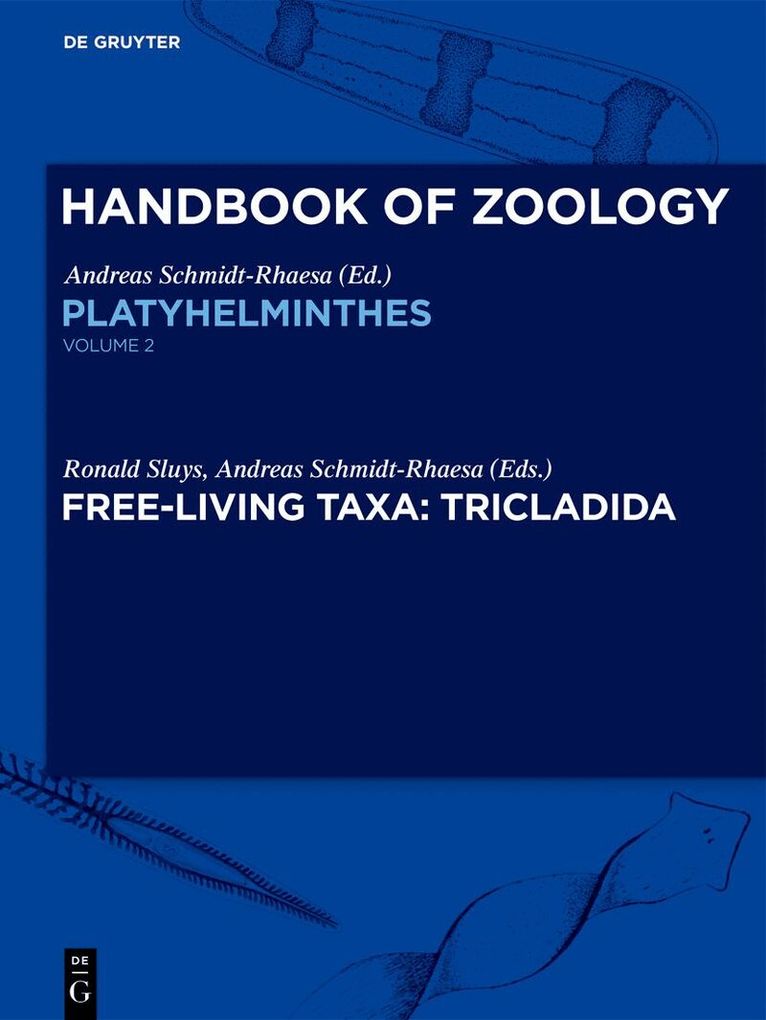
Free-living taxa: Tricladida
Av Ronald Sluys, Andreas Schmidt-Rhaesa
Inbunden, 2026
4741 kr
Lägg i varukorg
Flatworms (Platyhelminthes) occupy a variety of environments, they live in the sea, in freshwater and some even on land. Many flatworms are parasites. This comprehensive book deals with the free-living taxa, parasites are treated with in a future volume. Many free-living flatworms are …
Structure and Evolution of Invertebrate Nervous Systems
Av Gunter Purschke, Steffen Harzsch m. fl.
E-bok, 2015
2732 kr
Lägg i varukorg
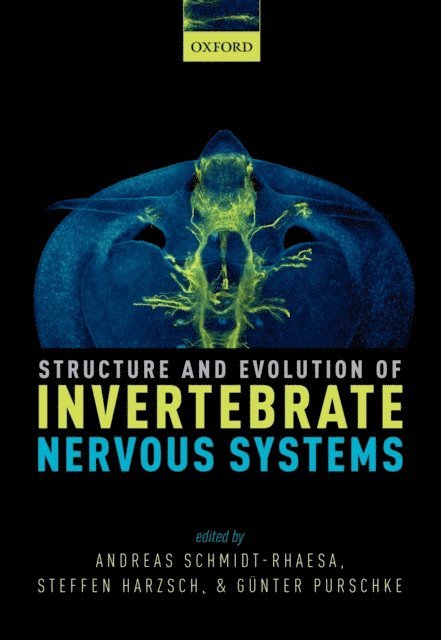
The nervous system is particularly fascinating for many biologists because it controls animal characteristics such as movement, behavior, and coordinated thinking. Invertebrate neurobiology has traditionally been studied in specific model organisms, whilst knowledge of the broad diversity of …
Structure and Evolution of Invertebrate Nervous Systems
Av Gunter Purschke, Steffen Harzsch m. fl.
E-bok, 2015
2732 kr
Lägg i varukorg
The nervous system is particularly fascinating for many biologists because it controls animal characteristics such as movement, behavior, and coordinated thinking. Invertebrate neurobiology has traditionally been studied in specific model organisms, whilst knowledge of the broad diversity of …
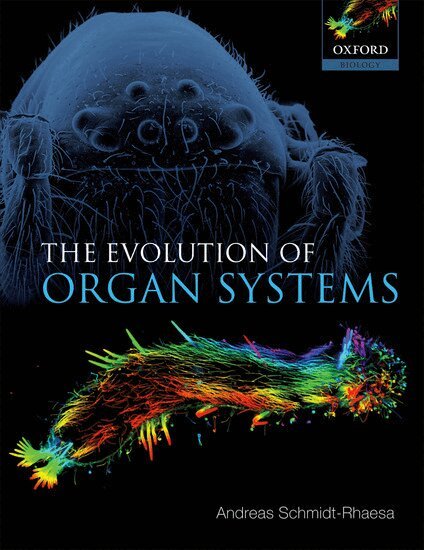
The Evolution of Organ Systems
Inbunden, 2007
2734 kr
Lägg i varukorg
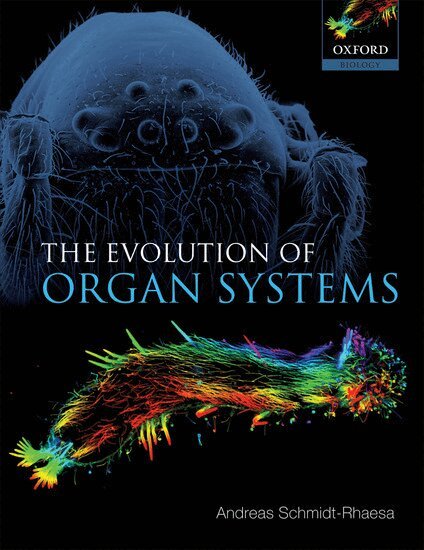
Systematics has developed rapidly during the past two decades. A multitude of new methods and contributions from a diversity of biological fields including molecular genetics and developmental biology have provided a wealth of phylogenetic hypotheses, some confirming traditional views others …
The Evolution of Organ Systems
Häftad, 2007
3,0 utav 5 stjärnor. Totalt antal röster: (2)
1225 kr
Lägg i varukorg
Systematics has developed rapidly during the past two decades. A multitude of new methods and contributions from a diversity of biological fields including molecular genetics and developmental biology have provided a wealth of phylogenetic hypotheses, some confirming traditional views others …
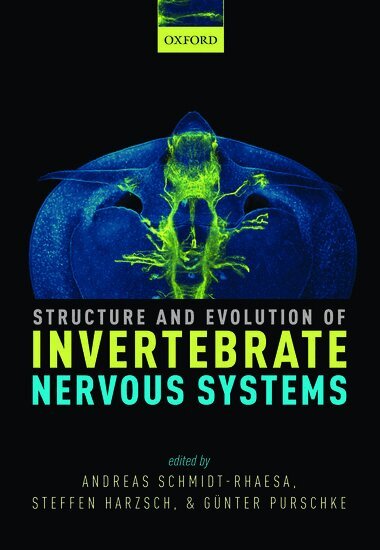
Structure and Evolution of Invertebrate Nervous Systems
Av Andreas Schmidt-Rhaesa, Steffen Harzsch m. fl.
Inbunden, 2015
3470 kr
Lägg i varukorg
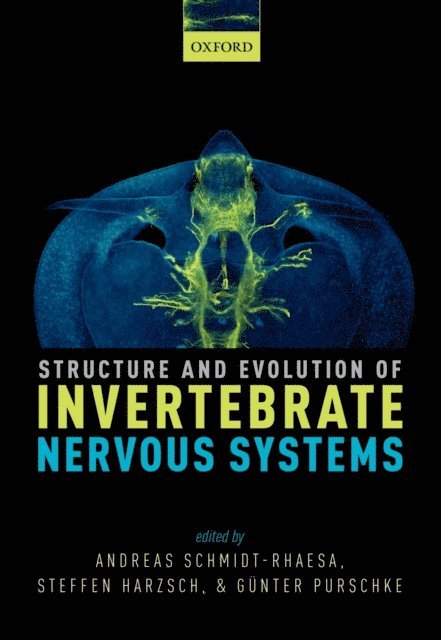
The nervous system is particularly fascinating for many biologists because it controls animal characteristics such as movement, behavior, and coordinated thinking. Invertebrate neurobiology has traditionally been studied in specific model organisms, whilst knowledge of the broad diversity of …
Hymenoptera, Unterordnung Symphyta
Pflanzenwespen
Av Wolfgang Schedl, Willy Kükenthal m. fl.
Inbunden, 1991
3111 kr
Lägg i varukorg
Keine ausführliche Beschreibung für "Hymenoptera, Unterordnung Symphyta" verfügbar.
Anoplura
(Echte Läuse)
Av Feliks Piotrowski, Willy Kükenthal m. fl.
Inbunden, 1992
2478 kr
Lägg i varukorg
Volume 1: Evolution, Systematics, and Biogeography
Av Niels P. Kristensen, Andreas Schmidt-Rhaesa
Inbunden, 1998
4292 kr
Lägg i varukorg
No detailed description available for "Volume 1: Evolution, Systematics, and Biogeography".
11
Inbunden, 2012
3259 kr
Lägg i varukorg
This section of the Handbook of Zoology is intended as a comprehensive and exhaustive account of the biology of the taxa Gastrotricha, Nematoda, Nematomorpha, Priapulida, Kinorhyncha, Loricifera, Gnathostomulida, Micrognathozoa, Rotifera, Seisonida and Acanthocephala, covering all relevant topics …
11
E-bok, 2012
3844 kr
Lägg i varukorg
This section of the Handbook of Zoology is intended as a comprehensive and exhaustive account of the biology of the taxa Gastrotricha, Nematoda, Nematomorpha, Priapulida, Kinorhyncha, Loricifera, Gnathostomulida, Micrognathozoa, Rotifera, Seisonida and Acanthocephala, covering all relevant topics …
Gastrotricha and Gnathifera
Inbunden, 2014
3117 kr
Lägg i varukorg
This section of the Handbook of Zoology is intended as a comprehensive and exhaustive account of the biology of the taxa Gastrotricha, Nematoda, Nematomorpha, Priapulida, Kinorhyncha, Loricifera, Gnathostomulida, Micrognathozoa, Rotifera, Seisonida and Acanthocephala, covering all relevant topics …
Nematoda
E-bok, 2013
3327 kr
Lägg i varukorg
This section of the Handbook of Zoology is intended as a comprehensive and exhaustive account of the biology of the taxa Gastrotricha, Nematoda, Nematomorpha, Priapulida, Kinorhyncha, Loricifera, Gnathostomulida, Micrognathozoa, Rotifera, Seisonida and Acanthocephala, covering all relevant topics …
Gastrotricha and Gnathifera
E-bok, 2014
3757 kr
Lägg i varukorg
This section of the Handbook of Zoology is intended as a comprehensive and exhaustive account of the biology of the taxa Gastrotricha, Nematoda, Nematomorpha, Priapulida, Kinorhyncha, Loricifera, Gnathostomulida, Micrognathozoa, Rotifera, Seisonida and Acanthocephala, covering all relevant topics …
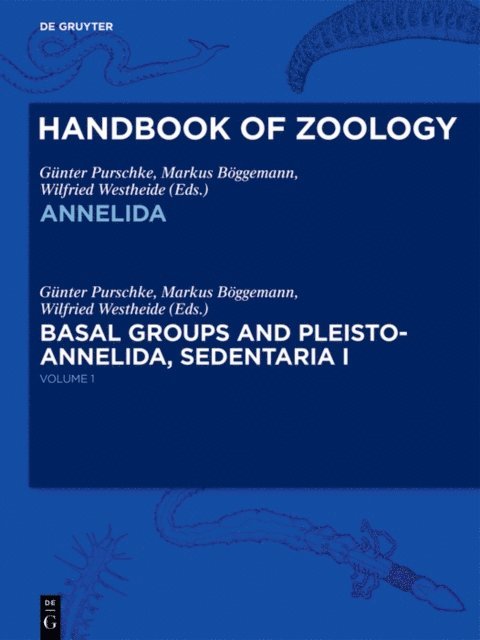
Annelida Basal Groups and Pleistoannelida, Sedentaria I
Av Günter Purschke, Markus Böggemann m. fl.
Inbunden, 2019
3719 kr
Lägg i varukorg
This book is the first in a series of 4 volumes in the Handbook of Zoology series about morphology, anatomy, reproduction, development, ecology, phylogeny and systematics of Annelida. This first volume covers members of the so-called basal radiation and the first part of Sedentaria. It is …
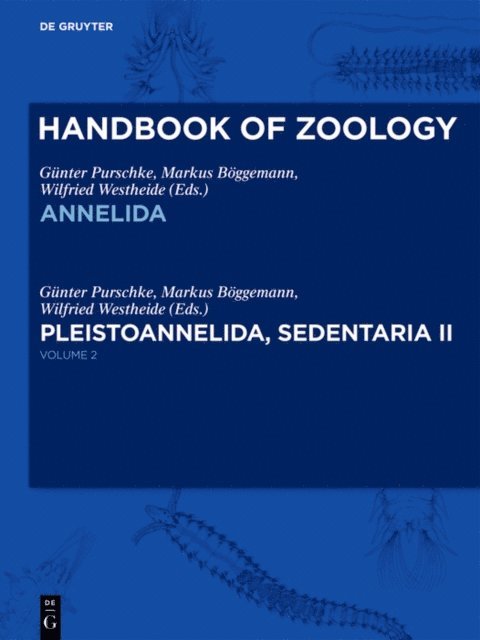
Pleistoannelida, Sedentaria II
Av Günter Purschke, Markus Böggemann m. fl.
Inbunden, 2020
3601 kr
Lägg i varukorg
This book is the second volume in a series of 4 volumes in the Handbook of Zoology series treating morphology, anatomy, reproduction, development, ecology, phylogeny, systematics and taxonomy of polychaetous Annelida. In this volume a comprehensive review of a few more derived higher taxa within …
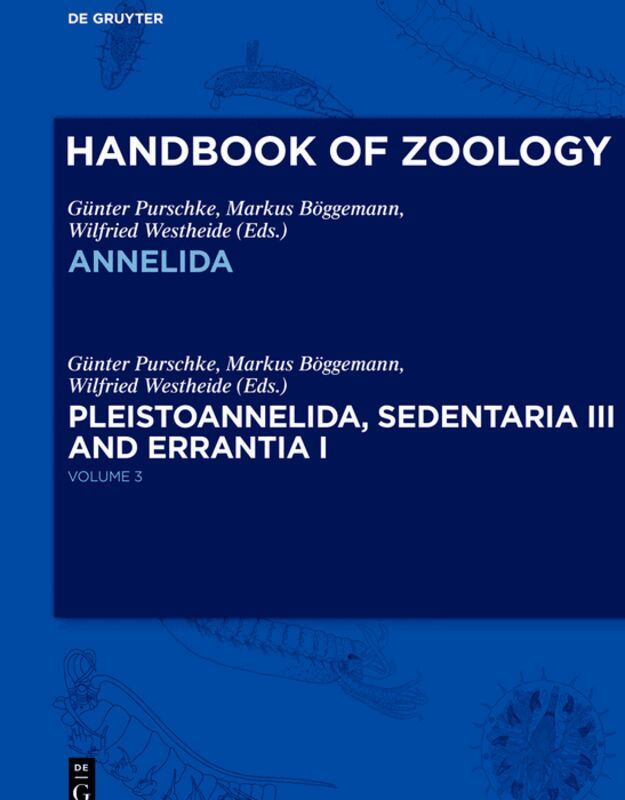
Pleistoannelida, Sedentaria III and Errantia I
Av Günter Purschke, Markus Böggemann m. fl.
Inbunden, 2020
4868 kr
Lägg i varukorg
This book is the third volume in a series of 4 volumes in the Handbook of Zoology series treating morphology, anatomy, reproduction, development, ecology, phylogeny, systematics and taxonomy of polychaetous Annelida. It is devoted to the remaining Sedentaria and the first branches of Errantia. …
Pleistoannelida, Sedentaria II
Av Wilfried Westheide, Andreas Schmidt-Rhaesa m. fl.
E-bok, 2020
4342 kr
Lägg i varukorg
This book is the second volume in a series of 4 volumes in the Handbook of Zoology series treating morphology, anatomy, reproduction, development, ecology, phylogeny, systematics and taxonomy of polychaetous Annelida. In this volume a comprehensive review of a few more derived higher taxa within …
Pleistoannelida, Sedentaria III and Errantia I
Av Wilfried Westheide, Andreas Schmidt-Rhaesa m. fl.
E-bok, 2020
4306 kr
Lägg i varukorg
This book is the third volume in a series of 4 volumes in the Handbook of Zoology series treating morphology, anatomy, reproduction, development, ecology, phylogeny, systematics and taxonomy of polychaetous Annelida. It is devoted to the remaining Sedentaria and the first branches of Errantia. …
Annelida Basal Groups and Pleistoannelida, Sedentaria I
Av Wilfried Westheide, Andreas Schmidt-Rhaesa m. fl.
E-bok, 2019
4342 kr
Lägg i varukorg
This book is the first in a series of 4 volumes in the Handbook of Zoology series about morphology, anatomy, reproduction, development, ecology, phylogeny and systematics of Annelida. This first volume covers members of the so-called basal radiation and the first part of Sedentaria. It is …
Gastrotricha and Gnathifera
E-bok, 2014
3757 kr
Lägg i varukorg
This section of the Handbook of Zoology is intended as a comprehensive and exhaustive account of the biology of the taxa Gastrotricha, Nematoda, Nematomorpha, Priapulida, Kinorhyncha, Loricifera, Gnathostomulida, Micrognathozoa, Rotifera, Seisonida and Acanthocephala, covering all relevant topics …
Pleistoannelida, Sedentaria II
Av Wilfried Westheide, Andreas Schmidt-Rhaesa m. fl.
E-bok, 2020
4204 kr
Lägg i varukorg
This book is the second volume in a series of 4 volumes in the Handbook of Zoology series treating morphology, anatomy, reproduction, development, ecology, phylogeny, systematics and taxonomy of polychaetous Annelida. In this volume a comprehensive review of a few more derived higher taxa within …
Pleistoannelida, Sedentaria III and Errantia I
Av Wilfried Westheide, Andreas Schmidt-Rhaesa m. fl.
E-bok, 2020
4306 kr
Lägg i varukorg
This book is the third volume in a series of 4 volumes in the Handbook of Zoology series treating morphology, anatomy, reproduction, development, ecology, phylogeny, systematics and taxonomy of polychaetous Annelida. It is devoted to the remaining Sedentaria and the first branches of Errantia. …
Miscellaneous Invertebrates
Inbunden, 2018
3719 kr
Lägg i varukorg
This volume of the Handbook of Zoology summarizes "small" groups of animals across the animal kingdom. Dicyemida and Orthonectida are enigmatic parasites, formerly united as "Mesozoa" and their position among the multicellular animals is still not known with certainty. Placozoa are small, flat …
Miscellaneous Invertebrates
E-bok, 2018
4342 kr
Lägg i varukorg
This volume of the Handbook of Zoology summarizes "small" groups of animals across the animal kingdom. Dicyemida and Orthonectida are enigmatic parasites, formerly united as "Mesozoa" and their position among the multicellular animals is still not known with certainty. Placozoa are small, flat …
Miscellaneous Invertebrates
E-bok, 2018
4484 kr
Lägg i varukorg
This volume of the Handbook of Zoology summarizes "small" groups of animals across the animal kingdom. Dicyemida and Orthonectida are enigmatic parasites, formerly united as "Mesozoa" and their position among the multicellular animals is still not known with certainty. Placozoa are small, flat …
Volume 1: Evolution, Systematics, and Biogeography
Av Andreas Schmidt-Rhaesa, Niels P. Kristensen
E-bok, 2013
3936 kr
Lägg i varukorg
Covering 100 years of zoological research, the Handbook of Zoology represents a vast store of knowledge. Handbook of Zoology provides an in-depth treatment of the entire animal kingdom covering both invertebrates and vertebrates. It publishes comprehensive overviews on animal systematics and …
Annelida 1-4
Inbunden, 2025
8002 kr
Lägg i varukorg
This set with a discount of 50 % compared to the single volumes includes the 4 Volumes in the Handbook of Zoology Annelida series. It covers morphology, anatomy, reproduction, development, ecology, phylogeny and systematics of Annelida. The segmented worms comprise one of the most important …
Nematoda
Inbunden, 2013
3117 kr
Tillfälligt slut
This section of the Handbook of Zoology is intended as a comprehensive and exhaustive account of the biology of the taxa Gastrotricha, Nematoda, Nematomorpha, Priapulida, Kinorhyncha, Loricifera, Gnathostomulida, Micrognathozoa, Rotifera, Seisonida and Acanthocephala, covering all relevant topics …