Andrew A. Chien - Böcker
Visar alla böcker från författaren Andrew A. Chien. Handla med fri frakt och snabb leverans.
2 produkter
2 produkter
1 494 kr
Skickas inom 10-15 vardagar
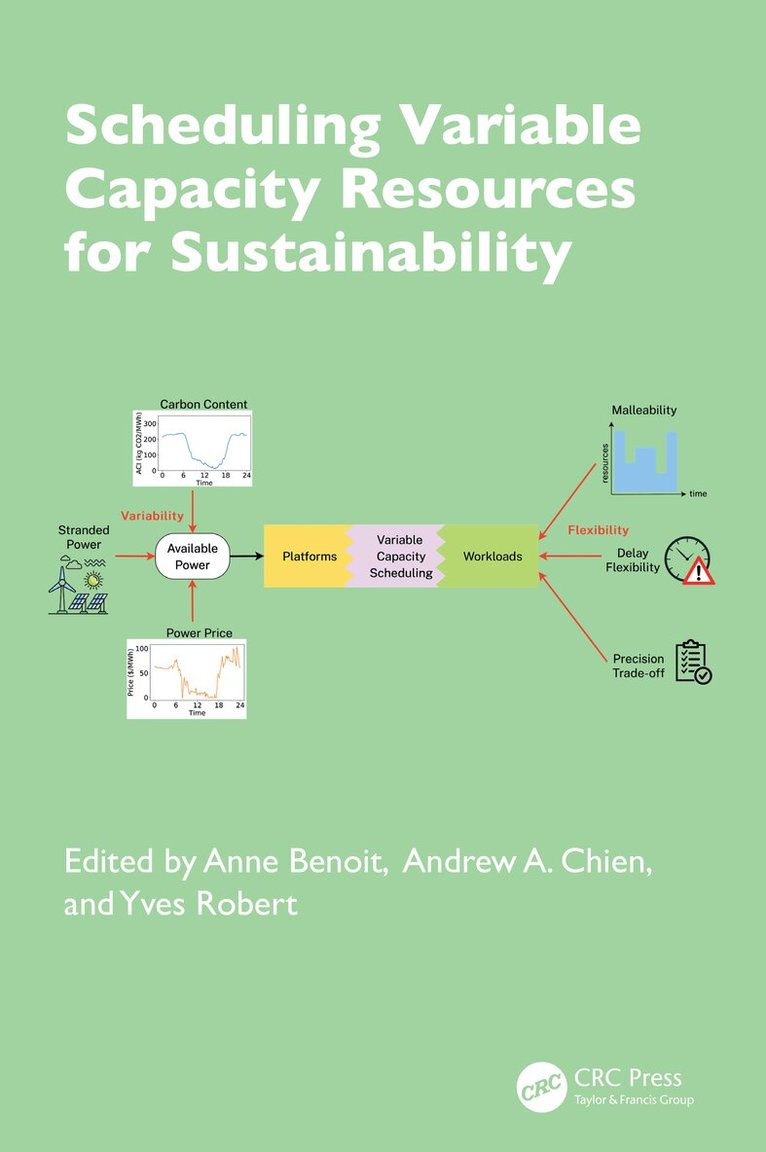
This book is the first to provide an overview of variable capacity scheduling and how it helps balance the growth of computing with its increasing environmental impact by creating more resilient and efficient systems that adapt to the dynamic nature of resource availability, optimizing utilization and minimizing disruptions. The book covers all aspects of variable capacity scheduling from a technical and a societal perspective. It considers the new age of renewable power generation and how computing services can contribute to sustainability and grid decarbonization. Contributors investigate techniques that can be deployed for schedulers to cope with, or even benefit from, changes in the number of computing resources and the nature of the power sources. They survey emerging computing devices, such as edge servers, as alternatives to classical cloud computing platforms; they identify applications for monitoring energy and regulating power; and they investigate energy minimization and risk-aware scheduling in real-time systems, asking: ‘How can a server with a variable processing speed schedule jobs with hard deadlines while minimizing its energy consumption?’ The authors address the societal impact of computing, exploring how the social sciences play a critical role in solving the computing sustainability challenge and including a holistic analysis of current and future approaches, taking the whole life-cycle and rebound effects into account. Presenting all the corresponding challenges and opportunities of variable capacity scheduling, this is an excellent introduction to the topic for students, researchers, computing scientists, or concerned citizens interested in sustainability.
681 kr
Skickas inom 7-10 vardagar
The dramatic increase in computer performance has been extraordinary, but not for all computations: it has key limits and structure. Software architects, developers, and even data scientists need to understand how exploit the fundamental structure of computer performance to harness it for future applications. Ideal for upper level undergraduates, Computer Architecture for Scientists covers four key pillars of computer performance and imparts a high-level basis for reasoning with and understanding these concepts: Small is fast - how size scaling drives performance; Implicit parallelism - how a sequential program can be executed faster with parallelism; Dynamic locality - skirting physical limits, by arranging data in a smaller space; Parallelism - increasing performance with teams of workers. These principles and models provide approachable high-level insights and quantitative modelling without distracting low-level detail. Finally, the text covers the GPU and machine-learning accelerators that have become increasingly important for mainstream applications.