Andrew Bacon - Böcker
Visar alla böcker från författaren Andrew Bacon. Handla med fri frakt och snabb leverans.
4 produkter
4 produkter
420 kr
Skickas inom 5-8 vardagar
Vagueness is the study of concepts that admit borderline cases: the property of being bald is vague because there are people who are neither definitely bald, nor definitely not bald. The epistemology of vagueness concerns the sorts of attitudes we ought to have towards propositions we know to be borderline. Is it possible to discover whether a borderline bald man is bald? Could two people with access to the same facts reasonably disagree about whether he is bald? Does it matter, when making practical decisions, whether he is bald? By drawing on such considerations, Andrew Bacon develops a novel theory of vagueness in which vagueness is fundamentally a property of propositions, and is explicated in terms of its role in thought. On this theory, language plays little role in explaining the central puzzles of vagueness.Part I of the book outlines some of the central questions regarding the logic and epistemology of vagueness, and criticizes some extant approaches to them. Part II concerns issues in the epistemology of vagueness, touching on the ramifications of vague thoughts on the study of evidence, ignorance, desire, probability theory, and decision theory. By examining the effects of vague information on one's beliefs about the precise, a positive theory of vagueness is proposed. Part III concerns the logic of vagueness, including the interaction between vagueness and modality, vague identity, and the paradoxes of higher-order vagueness. Bacon suggests that some familiar philosophical notions -- including the concept of a fundamental proposition, a possible world and a precisification -- need to be revised.
1 461 kr
Skickas inom 5-8 vardagar
Vagueness is the study of concepts that admit borderline cases: the property of being bald is vague because there are people who are neither definitely bald, nor definitely not bald. The epistemology of vagueness concerns the sorts of attitudes we ought to have towards propositions we know to be borderline. Is it possible to discover whether a borderline bald man is bald? Could two people with access to the same facts reasonably disagree about whether he is bald? Does it matter, when making practical decisions, whether he is bald? By drawing on such considerations, Andrew Bacon develops a novel theory of vagueness in which vagueness is fundamentally a property of propositions, and is explicated in terms of its role in thought. On this theory, language plays little role in explaining the central puzzles of vagueness.Part I of the book outlines some of the central questions regarding the logic and epistemology of vagueness, and criticizes some extant approaches to them. Part II concerns issues in the epistemology of vagueness, touching on the ramifications of vague thoughts on the study of evidence, ignorance, desire, probability theory, and decision theory. By examining the effects of vague information on one's beliefs about the precise, a positive theory of vagueness is proposed. Part III concerns the logic of vagueness, including the interaction between vagueness and modality, vague identity, and the paradoxes of higher-order vagueness. Bacon suggests that some familiar philosophical notions -- including the concept of a fundamental proposition, a possible world and a precisification -- need to be revised.
574 kr
Skickas inom 10-15 vardagar
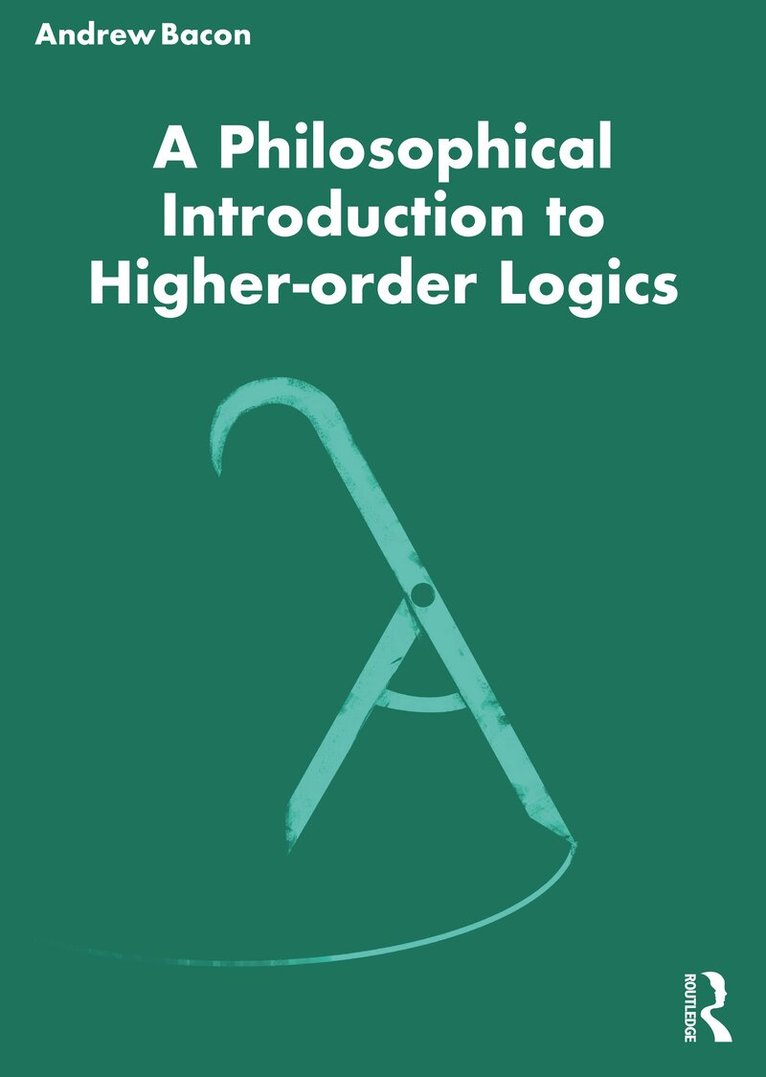
This is the first comprehensive textbook on higher-order logic that is written specifically to introduce the subject matter to graduate students in philosophy. The book covers both the formal aspects of higher-order languages—their model theory and proof theory, the theory of λ-abstraction and its generalizations—and their philosophical applications, especially to the topics of modality and propositional granularity. The book has a strong focus on non-extensional higher-order logics, making it more appropriate for foundational metaphysics than other introductions to the subject from computer science, mathematics, and linguistics. A Philosophical Introduction to Higher-order Logics assumes only that readers have a basic knowledge of first-order logic. With an emphasis on exercises, it can be used as a textbook though is also ideal for self-study.Author Andrew Bacon organizes the book's 18 chapters around four main parts:I. Typed LanguageII. Higher-Order LanguagesIII. General Higher-Order LanguagesIV. Higher-Order Model Theory In addition, two appendices cover the Curry-Howard isomorphism and its applications for modeling propositional structure. Each chapter includes exercises that move from easier to more difficult, strategically placed throughout the chapter, and concludes with an annotated suggested reading list providing graduate students with most valuable additional resources. Key Features: Is the first comprehensive introduction to higher-order logic as a grounding for addressing problems in metaphysicsIntroduces the basic formal tools that are needed to theorize in, and model, higher-order languagesOffers an abundance of- Simple exercises throughout the book, serving as comprehension checks on basic concepts and definitions- More difficult exercises designed to facilitate long-term learningContains annotated sections on further reading, pointing the reader to related literature, learning resources, and historical context
2 100 kr
Skickas inom 10-15 vardagar
This is the first comprehensive textbook on higher-order logic that is written specifically to introduce the subject matter to graduate students in philosophy. The book covers both the formal aspects of higher-order languages—their model theory and proof theory, the theory of λ-abstraction and its generalizations—and their philosophical applications, especially to the topics of modality and propositional granularity. The book has a strong focus on non-extensional higher-order logics, making it more appropriate for foundational metaphysics than other introductions to the subject from computer science, mathematics, and linguistics. A Philosophical Introduction to Higher-order Logics assumes only that readers have a basic knowledge of first-order logic. With an emphasis on exercises, it can be used as a textbook though is also ideal for self-study.Author Andrew Bacon organizes the book's 18 chapters around four main parts:I. Typed LanguageII. Higher-Order LanguagesIII. General Higher-Order LanguagesIV. Higher-Order Model Theory In addition, two appendices cover the Curry-Howard isomorphism and its applications for modeling propositional structure. Each chapter includes exercises that move from easier to more difficult, strategically placed throughout the chapter, and concludes with an annotated suggested reading list providing graduate students with most valuable additional resources. Key Features: Is the first comprehensive introduction to higher-order logic as a grounding for addressing problems in metaphysicsIntroduces the basic formal tools that are needed to theorize in, and model, higher-order languagesOffers an abundance of- Simple exercises throughout the book, serving as comprehension checks on basic concepts and definitions- More difficult exercises designed to facilitate long-term learningContains annotated sections on further reading, pointing the reader to related literature, learning resources, and historical context