Andrew Fuyarchuk – författare
Visar alla böcker från författaren Andrew Fuyarchuk. Handla med fri frakt och snabb leverans.
6 produkter
6 produkter
Inbunden, Engelska, 2010
428 kr
Skickas inom 5-8 vardagar
426 kr
Läs direkt efter köp
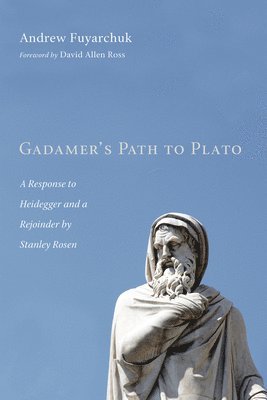
Gadamer''s Path to Plato investigates the formative years of Hans-Georg Gadamer''s Plato studies, while studying with Martin Heidegger at Marburg University. It outlines the evolution of Heidegger''s understanding of Plato, explains why his hermeneutics and phenomenological method inspired Gadamer, and why Heidegger''s argument, that Plato was responsible for Western civilization''s forgetting the meaning of existence, provoked him. Heidegger''s provocation was crucial to the development of Gadamer''s understanding of Plato. This book thus puts forward an argument for Gadamer''s having indirectly refuted Heidegger''s Plato. This involves a dialogical relationship to the past and a re-examination of the relation of Plato to Aristotle in matters of ethics, physics, and truth. Above all, however, it is Gadamer''s concept of Platonic dialectic that refutes Heidegger. This challenge to Heidegger''s Plato was commensurate with the origination of Gadamer''s positive hermeneutical philosophy. In order to test the alleged openness of that philosophy to the other as other Gadamer''s reading of the Republic is scrutinized by using the brilliant scholarship of Stanley Rosen. An examination of their interpretations of the Republic includes an inquiry into their intellectual influences. For Gadamer these include Hegel, the Tubingen school and Jacob Klein; for Rosen, the poetic genius of Leo Strauss. Rosen''s mathematical and poetic orientation is then compared to Gadamer''s dialectical orientation to Plato. The mathematical approach dovetails with a theory of human nature and procedural rationalism in Gadamer''s hermeneutical philosophy that explains why he, in contrast to Rosen, bypasses important dimensions of the Republic such as the significance of particular characters and settings to understanding the whole. In turn, this methodological shortcoming calls into question the truth of Gadamer''s method and, with it, the foundations of a truly open and pluralist society.
Inbunden, Engelska, 2017
1 368 kr
Skickas inom 10-15 vardagar
The inner word in Gadamer’s hermeneutics refers to the meaning that exceeds anything explicitly said. This explanation has been subsumed within metaphysical and theological parameters of interpretation with little regard for the implication of Gadamer’s turn to the living language for understanding the inner word. Through examining his phenomenology of the inner word, The Inner Voice in Gadamer’s Hermeneutics reveals its musical (rhythmic and tonal) dimensions and how they function to harmonize disparate orientations in the middle voice, above all for Gadamer, those that underlie modes of cognition in both the humanities and the sciences—a visual and auditory ethos. However, understood as constituting the music of language discernible in the middle voice, the inner word is also suppressed or forgotten by the technological extension of sight—that is, print—and thus requires a turn of the inner ear or auditory disposition. Andrew Fuyarchuk assesses theories of language in evolutionary and cognitive science in light of Gadamer’s insights into the nature of thought, and he employs them to account for a dimension of language that is inscribed in the lingual minds of our species. When recalled by the inner ear, this dimension enables us to think such opposites together as we find in the humanities and sciences together. This thinking together is expressed in a double account of an object of inquiry, such as the one Fuyarchuk puts forward about the inner word in Gadamer’s philosophical hermeneutics.
Häftad, Engelska, 2010
276 kr
Skickas inom 5-8 vardagar
Inbunden, Engelska, 2026
1 164 kr
Skickas inom 10-15 vardagar
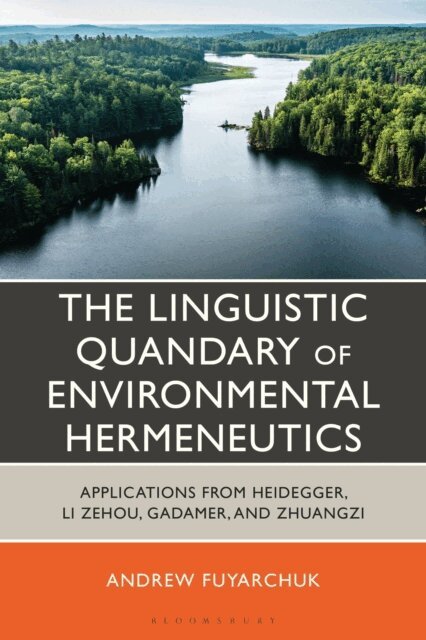
Within the context of the Age of the Anthropocene, this book outlines the existential preconditions for understanding the language of nature.Andrew Fuyarchuk uses environmental hermeneutics as an example of a social conundrum, which is traced to the barriers created by Heidegger to understand animals-in-their environment. In response to these barriers, the author draws on the anthropological ontology of Li Zehou and Daoist philosophy. In contrast to the tradition of metaphysics that overshadows Heidegger, these philosophies think about humans and nature within a “one-world view” and thereby provide the conceptual resources to redefine what it means to be a human being from the domain of “being-in-nature.” This entails a transformation in the meaning of existence that the author develops in terms of three Gadamerian dispositional preconditions for a hermeneutics of nature: empathetic bodily affinity, receptivity to ambient environments, and imitation as a way of knowing.
E-bok
PDF, Engelska, 2017251 kr
Läs direkt efter köp
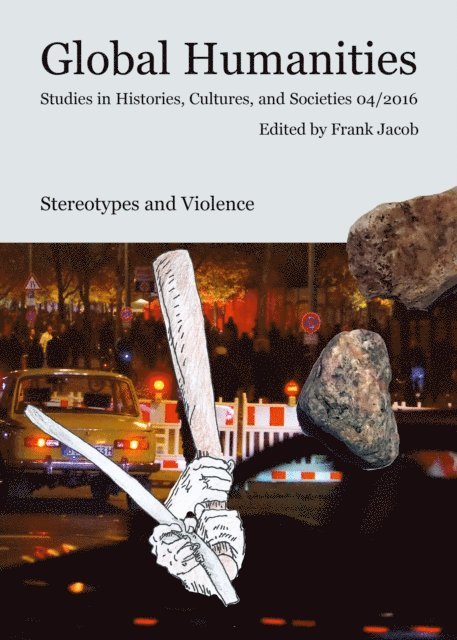
Stereotypes are dangerous, especially when they are used by demagogues. Slogans, which remind the historian of darker times in human history, however, reappear again in a growing number. As companions of the rise of right wing forces in Europe they make up ground in more and more regions and gain momentum in the political debate. It consequently seems to be more than important to focus on and closer analyze the interrelationship between stereo types and violence in modern societies.The fourth volume of Global Humanities tries to achieve such a broader analysis and provides reading in the fields of history, political science, gender and media studies. The authors show and emphasize in which ways the two above named factors are interacting with each other and influencing the popular opinion in modern nation states. Topics that are covered include Anti-Italian riots in Zurich at the end of the 19th century, a discussion of the interrelationship of racism and violence in Germany since the 1980s, and an analysis of gender based violence in Serbia. In addition, the persistence of stereo types in entertainment is closely studied by taking a look on Sinti and Roma depictions in current European films.