Andria Wisler - Böcker
Visar alla böcker från författaren Andria Wisler. Handla med fri frakt och snabb leverans.
3 produkter
3 produkter
1 261 kr
Tillfälligt slut
This introductory textbook surveys the evolutions of the histories, concepts, actors, actions, and pedagogies of the growing transdisciplinary field of Peace and Conflict Studies.The book provides an inclusive historical overview of the field and a thorough conceptual framework of peace, conflict, violence, and related terminology. It offers readers an introduction to the current issues dominating this growing academic field, as well as to the movements and structures that contribute to or hinder the creation of a more just and peaceful world. New, in-depth case studies will enable readers to understand the lived realities of peace action. From using this textbook, students will: develop a thorough understanding of the economic, socio-cultural, and political dimensions of peace and justice across the spectrum from micro- (neighborhood) to macro- (global) levels; become familiar with the array of inter/trans-national and local actors in the pursuit or destruction of peace and justice; and identify, compare, and critique the assumptions, benefits, and limitations of individuals’ and societies’ approaches to peace, including their own.Throughout, Peace Studies is understood as practical and do-able, with many applications from classrooms, to militaries, to transnational corporations. The book mainstreams issues often analyzed separately from traditional Peace Studies tracks, such as gender, religion, international development, climate change, and terrorism. This book will be essential reading for students of peace and conflict studies, conflict resolution and peace and justice courses, and recommended for students of war and conflict studies and IR/ Security Studies.
643 kr
Skickas inom 7-10 vardagar
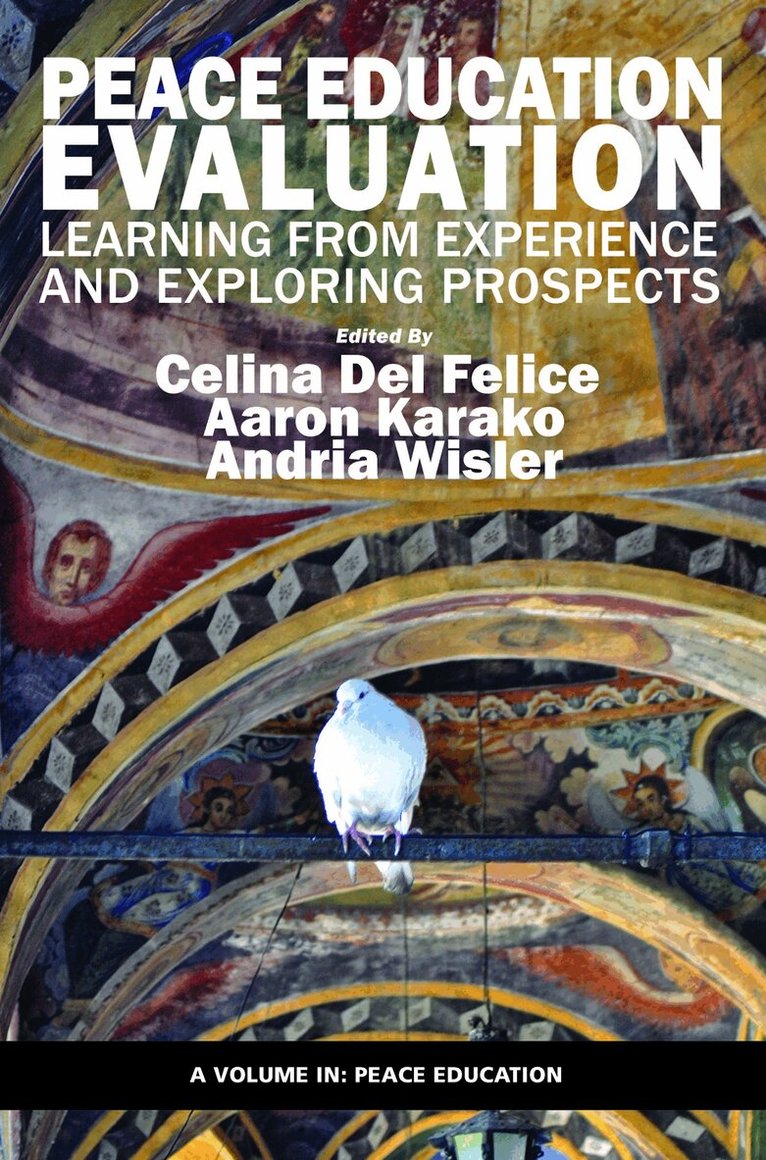
Practice and research of peace education has grown in the recent years as shown by a steadily increasing number of publications, programs, events, and funding mechanisms. The oft-cited point of departure for the peace education community is the belief in education as a valuable tool for decreasing the use of violence in conflict and for building cultures of positive peace hallmarked by just and equitable structures. Educators and organizations implementing peace education activities and programming, however, often lack the tools and capacities for evaluation and thus pay scant regard to this step in program management. Reasons for this inattention are related to the perceived urgency to prioritize new and more action in the context of scarce financial and human resources, notwithstanding violence or conflict; the lack of skills and time to indulge in a thorough evaluative strategy; and the absence of institutional incentives and support. Evaluation is often demand-driven by donors who emphasize accounting given the current context of international development assistance and budget cuts. Program evaluation is considered an added burden to already over-tasked programmers who are unaware of the incentives and of assessment techniques. Peace education practitioners are typically faced with forcing evaluation frameworks, techniques, and norms standardized for traditional education programs and venues. Together, these conditions create an unfavorable environment in which evaluation becomes under-valued, de-prioritized, and mythologized for its laboriousness.This volume serves three inter-related objectives. First, it offers a critical reflection on theoretical and methodological issues regarding evaluation applied to peace education interventions and programming. The overarching questions of the nature of peace and the principles guiding peace education, as well as governing theories and assumptions of change, transformation, and complexity are explored. Second, the volume investigates existing quantitative, qualitative, and mixed methods evaluation practices of peace educators in order to identify what needs related to evaluation persist among practitioners. Promising practices are presented from peace education programming in different settings (formal and non-formal education), within various groups (e.g. children, youth, police, journalists) and among diverse cultural contexts. Finally, the volume proposes ideas of evaluation, novel techniques for experimentation, and creative adaptation of tools from related fields, in order to offer pragmatic and philosophical substance to peace educators’ “next moves” and inspire the agenda for continued exploration and innovation. The authors come from variety of fields including education, peace and conflict studies, educational evaluation, development studies, comparative education, economics, and psychology.
1 089 kr
Skickas inom 7-10 vardagar
Practice and research of peace education has grown in the recent years as shown by a steadily increasing number of publications, programs, events, and funding mechanisms. The oft-cited point of departure for the peace education community is the belief in education as a valuable tool for decreasing the use of violence in conflict and for building cultures of positive peace hallmarked by just and equitable structures. Educators and organizations implementing peace education activities and programming, however, often lack the tools and capacities for evaluation and thus pay scant regard to this step in program management. Reasons for this inattention are related to the perceived urgency to prioritize new and more action in the context of scarce financial and human resources, notwithstanding violence or conflict; the lack of skills and time to indulge in a thorough evaluative strategy; and the absence of institutional incentives and support. Evaluation is often demand-driven by donors who emphasize accounting given the current context of international development assistance and budget cuts. Program evaluation is considered an added burden to already over-tasked programmers who are unaware of the incentives and of assessment techniques. Peace education practitioners are typically faced with forcing evaluation frameworks, techniques, and norms standardized for traditional education programs and venues. Together, these conditions create an unfavorable environment in which evaluation becomes under-valued, de-prioritized, and mythologized for its laboriousness.This volume serves three inter-related objectives. First, it offers a critical reflection on theoretical and methodological issues regarding evaluation applied to peace education interventions and programming. The overarching questions of the nature of peace and the principles guiding peace education, as well as governing theories and assumptions of change, transformation, and complexity are explored. Second, the volume investigates existing quantitative, qualitative, and mixed methods evaluation practices of peace educators in order to identify what needs related to evaluation persist among practitioners. Promising practices are presented from peace education programming in different settings (formal and non-formal education), within various groups (e.g. children, youth, police, journalists) and among diverse cultural contexts. Finally, the volume proposes ideas of evaluation, novel techniques for experimentation, and creative adaptation of tools from related fields, in order to offer pragmatic and philosophical substance to peace educators’ “next moves” and inspire the agenda for continued exploration and innovation. The authors come from variety of fields including education, peace and conflict studies, educational evaluation, development studies, comparative education, economics, and psychology.