Anita Guerrini - Böcker
Visar alla böcker från författaren Anita Guerrini. Handla med fri frakt och snabb leverans.
5 produkter
5 produkter
306 kr
Skickas inom 7-10 vardagar
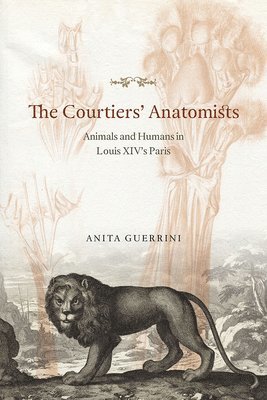
The Courtiers' Anatomists is about dead bodies and live animals in Louis XIV's Paris - and the surprising links between them. Examining the practice of seventeenth-century anatomy, Anita Guerrini reveals how anatomy and natural history were connected through animal dissection and vivisection. Driven by an insatiable curiosity, Parisian scientists, with the support of the king, dissected hundreds of animals from the royal menageries and the streets of Paris. Guerrini is the first to tell the story of Joseph-Guichard Duverney, who performed violent, riot-inducing dissections of both animal and human bodies before the king at Versailles and in front of hundreds of spectators at the King's Garden in Paris. At the Paris Academy of Sciences, meanwhile, Claude Perrault, with the help of Duverney's dissections, edited two folios in the 1670s filled with lavish illustrations by court artists of exotic royal animals.Through the stories of Duverney and Perrault, as well as those of Marin Cureau de la Chambre, Jean Pecquet, and Louis Gayant, The Courtiers' Anatomists explores the relationships between empiricism and theory, human and animal, as well as the origins of the natural history museum and the relationship between science and other cultural activities, including art, music, and literature.
2 492 kr
Skickas inom 10-15 vardagar
Bringing together diverse scholars to represent the full historical breadth of the early modern period, and a wide range of disciplines (literature, women's studies, folklore, ethnomusicology, art history, media studies, the history of science, and history), Ballads and Broadsides in Britain, 1500-1800 offers an unprecedented perspective on the development and cultural practice of popular print in early modern Britain. Fifteen essays explore major issues raised by the broadside genre in the early modern period: the different methods by which contemporaries of the sixteenth through nineteenth centuries collected and "appreciated" such early modern popular forms; the preoccupation in the early modern period with news and especially monsters; the concomitant fascination with and representation of crime and the criminal subject; the technology and formal features of early modern broadside print together with its bearing on gender, class, and authority/authorship; and, finally, the nationalizing and internationalizing of popular culture through crossings against (and sometimes with) cultural Others in ballads and broadsides of the time.
323 kr
Tillfälligt slut
Experimentation on animals and particularly humans is often assumed to be a uniquely modern phenomenon. But the ideas and attitudes that encourage the biological and medical sciences to experiment on living creatures date from the earliest expression of Western thought. In Animal and Human Experimentation, Anita Guerrini looks at the history of these practices from vivisection in ancient Alexandria to present-day battles over animal rights and medical research employing human subjects. Guerrini discusses in-depth key historical episodes in the use of living beings in science and medicine, including the discovery of blood circulation, the development of smallpox and polio vaccines, and recent AIDS research. She also explores the rise of the antivivisection movement in Victorian England, the modern animal rights movement, and current debates over gene therapy. In this highly accessible text, we learn how our understanding of an animal's capacity to feel pain has evolved. Guerrini reminds us that the ethical values of science seldom stray far from those of the society in which scientists live and work.Ethical questions about the use of animals and humans in research remain among the most vexing within both the scientific community and society at large. These often rancorous arguments have gone on, however, with little awareness of their historical antecedents. Animal and Human Experimentation offers students and concerned general readers on every side of this debate a context within which to understand more fully the responsibility we all bear for the suffering inflicted on other living beings in the name of scientific knowledge.
877 kr
Skickas inom 10-15 vardagar
Bringing together diverse scholars to represent the full historical breadth of the early modern period, and a wide range of disciplines (literature, women's studies, folklore, ethnomusicology, art history, media studies, the history of science, and history), Ballads and Broadsides in Britain, 1500-1800 offers an unprecedented perspective on the development and cultural practice of popular print in early modern Britain. Fifteen essays explore major issues raised by the broadside genre in the early modern period: the different methods by which contemporaries of the sixteenth through nineteenth centuries collected and "appreciated" such early modern popular forms; the preoccupation in the early modern period with news and especially monsters; the concomitant fascination with and representation of crime and the criminal subject; the technology and formal features of early modern broadside print together with its bearing on gender, class, and authority/authorship; and, finally, the nationalizing and internationalizing of popular culture through crossings against (and sometimes with) cultural Others in ballads and broadsides of the time.
320 kr
Skickas inom 7-10 vardagar
Examining the ideas and attitudes that encourage scientists to experiment on living creatures, what their justifications are, and how these have changed over time.Experimentation on animals—particularly humans—is often assumed to be a uniquely modern phenomenon. But the ideas and attitudes that encourage biological and medical scientists to experiment on living creatures date from the earliest expressions of Western thought. In Experimenting with Humans and Animals, Anita Guerrini looks at the history of these practices and examines the philosophical and ethical arguments that justified them.Guerrini discusses key historical episodes in the use of living beings in science and medicine, including the discovery of blood circulation, the development of smallpox and polio vaccines, and recent research in genetics, ecology, and animal behavior. She also explores the rise of the antivivisection movement in Victorian England, the modern animal rights movement, and current debates over gene therapy and genetically engineered animals. We learn how perceptions and understandings of human and animal pain have changed; how ideas of class, race, and gender have defined the human research subject; and that the ethical values of science seldom stray far from the society in which scientists live and work.Thoroughly rewritten and updated, with new material in every chapter, the book emphasizes a broader understanding of experimentation and adds material on gene therapy, self-experimentation, and prisoners and slaves as experimental subjects. A new chapter brings the story up to the present while reflecting on the current regulatory scene, new developments in science, and emerging genomics. Experimenting with Humans and Animals offers readers a context within which to understand more fully the responsibility we all bear for the suffering inflicted on other living beings in the name of scientific knowledge.