Anna Basso – författare
Visar alla böcker från författaren Anna Basso. Handla med fri frakt och snabb leverans.
8 produkter
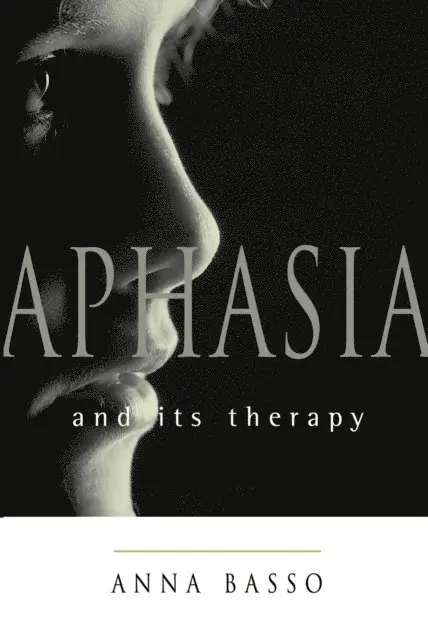
Aphasia and Its Therapy
Av Anna Basso
E-bok, 2003
831 kr
Lägg i varukorg
This is the first single-authored book to attempt to bridge the gap between aphasia research and the rehabilitation of patients with this language disorder. Studies of the deficits underlying aphasia and the practice of aphasia rehabilitation have often diverged, and the relationship between theory …
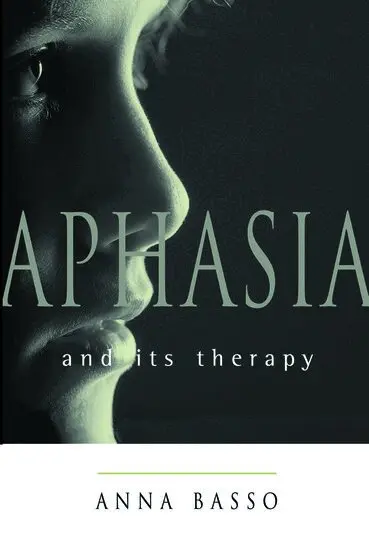
Aphasia and Its Therapy
Av Anna Basso
Inbunden, 2003
1526 kr
Lägg i varukorg
This is the first single-authored book to attempt to bridge the gap between aphasia research and the rehabilitation of patients with this language disorder. Studies of the deficits underlying aphasia and the practice of aphasia rehabilitation have often diverged, and the relationship between theory …
Aphasia and Its Therapy
Av Anna Basso
E-bok, 2003
831 kr
Lägg i varukorg
This is the first single-authored book to attempt to bridge the gap between aphasia research and the rehabilitation of patients with this language disorder. Studies of the deficits underlying aphasia and the practice of aphasia rehabilitation have often diverged, and the relationship between theory …
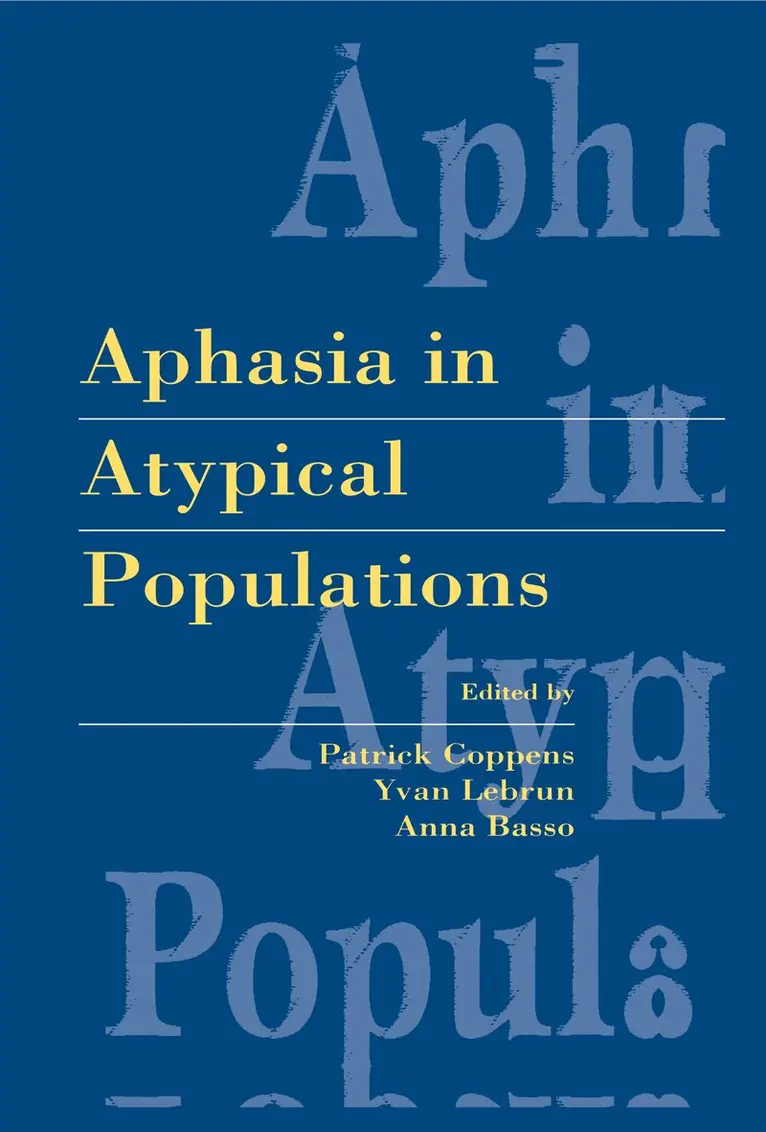
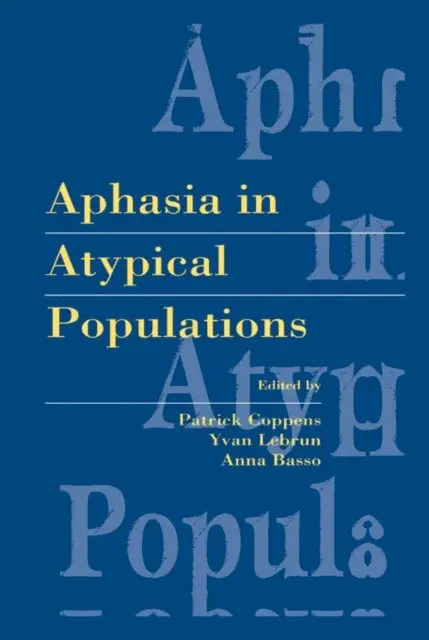
Aphasia in Atypical Populations
Av Patrick Coppens, Yvan Lebrun m. fl.
Inbunden, 1998
2516 kr
Lägg i varukorg
Theory and research in aphasiology have typically concentrated on a limited population--right-handed adult monolinguals whose language uses an alphabetic code. Bilingual individuals, ideographical code users, and children (among others) have been separated out. This book examines the available data …
Aphasia in Atypical Populations
Av Anna Basso, Yvan Lebrun m. fl.
E-bok, 2012
1106 kr
Lägg i varukorg
Theory and research in aphasiology have typically concentrated on a limited population--right-handed adult monolinguals whose language uses an alphabetic code. Bilingual individuals, ideographical code users, and children (among others) have been separated out. This book examines the available data …
Aphasia in Atypical Populations
Av Anna Basso, Yvan Lebrun m. fl.
E-bok, 2012
1106 kr
Lägg i varukorg
Theory and research in aphasiology have typically concentrated on a limited population--right-handed adult monolinguals whose language uses an alphabetic code. Bilingual individuals, ideographical code users, and children (among others) have been separated out. This book examines the available data …
Aphasia in Atypical Populations
Av Patrick Coppens, Yvan Lebrun m. fl.
Häftad, 2015
938 kr
Lägg i varukorg
Theory and research in aphasiology have typically concentrated on a limited population--right-handed adult monolinguals whose language uses an alphabetic code. Bilingual individuals, ideographical code users, and children (among others) have been separated out. This book examines the available data …
Cognitive Neuropsychology and Language Rehabilitation
A Special Issue of Neuropsychological Rehabilitation
Av Anna Basso, Stefano Cappa m. fl.
Häftad, 2002
711 kr
Lägg i varukorg
Even if, in recent years, the study of language disorders in brain-damaged patients has been strongly influenced by models and experimental paradigms of cognitive neuropsychology, much less relevant has been the impact of this new approach to language rehabilitation. Contrasting opinions exist on …