Anna Everett - Böcker
Visar alla böcker från författaren Anna Everett. Handla med fri frakt och snabb leverans.
8 produkter
8 produkter
77 kr
Tillfälligt slut
95 kr
Tillfälligt slut
2 088 kr
Skickas inom 10-15 vardagar
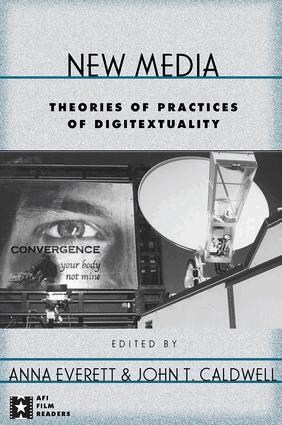
The mushroom-like growth of new media technologies is radically challenging traditional media outlets. The proliferation of technologies like DVDs, MP3s and the Internet has freed the public from what we used to understand as mass media. In the face of such seismic shifts and ruptures, the theoretical and pedagogical foundations of film and TV studies are being shaken to their core. New Media demands a necessary rethinking of the field. Writing from a range of disciplines and perspectives, the scholars here outline new theses and conceptual frameworks capable of engaging the numerous facets of emergent digital technology.
563 kr
Skickas inom 10-15 vardagar
The mushroom-like growth of new media technologies is radically challenging traditional media outlets. The proliferation of technologies like DVDs, MP3s and the Internet has freed the public from what we used to understand as mass media. In the face of such seismic shifts and ruptures, the theoretical and pedagogical foundations of film and TV studies are being shaken to their core. New Media demands a necessary rethinking of the field. Writing from a range of disciplines and perspectives, the scholars here outline new theses and conceptual frameworks capable of engaging the numerous facets of emergent digital technology.
1 057 kr
Tillfälligt slut
Traces the rise of black participation in cyberspace.2009 CHOICE Outstanding Academic Title Deftly interweaving history, culture, and critical theory, Anna Everett traces the rise of black participation in cyberspace, particularly during the early years of the Internet. She challenges the problematic historical view of black people as quintessential information-age outsiders or poster children for the digital divide by uncovering their early technolust and repositioning them as eager technology adopters and consumers, and thus as coconstituent elements in the information technology revolution. She offers several case studies that include lessons learned from early adoption of the Internet by the Association of Nigerians Living Abroad and their Niajanet virtual community, the grassroots organizing efforts that led to the phenomenally successful Million Woman March, the migration of several historic black presses online, and an interventionist critique of race in contemporary video games. Ultimately, Digital Diaspora shows how African Americans and African diasporic peoples developed the necessary technomastery to ride in the front of the bus on the information superhighway.
353 kr
Skickas inom 7-10 vardagar
Traces the rise of black participation in cyberspace.2009 CHOICE Outstanding Academic Title Deftly interweaving history, culture, and critical theory, Anna Everett traces the rise of black participation in cyberspace, particularly during the early years of the Internet. She challenges the problematic historical view of black people as quintessential information-age outsiders or poster children for the digital divide by uncovering their early technolust and repositioning them as eager technology adopters and consumers, and thus as coconstituent elements in the information technology revolution. She offers several case studies that include lessons learned from early adoption of the Internet by the Association of Nigerians Living Abroad and their Niajanet virtual community, the grassroots organizing efforts that led to the phenomenally successful Million Woman March, the migration of several historic black presses online, and an interventionist critique of race in contemporary video games. Ultimately, Digital Diaspora shows how African Americans and African diasporic peoples developed the necessary technomastery to ride in the front of the bus on the information superhighway.
454 kr
Skickas inom 7-10 vardagar
In the 1990s, American civil society got upended and reordered as many social, cultural, political, and economic institutions were changed forever. Pretty People examines a wide range of Hollywood icons who reflect how stardom in that decade was transformed as the nation itself was signaling significant changes to familiar ideas about gender, race, ethnicity, age, class, sexuality, and nationality.Such actors as Denzel Washington, Andy Garcia, Halle Berry, Angela Bassett, Will Smith, Jennifer Lopez, and Antonio Banderas became bona fide movie stars who carried major films to amazing box-office success. Five of the decade’s top ten films were opened by three women—Julia Roberts, Jodie Foster, and Whoopi Goldberg. “Chick flick” entered the lexicon as Leonardo DiCaprio became the “King of the World,” ushering in the cult of the mega celebrity. Tom Hanks and Tom Cruise defined screen masculinity as stark contrasts between “the regular guy” and “the intense guy” while the roles of Michael Douglas exemplified the endangered “Average White Male.” A fascinating composite portrait of 1990s Hollywood and its stars, this collection marks the changes to stardom and society at century’s end.
415 kr
Skickas inom 7-10 vardagar
In Returning the Gaze Anna Everett revises American film history by recuperating the extensive and all-but-forgotten participation of black film critics during the early twentieth century. While much of the existing scholarship on blacks and the cinema focuses on image studies and stereotypical representations, this work excavates a wealth of early critical writing on the cinema by black cultural critics, academics, journalists, poets, writers, and film fans.Culling black newspapers, magazines, scholarly and political journals, and monographs, Everett has produced an unparalleled investigation of black critical writing on the early cinema during the era of racial segregation in America. Correcting the notion that black critical interest in the cinema began and ended with the well-documented press campaign against D. W. Griffith’s Birth of a Nation, she discovers that as early as 1909 black newspapers produced celebratory discourses about the cinema as a much-needed corrective to the predominance of theatrical blackface minstrelsy. She shows how, even before the Birth of a Nation controversy, the black press succeeded in drawing attention to both the callous commercial exploitation of lynching footage and the varied work of black film entrepreneurs. The book also reveals a feast of film commentaries that were produced during the “roaring twenties” and the jazz age by such writers as W.E.B. DuBois, Langston Hughes, and Zora Neale Hurston, as well as additional pieces that were written throughout the Depression and the pre– and post–war periods. Situating this wide-ranging and ideologically complex material in its myriad social, political, economic, and cultural contexts, Everett aims to resuscitate a historical tradition for contemporary black film literature and criticism. Returning the Gaze will appeal to scholars and students of film, black and ethnic studies, American studies, cultural studies, literature, and journalism.