Annette Kur – författare
Visar alla böcker från författaren Annette Kur. Handla med fri frakt och snabb leverans.
21 produkter
European Intellectual Property Law
Text, Cases and Materials: Second Edition
Av Annette Kur, Thomas Dreier m. fl.
Häftad, 2019
754 kr
Lägg i varukorg
The second edition of this popular textbook has been thoroughly revised, expanded and updated in order to reflect the recent extensive changes in European IP legislation. Providing an in-depth examination of the core areas of IP law, from copyright, patents and trademarks through to the protection …
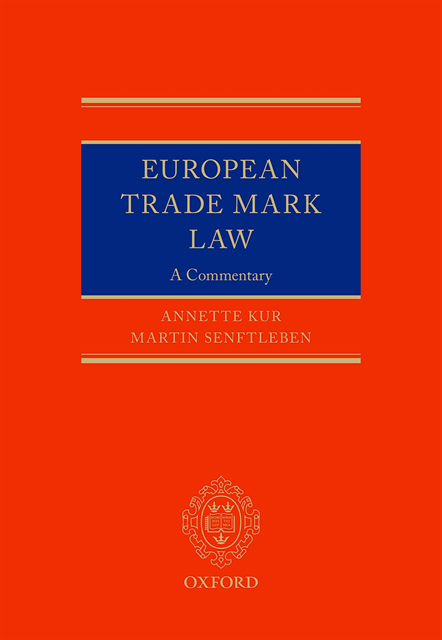
European Trade Mark Law
Av Martin Senftleben, Annette Kur
E-bok, 2017
4554 kr
Lägg i varukorg
European Trade Mark Law provides a coherent and authoritative commentary on both the substantive and procedural aspects of European trade mark law. It presents an integrated picture of the two major trade mark law provisions at EU level: the Community Trade Mark Regulation (CMTR), which provides …
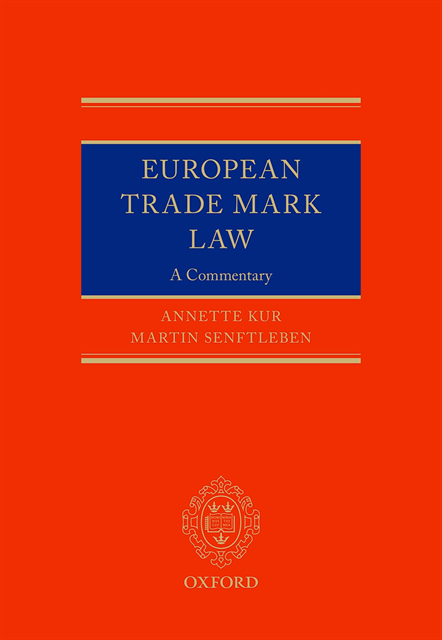
European Trade Mark Law
Av Martin Senftleben, Annette Kur
E-bok, 2017
4554 kr
Lägg i varukorg
European Trade Mark Law provides a coherent and authoritative commentary on both the substantive and procedural aspects of European trade mark law. It presents an integrated picture of the two major trade mark law provisions at EU level: the Community Trade Mark Regulation (CMTR), which provides …
Structure of Intellectual Property Law
Can One Size Fit All?
Av Vytautas Mizaras, Annette Kur
E-bok, 2011
422 kr
Lägg i varukorg
This well-researched and highly topical book analyzes whether the ever-increasing degree of sophistication in intellectual property law necessarily leads to fragmentation and inconsistency, or whether the common principles informing the system are sustainable enough to offer a solid and resilient …
Intellectual Property, Unfair Competition and Publicity
Convergences and Development
Av Nari Lee, Guido Westkamp m. fl.
Inbunden, 2014
2224 kr
Lägg i varukorg
Dealing with rights and developments at the margin of classic intellectual property, this fascinating book explores emerging types of regulations and how existing IP regimes inform and influence the judicial and legislative creation of 'substitute' IP rights.The editors have carefully structured …
Intellectual Property, Unfair Competition and Publicity
Convergences and Development
Av Ansgar Ohly, Annette Kur m. fl.
E-bok, 2014
413 kr
Lägg i varukorg
Dealing with rights and developments at the margin of classic intellectual property, this fascinating book explores emerging types of regulations and how existing IP regimes inform and influence the judicial and legislative creation of ''substitute'' IP rights. The editors have carefully structured …
European Intellectual Property Law
Third Edition
Av Annette Kur, Daniël Jongsma m. fl.
Inbunden, 2027
3095 kr
Kommande
Expanded and updated to reflect the recent extensive changes in European intellectual property (IP) law, the third edition of this popular textbook provides engaging, insightful coverage of the field of IP in a manner that allows students and other readers to grasp the fundamentals as well as the …
European Intellectual Property Law
Third Edition
Av Annette Kur, Daniël Jongsma m. fl.
Häftad, 2027
643 kr
Kommande
Expanded and updated to reflect the recent extensive changes in European intellectual property (IP) law, the third edition of this popular textbook provides engaging, insightful coverage of the field of IP in a manner that allows students and other readers to grasp the fundamentals as well as the …
Fairness in Intellectual Property Law
Searching for a Uniform Concept
Av Anna Tischner, Nari Lee m. fl.
E-bok, 2024
413 kr
Lägg i varukorg
This book contends that the concept of fairness should be embraced and developed as a middle ground between strictly utilitarian and fundamental rights-based approaches to intellectual property (IP) law.Annette Kur, Nari Lee and Anna Tischner provide elegant arguments as to why this should be the …
European Intellectual Property Law
Text, Cases and Materials: Second Edition
Av Annette Kur, Thomas Dreier m. fl.
Inbunden, 2019
2825 kr
Lägg i varukorg
The second edition of this popular textbook has been thoroughly revised, expanded and updated in order to reflect the recent extensive changes in European IP legislation. Providing an in-depth examination of the core areas of IP law, from copyright, patents and trademarks through to the protection …
European Intellectual Property Law
Text, Cases and Materials: Second Edition
Av Stefan Luginbuehl, Thomas Dreier m. fl.
E-bok, 2019
710 kr
Lägg i varukorg
The second edition of this popular textbook has been thoroughly revised, expanded and updated in order to reflect the recent extensive changes in European IP legislation. Providing an in-depth examination of the core areas of IP law, from copyright, patents and trademarks through to the protection …
EU Design Approach
A Global Appraisal
Av Annette Kur, Marianne Levin m. fl.
Inbunden, 2018
1843 kr
Lägg i varukorg
EU legislation for the protection of designs has been described as a 'third way’'in contrast to traditional concepts of design protection. This book provides a thorough appraisal of the EU's unique Design Approach; assessing its formation, development and impact over the past decade.The EU Design …
EU Design Approach
A Global Appraisal
Av Jens Schovsbo, Marianne Levin m. fl.
E-bok, 2018
422 kr
Lägg i varukorg
EU legislation for the protection of designs has been described as a ''third way’''in contrast to traditional concepts of design protection. This book provides a thorough appraisal of the EU''s unique Design Approach; assessing its formation, development and impact over the past decade. The EU …
Fairness in Intellectual Property Law
Searching for a Uniform Concept
Av Annette Kur, Nari Lee m. fl.
Inbunden, 2024
2223 kr
Lägg i varukorg
This book contends that the concept of fairness should be embraced and developed as a middle ground between strictly utilitarian and fundamental rights-based approaches to intellectual property (IP) law.Annette Kur, Nari Lee and Anna Tischner provide elegant arguments as to why this should be the …
Fairness in Intellectual Property Law
Searching for a Uniform Concept
Av Anna Tischner, Nari Lee m. fl.
E-bok, 2024
25 kr
Lägg i varukorg
This book contends that the concept of fairness should be embraced and developed as a middle ground between strictly utilitarian and fundamental rights-based approaches to intellectual property (IP) law. Annette Kur, Nari Lee and Anna Tischner provide elegant arguments as to why this should be the …
Intellectual Property and Private International Law
Heading for the Future
Häftad, 2005
1825 kr
Lägg i varukorg
The relationship between intellectual property and private international law is a fascinating and multi-faceted one. Both fields are inherently international, but it is the exponential increase in conflicts involving trans-border elements, in a world characterised by global trade and borderless …
Intellectual Property and Private International Law
Heading for the Future
E-bok, 2005
2007 kr
Lägg i varukorg
The relationship between intellectual property and private international law is a fascinating and multi-faceted one. Both fields are inherently international, but it is the exponential increase in conflicts involving trans-border elements, in a world characterised by global trade and borderless …
Structure of Intellectual Property Law
Can One Size Fit All?
Av Annette Kur, Vytautas Mizaras
Inbunden, 2011
2572 kr
Lägg i varukorg
This well-researched and highly topical book analyzes whether the ever-increasing degree of sophistication in intellectual property law necessarily leads to fragmentation and inconsistency, or whether the common principles informing the system are sustainable enough to offer a solid and resilient …
Intellectual Property Rights in a Fair World Trade System
Proposals for Reform of TRIPS
Av Annette Kur
Inbunden, 2011
3063 kr
Lägg i varukorg
This important new book constitutes a serious examination of both the positive potential, as well as the deficiencies, of the TRIPS agreement. In the light of their analysis, the editors and their colleagues make a powerful case for wide ranging reforms.Intellectual Property (IP) law – particularly …
Intellectual Property Rights in a Fair World Trade System
Proposals for Reform of TRIPS
Av Annette Kur
E-bok, 2011
422 kr
Lägg i varukorg
This important new book constitutes a serious examination of both the positive potential, as well as the deficiencies, of the TRIPS agreement. In the light of their analysis, the editors and their colleagues make a powerful case for wide ranging reforms. Intellectual Property (IP) law – …