Anthony D. Barnosky - Böcker
Visar alla böcker från författaren Anthony D. Barnosky. Handla med fri frakt och snabb leverans.
5 produkter
5 produkter
290 kr
Tillfälligt slut
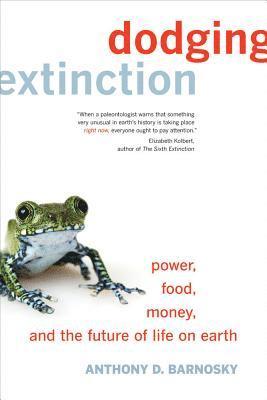
Paleobiologist Anthony D. Barnosky weaves together evidence from the deep past and the present to alert us to the looming Sixth Mass Extinction and to offer a practical, hopeful plan for avoiding it. Writing from the front lines of extinction research, Barnosky tells the overarching story of geologic and evolutionary history and how it informs the way humans inhabit, exploit, and impact Earth today. He presents compelling evidence that unless we rethink how we generate the power we use to run our global ecosystem, where we get our food, and how we make our money, we will trigger what would be the sixth great extinction on Earth, with dire consequences. Optimistic that we can change this ominous forecast if we act now, Barnosky provides clear-cut strategies to guide the planet away from global catastrophe. In many instances the necessary technology and know-how already exist and are being applied to crucial issues around human-caused climate change, feeding the world's growing population, and exploiting natural resources. Deeply informed yet accessibly written, Dodging Extinction is nothing short of a guidebook for saving the planet.
242 kr
Skickas inom 7-10 vardagar
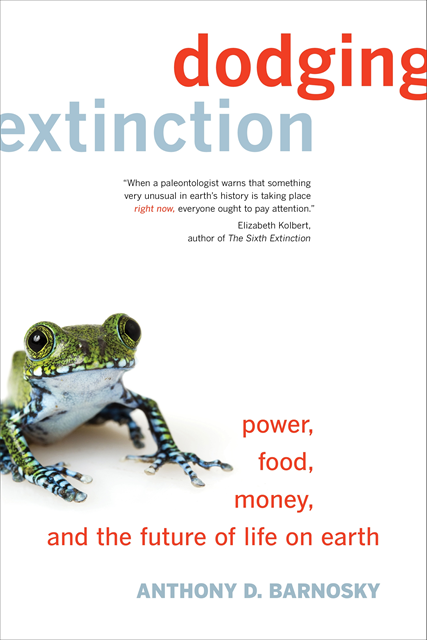
Paleobiologist Anthony D. Barnosky weaves together evidence from the deep past and the present to alert us to the looming Sixth Mass Extinction and to offer a practical, hopeful plan for avoiding it. Writing from the front lines of extinction research, Barnosky tells the overarching story of geologic and evolutionary history and how it informs the way humans inhabit, exploit, and impact Earth today. He presents compelling evidence that unless we rethink how we generate the power we use to run our global ecosystem, where we get our food, and how we make our money, we will trigger what would be the sixth great extinction on Earth, with dire consequences. Optimistic that we can change this ominous forecast if we act now, Barnosky provides clear-cut strategies to guide the planet away from global catastrophe. In many instances the necessary technology and know-how already exist and are being applied to crucial issues around human-caused climate change, feeding the world's growing population, and exploiting natural resources. Deeply informed yet accessibly written, Dodging Extinction is nothing short of a guidebook for saving the planet.
586 kr
Skickas inom 7-10 vardagar
This 1993 book examines case studies of North American Quaternary mammalian evolution within the larger domain of evolutionary theory. It presents studies of a variety of taxa (xenarthrans, rodents, carnivores, ungulates) examined over several temporal scales, from a few thousand years during the Holocene to millions of years of late Pliocene and Pleistocene time. Different organisational levels are represented, from mosaic population variation, to a synopsis of Quaternary evolution of an entire order (Rodentia). The book also includes purely theoretical and methodological contributions, for example, on the statistical recognition of stasis in the fossil record, ways to calculate evolutionary rates, and the use of digital image analysis in the study of dental ontogeny. Perhaps the most important aspect of the studies reported in this book is that they span the time between the 'ecological moment' and 'deep time'. The book will interest vertebrate palaeontologists, ecologists concerned with the origin of biological diversity and also evolutionists interested in the competing evolutionary models.
1 719 kr
Skickas inom 7-10 vardagar
This 1993 book examines case studies of North American Quaternary mammalian evolution within the larger domain of evolutionary theory. It presents studies of a variety of taxa (xenarthrans, rodents, carnivores, ungulates) examined over several temporal scales, from a few thousand years during the Holocene to millions of years of late Pliocene and Pleistocene time. Different organisational levels are represented, from mosaic population variation, to a synopsis of Quaternary evolution of an entire order (Rodentia). The book also includes purely theoretical and methodological contributions, for example, on the statistical recognition of stasis in the fossil record, ways to calculate evolutionary rates, and the use of digital image analysis in the study of dental ontogeny. Perhaps the most important aspect of the studies reported in this book is that they span the time between the 'ecological moment' and 'deep time'. The book will interest vertebrate palaeontologists, ecologists concerned with the origin of biological diversity and also evolutionists interested in the competing evolutionary models.
329 kr
Skickas inom 7-10 vardagar
How is wildlife adapting to climate change? In 2006, one of the hottest years on record, a 'pizzly' was discovered near the top of the world. Half polar bear, half grizzly, this never-before-seen animal might be dismissed as a fluke of nature. Anthony Barnosky instead sees it as a harbinger of things to come. In "Heatstroke", the renowned paleoecologist shows how global warming is fundamentally changing the natural world and its creatures. While melting ice may have helped produce the pizzly, climate change is more likely to wipe out species than to create them. Plants and animals that have followed the same rhythms for millennia are suddenly being confronted with a world they're unprepared for - and adaptation usually isn't an option. This is not the first time climate change has dramatically transformed Earth. Barnosky draws connections between the coming centuries and the end of the last ice age, when mass extinctions swept the planet. The differences now are that climate change is faster and hotter than past changes, and for the first time humanity is driving it. Which means this time we can work to stop it.No one knows exactly what nature will come to look like in this new age of global warming. But "Heatstroke" gives us a haunting portrait of what we stand to lose and the vitality of what can be saved.