Anton Vedder - Böcker
Visar alla böcker från författaren Anton Vedder. Handla med fri frakt och snabb leverans.
2 produkter
2 produkter
Del 7 - KU Leuven Centre for IT & IP Law Series
Security and Law
Legal and Ethical Aspects of Public Security, Cyber Security and Critical Infrastructure Security
Inbunden, Engelska, 2019
1 367 kr
Skickas inom 5-8 vardagar
Security and law against the backdrop of technological development.Few people doubt the importance of the security of a state, its society and its organizations, institutions and individuals, as an unconditional basis for personal and societal flourishing. Equally, few people would deny being concerned by the often occurring conflicts between security and other values and fundamental freedoms and rights, such as individual autonomy or privacy for example. While the search for a balance between these public values is far from new, ICT and data-driven technologies have undoubtedly given it a new impulse. These technologies have a complicated and multifarious relationship with security.This book combines theoretical discussions of the concepts at stake and case studies following the relevant developments of ICT and data-driven technologies. Part I sets the scene by considering definitions of security. Part II questions whether and, if so, to what extent the law has been able to regulate the use of ICT and datadriven technologies as a means to maintain, protect or raise security, in search of a balance between security and other public values, such as privacy and equality. Part III investigates the regulatory means that can be leveraged by the law-maker in attempts to secure products, organizations or entities in a technological and multiactor environment. Lastly, Part IV, discusses typical international and national aspects of ICT, security and the law.
Del 72 - Nijhoff Law Specials
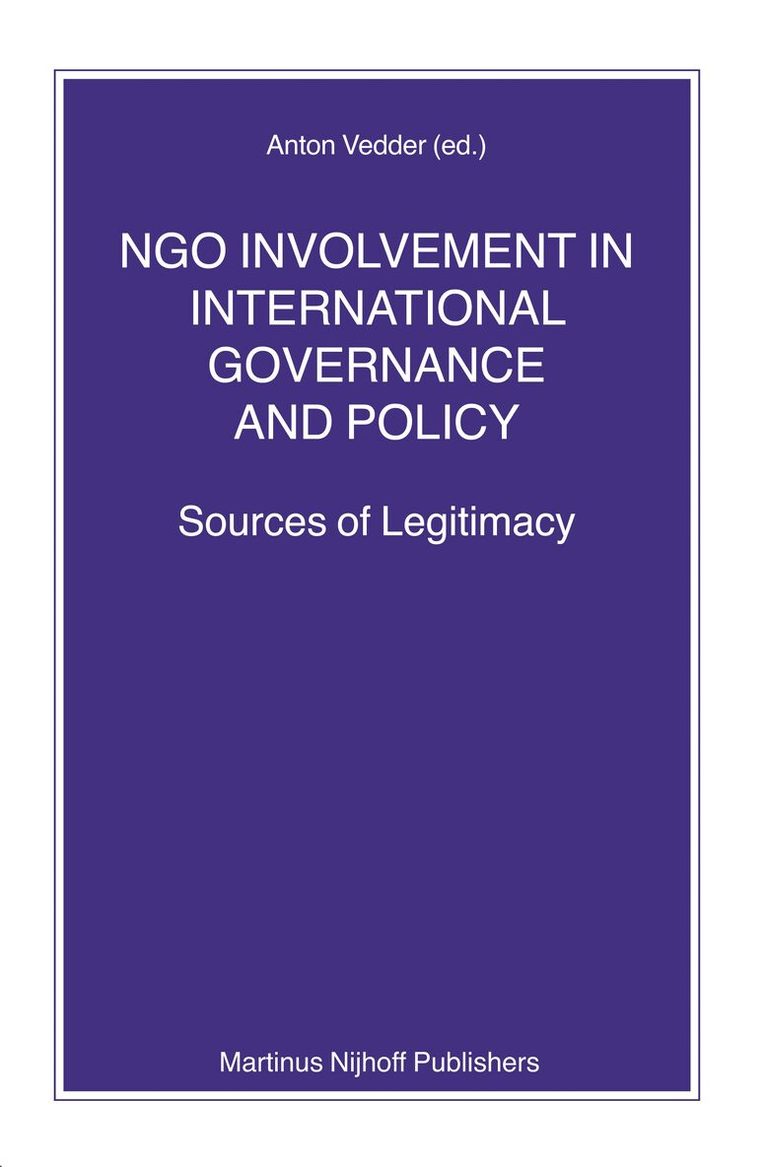
NGO Involvement in International Governance and Policy
Sources of Legitimacy
Häftad, Engelska, 2007
1 929 kr
Skickas inom 5-8 vardagar
Internationally operating nongovernmental organisations, NGOs, are increasingly involved in international politics and policy making. In many respects their involvement resembles activities and policies that, until recently, were typical of traditional national authorities. This book is about the reasons for which NGOs can and the reasons for which NGOs cannot be considered as rightful participants in international governance. It tries to deliver rationally defensible starting points for the discussion and the assessment of claims for the legitimacy of their organizations and activities. The book focuses on the question: What conditions must ideally be met for an organization to be called truthfully legitimate, be it or be it not as a matter of fact perceived as legitimate by the public? This does not mean that empirically descriptive questions are left aside. Practical feasibility is important even to a thoroughly normative conception of legitimacy. For that reason and for heuristic purposes, large parts of this book are dedicated to the ways in which NGOs and stakeholders perceive NGO legitimacy.