Ariel Porat - Böcker
Visar alla böcker från författaren Ariel Porat. Handla med fri frakt och snabb leverans.
7 produkter
7 produkter
611 kr
Skickas inom 3-6 vardagar
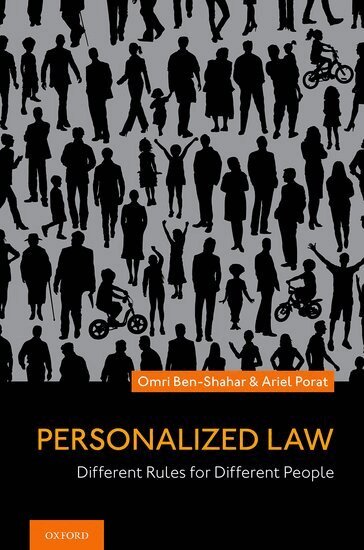
We live in a world of one-size-fits-all law. People are different, but the laws that govern them are uniform. “Personalized Law”---rules that vary person by person---will change that. Here is a vision of a brave new world, where each person is bound by their own personally-tailored law. “Reasonable person” standards would be replaced by a multitude of personalized commands, each individual with their own “reasonable you” rule. Skilled doctors would be held to higher standards of care, the most vulnerable consumers and employees would receive stronger protections, age restrictions for driving or for the consumption of alcohol would vary according the recklessness risk that each person poses, and borrowers would be entitled to personalized loan disclosures tailored to their unique needs and delivered in a format fitting their mental capacity. The data and algorithms to administer personalize law are at our doorstep, and embryos of this regime are sprouting. Should we welcome this transformation of the law? Does personalized law harbor a utopic promise, or would it produce alienation, demoralization, and discrimination? This book is the first to explore personalized law, offering a vision of law and robotics that delegates to machines those tasks humans are least able to perform well. It inquires how personalized law can be designed to deliver precision and justice and what pitfalls the regime would have to prudently avoid. In this book, Omri Ben-Shahar and Ariel Porat not only present this concept in a clear, easily accessible way, but they offer specific examples of how personalized law may be implemented across a variety of real-life applications.
1 817 kr
Skickas inom 5-8 vardagar
Uncertainty is present in virtually every tort litigation. Generally, courts tackle the uncertainty problem by requiring the plaintiff to prove his case by the preponderance of the evidence. However, on numerous occasions tort plaintiffs encounter systematic difficulties in establishing their allegations against defendants. This phenomenon is prevalent in the area of mass torts, which occupies the centre of the tort law agenda in the past three decades. In this area, victims of torts systematically fail to establish their lawsuits against wrongdoers even when it is clear that the latter are responsible for enormous damages. The uncertainty problem is not limited to the mass tort context. In many other contexts, tort and evidence law doctrines also fail to offer satisfactory solutions to that problem. Typically, this failure occurs in cases that involve indeterminate causation, an evidentiary barrier that prevents factual attribution of the litigated damage to the defendant's wrongdoing. Due to this failure, victims of torts are left under-compensated and their wrongdoers under-deterred. This book provides a comprehensive treatment of the problem of uncertainty in torts at both doctrinal and policy levels. It presents and critically examines the existing doctrinal solutions of the problem. It also offers a number of original solutions to the problem, such as imposition of collective liability and liability for evidential damage. The book combines the traditional doctrinal depiction of the law, as evolved in England, Canada, United States, and Israel, with general theoretical insights that include economic analysis.
1 218 kr
Skickas inom 7-10 vardagar
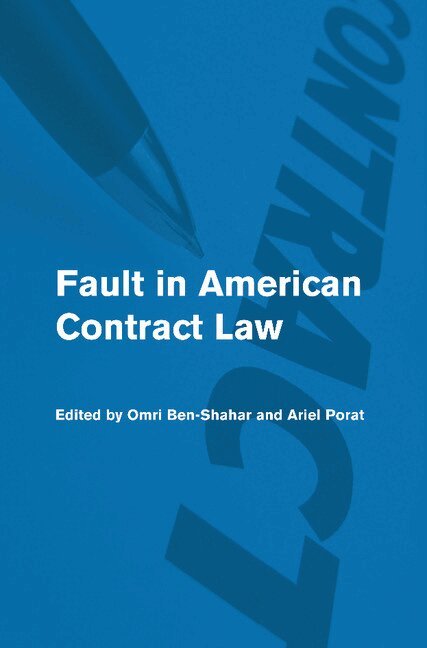
Representing an unprecedented joint effort from top scholars in the field, this volume collects original contributions to examine the fundamental role of 'fault' in contract law. Is it immoral to breach a contract? Should a breaching party be punished more harshly for willful breach? Does it matter if the victim of breach engaged in contributory fault? Is there room for a calculus of fault within the 'efficient breach' framework? For generations, contract liability has been viewed as a no-fault regime, in sharp contrast to tort liability. Is this dichotomy real? Is it justified? How do the American and European traditions compare? In exploring these and related issues, the essays in this volume bring together a variety of outlooks, including economic, psychological, philosophical, and comparative approaches to law.
405 kr
Skickas inom 7-10 vardagar
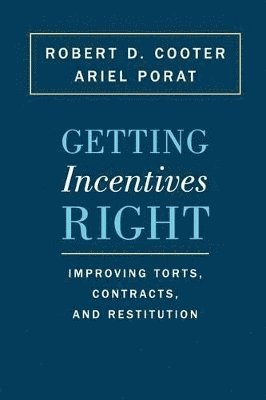
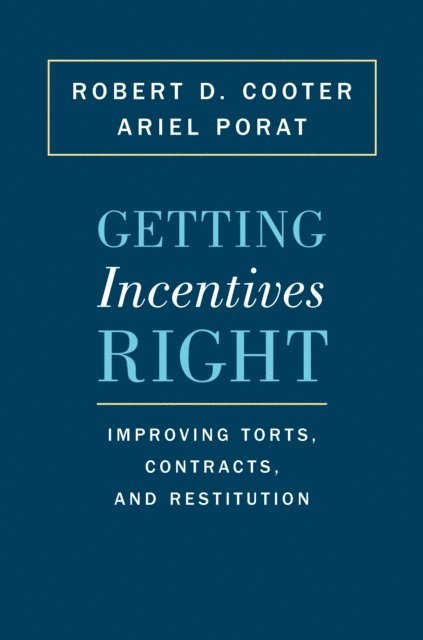
Lawyers, judges, and scholars have long debated whether incentives in tort, contract, and restitution law effectively promote the welfare of society. If these incentives were ideal, tort law would reduce the cost and frequency of accidents, contract law would lubricate transactions, and restitution law would encourage people to benefit others. Unfortunately, the incentives in these laws lead to too many injuries, too little contractual cooperation, and too few unrequested benefits. Getting Incentives Right explains how law might better serve the social good. In tort law, Robert Cooter and Ariel Porat propose that all foreseeable risks should be included when setting standards of care and awarding damages. Failure to do so causes accidents that better legal incentives would avoid. In contract law, they show that making a promise often causes the person who receives it to change behavior and undermine the cooperation between the parties. They recommend several solutions, including a novel contract called "anti-insurance." In restitution law, people who convey unrequested benefits to others are seldom entitled to compensation.Restitution law should compensate them more than it currently does, so that they will provide more unrequested benefits. In these three areas of law, Getting Incentives Right demonstrates that better law can promote the well-being of people by providing better incentives for the private regulation of conduct.
260 kr
Skickas inom 7-10 vardagar
Lawyers, judges, and scholars have long debated whether incentives in tort, contract, and restitution law effectively promote the welfare of society. If these incentives were ideal, tort law would reduce the cost and frequency of accidents, contract law would lubricate transactions, and restitution law would encourage people to benefit others. Unfortunately, the incentives in these laws lead to too many injuries, too little contractual cooperation, and too few unrequested benefits. Getting Incentives Right explains how law might better serve the social good. In tort law, Robert Cooter and Ariel Porat propose that all foreseeable risks should be included when setting standards of care and awarding damages. Failure to do so causes accidents that better legal incentives would avoid. In contract law, they show that making a promise often causes the person who receives it to change behavior and undermine the cooperation between the parties. They recommend several solutions, including a novel contract called "anti-insurance." In restitution law, people who convey unrequested benefits to others are seldom entitled to compensation.Restitution law should compensate them more than it currently does, so that they will provide more unrequested benefits. In these three areas of law, Getting Incentives Right demonstrates that better law can promote the well-being of people by providing better incentives for the private regulation of conduct.
4 826 kr
Skickas inom 7-10 vardagar
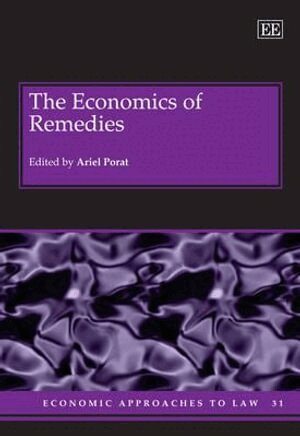
This essential volume incorporates major contributions made by prominent scholars in the past forty years, which illustrate the understanding of the economics of remedies. The editor has selected seminal articles that analyze the well known distinction between property rules and liability rules and demonstrates its significance. The articles also demonstrate the dilemma of which remedy is the more efficient - damages or specific performance. In addition the collection addresses questions concerning the measure of recovery and the scope of liability, and concludes with the novel topic of partial compensation under uncertainty.This set of indispensable articles, along with an original introduction by the editor, will be of great value to law professors, law students, judges and practicing lawyers interested in law and economics, and economists.
418 kr
Skickas inom 7-10 vardagar
Representing an unprecedented joint effort from top scholars in the field, this volume collects original contributions to examine the fundamental role of 'fault' in contract law. Is it immoral to breach a contract? Should a breaching party be punished more harshly for willful breach? Does it matter if the victim of breach engaged in contributory fault? Is there room for a calculus of fault within the 'efficient breach' framework? For generations, contract liability has been viewed as a no-fault regime, in sharp contrast to tort liability. Is this dichotomy real? Is it justified? How do the American and European traditions compare? In exploring these and related issues, the essays in this volume bring together a variety of outlooks, including economic, psychological, philosophical, and comparative approaches to law.