Arjan van der Schaft - Böcker
Visar alla böcker från författaren Arjan van der Schaft. Handla med fri frakt och snabb leverans.
8 produkter
8 produkter
1 381 kr
Skickas inom 10-15 vardagar
This book has recently been retypeset in LaTeX for clearer presentation.This textbook on the differential geometric approach to nonlinear control grew out of a set of lecture notes, which were prepared for a course on nonlinear system theory, given by us for the first time during the fall semester of 1988. The audience consisted mostly of graduate students , taking part in the Dutch national Graduate Program on Systems and Control.The course gives a general introduction to modern nonlinear control theory (with an emphasis on the differential geometric approach), as well as providing students specializing in nonlinear control theory with a firm starting point for doing research in this area. One of the authors' primary objectives is to give a self-contained treatment of all the topics covered. Although the amount of work published on nonlinear geometric control theory is expanding rapidly expanding, the authors confine themselves to treating solid and clear-cut achievements of modern nonlinear control, which can be expected to be of remaining interest. The final selection of topics reflects the authors' own judgement of their importance.
1 381 kr
Skickas inom 10-15 vardagar
This book has recently been retypeset in LaTeX for clearer presentation.This textbook on the differential geometric approach to nonlinear control grew out of a set of lecture notes, which were prepared for a course on nonlinear system theory, given by us for the first time during the fall semester of 1988. The audience consisted mostly of graduate students , taking part in the Dutch national Graduate Program on Systems and Control.The course gives a general introduction to modern nonlinear control theory (with an emphasis on the differential geometric approach), as well as providing students specializing in nonlinear control theory with a firm starting point for doing research in this area. One of the authors' primary objectives is to give a self-contained treatment of all the topics covered. Although the amount of work published on nonlinear geometric control theory is expanding rapidly expanding, the authors confine themselves to treating solid and clear-cut achievements of modern nonlinear control, which can be expected to be of remaining interest. The final selection of topics reflects the authors' own judgement of their importance.
1 577 kr
Skickas inom 10-15 vardagar
This book gives a unified treatment of classical input-output stability theory and recent developments in nonlinear robust and passivity-based control. The synthesis between these areas is provided by the theory of dissipative systems. Specifically, the small-gain and passivity theorems and their implications for nonlinear stability and stabilization are discussed from this vantage-ground. The connection between L2-gain and passivity via scattering is detailed.The passivity concepts are enriched by a generalised Hamiltonian formalism, emphasizing the close relations with modeling and control by interconnection. Feedback equivalence to a passive system and resulting stabilization strategies are discussed.The potential of L2-gain techniques in nonlinear control is demonstrated, including a compact treatment of the nonlinear H optimal control problem. This book supplies the reader with a succinct, informative summary of a fundamental and rapidly developing area of nonlinear control theory.
535 kr
Skickas inom 10-15 vardagar
The chapters of this book have been presented at the 1st Workshop of the Nonlinear Control Network*, which was held in Ghent, March 15,16, 1999. These contributions give an overview of some of the current and emerging trends in nonlinear systems and control theory. As editors of this book we would very much like to thank the speakers at this workshop for their sti- lating presentations and for their efforts to bring this material to its current form, which we are sure will provide stimulating reading as well. Dirk Aeyels Franchise Lamnabhi-Lagarrigue Arjan J. van der Schaft 'The Nonlinear Control Network is a four year project within the framework of the European Commission's Training and Mobility of Researchers (TMR) Programme that started on December 1, 1997. There are nine partners involved: Dirk Aeyels Universiteit Gent Dirk. Asysls4rug. ac. be Belgium Alfonso Banos Universidad de Murcia abanostdif. um. es Spain Fritz Colonius Universitat Augsburg ColoniusCmath. uni-augsburg. de Germany Alberto Isidori Universita di Roma isidoriCgiannutri. caspur. it Italy Francoise Lamnabhi-Lagarrigue Centre National de la Recherche Scientifique lamnabhiClss. supslsc. fr France (coordinator) David H.Owens University of Sheffield D. H. OnensCshsffield. ac. uk England Arjan J. van der Schaft Universiteit Twente a. j. vanderschaftCmath. ut8ents. nl The Netherlands Fatima Silva Leite Universidade de Coimbra fleiteCmat. uc. pt Portugal John Tsinias National Technical University of Athens jtsinCmath. ntua. gr Greece url: Nonlinear Control Network http://nuH. supelec. fr/lss/NCN Contents 1.
788 kr
Skickas inom 7-10 vardagar
This text provides a detailed and self-contained introduction to the core topics of optimal control for finite-dimensional deterministic dynamical systems.
580 kr
Skickas inom 10-15 vardagar
This text provides a detailed and self-contained introduction to the core topics of optimal control for finite-dimensional deterministic dynamical systems.
2 414 kr
Skickas inom 10-15 vardagar
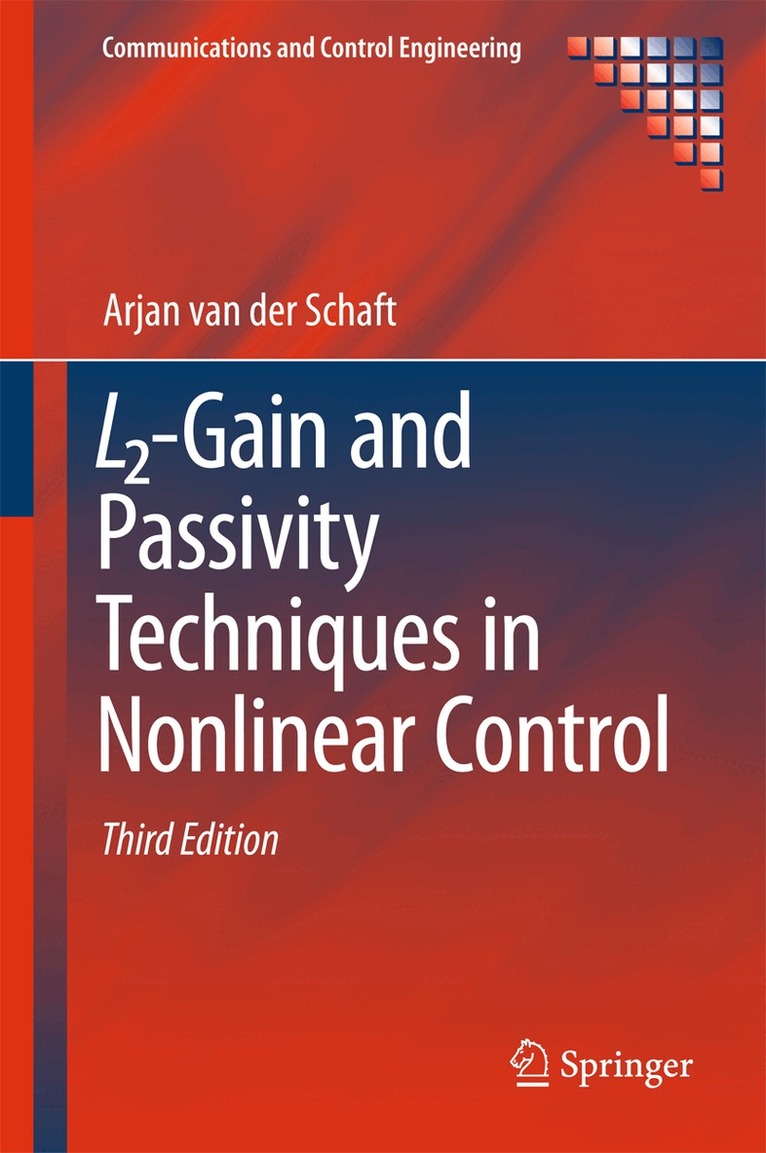
This standard text gives a unified treatment of passivity and L2-gain theory for nonlinear state space systems, preceded by a compact treatment of classical passivity and small-gain theorems for nonlinear input-output maps. The synthesis between passivity and L2-gain theory is provided by the theory of dissipative systems. Specifically, the small-gain and passivity theorems and their implications for nonlinear stability and stabilization are discussed from this standpoint. The connection between L2-gain and passivity via scattering is detailed.Feedback equivalence to a passive system and resulting stabilization strategies are discussed. The passivity concepts are enriched by a generalised Hamiltonian formalism, emphasising the close relations with physical modeling and control by interconnection, and leading to novel control methodologies going beyond passivity.The potential of L2-gain techniquesin nonlinear control, including a theory of all-pass factorizations of nonlinear systems, and of parametrization of stabilizing controllers, is demonstrated. The nonlinear H-infinity optimal control problem is also treated and the book concludes with a geometric analysis of the solution sets of Hamilton-Jacobi inequalities and their relation with Riccati inequalities for the linearization. · L2-Gain and Passivity Techniques in Nonlinear Control (third edition) is thoroughly updated, revised, reorganized and expanded. Among the changes, readers will find:· updated and extended coverage of dissipative systems theory· substantial new material regarding converse passivity theorems and incremental/shifted passivity · coverage of recent developments on networks of passive systems with examples· a completely overhauled and succinct introduction to modeling and control of port-Hamiltonian systems, followed by an exposition of port-Hamiltonian formulation of physical network dynamics· updated treatment of all-pass factorization of nonlinear systems The book provides graduate students and researchers in systems and control with a compact presentation of a fundamental and rapidly developing area of nonlinear control theory, illustrated by a broad range of relevant examples stemming from different application areas.
2 414 kr
Skickas inom 10-15 vardagar
This standard text gives a unified treatment of passivity and L2-gain theory for nonlinear state space systems, preceded by a compact treatment of classical passivity and small-gain theorems for nonlinear input-output maps. The synthesis between passivity and L2-gain theory is provided by the theory of dissipative systems. Specifically, the small-gain and passivity theorems and their implications for nonlinear stability and stabilization are discussed from this standpoint. The connection between L2-gain and passivity via scattering is detailed.Feedback equivalence to a passive system and resulting stabilization strategies are discussed. The passivity concepts are enriched by a generalised Hamiltonian formalism, emphasising the close relations with physical modeling and control by interconnection, and leading to novel control methodologies going beyond passivity.The potential of L2-gain techniquesin nonlinear control, including a theory of all-pass factorizations of nonlinear systems, and of parametrization of stabilizing controllers, is demonstrated. The nonlinear H-infinity optimal control problem is also treated and the book concludes with a geometric analysis of the solution sets of Hamilton-Jacobi inequalities and their relation with Riccati inequalities for the linearization. · L2-Gain and Passivity Techniques in Nonlinear Control (third edition) is thoroughly updated, revised, reorganized and expanded. Among the changes, readers will find:· updated and extended coverage of dissipative systems theory· substantial new material regarding converse passivity theorems and incremental/shifted passivity · coverage of recent developments on networks of passive systems with examples· a completely overhauled and succinct introduction to modeling and control of port-Hamiltonian systems, followed by an exposition of port-Hamiltonian formulation of physical network dynamics· updated treatment of all-pass factorization of nonlinear systems The book provides graduate students and researchers in systems and control with a compact presentation of a fundamental and rapidly developing area of nonlinear control theory, illustrated by a broad range of relevant examples stemming from different application areas.