Arthur W. Staats - Böcker
Visar alla böcker från författaren Arthur W. Staats. Handla med fri frakt och snabb leverans.
2 produkter
2 produkter
1 034 kr
Skickas inom 10-15 vardagar
I have been involved in constructing a unified theory for many years, in considering the state of psychology's unity-disunity, and in generally attempt ing to persuade our profession to work on its unification. In this work I have had the opportunity to become acquainted with the works of a number of other psychologists whose statements indicated that they had something to say on these topics. I saw also that it would be very productive for psychology to have these individuals address themselves to psychology's disunity-unity, consid ered as a problem that should be confronted and addressed. In 1983 I began to indicate that it was my intention to devote a book to the topic, as seen through the eyes of a group of prominent psychologists concerned with related issues. It was very fortunate from my standpoint that Joseph Royce and later Leendert Mos, who were editing this series, were interested in this book. I accepted the former's invitation to do within the present series the book I had planned. Although I must assume responsibility for selection of the contributors, for the book's organization, and for the first editing of their papers for substance, Pro fessor Mos offered to help in an editorial capacity and I am most grateful for his contributions to the formal editing. The volume is much improved as a result of his careful efforts, which in one case involved rewriting material.
282 kr
Tillfälligt slut
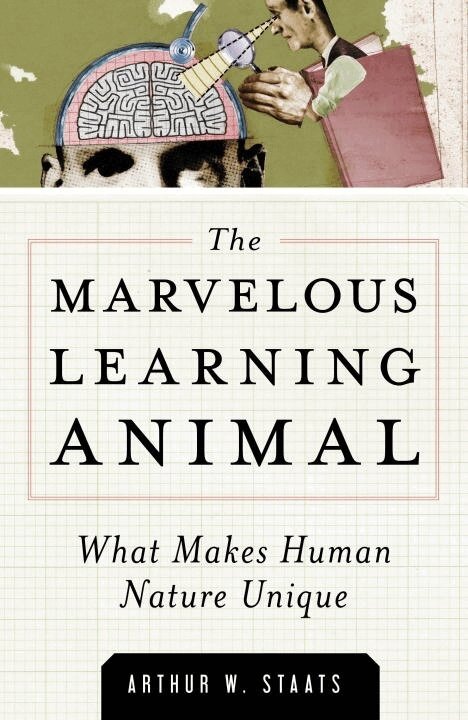
What makes us human? In recent decades, researchers have focused on innate tendencies and inherited traits as explanations for human behavior, especially in light of groundbreaking human genome research. The author thinks this trend is misleading. As he shows in great detail in this engaging, thought-provoking, and highly informative book, what makes our species unique is our marvelous ability to learn, which is an ability that no other primate possesses. In his exploration of human progress, the author reveals that the immensity of human learning has not been fully understood or examined. Evolution has endowed us with extremely versatile bodies and a brain comprised of one hundred billion neurons, which makes us especially suited for a wide range of sophisticated learning. Already in childhood, human beings begin learning complex repertoires-language, sports, value systems, music, science, rules of behavior, and many other aspects of culture. These repertoires build on one another in special ways, and our brains develop in response to the learning experiences we receive from those around us and from what we read and hear and see. When humans gather in society, the cumulative effect of building learning upon learning is enormous.The author presents a new way of understanding humanness-in the behavioral nature of the human body, in the unique human way of learning, in child development, in personality, and in abnormal behavior. With all this, and his years of basic and applied research, he develops a new theory of human evolution and a new vision of the human being. This book offers up a unified concept that not only provides new ways of understanding human behavior and solving human problems but also lays the foundations for opening new areas of science.