Arvid Aulin – författare
Visar alla böcker från författaren Arvid Aulin. Handla med fri frakt och snabb leverans.
8 produkter
8 produkter
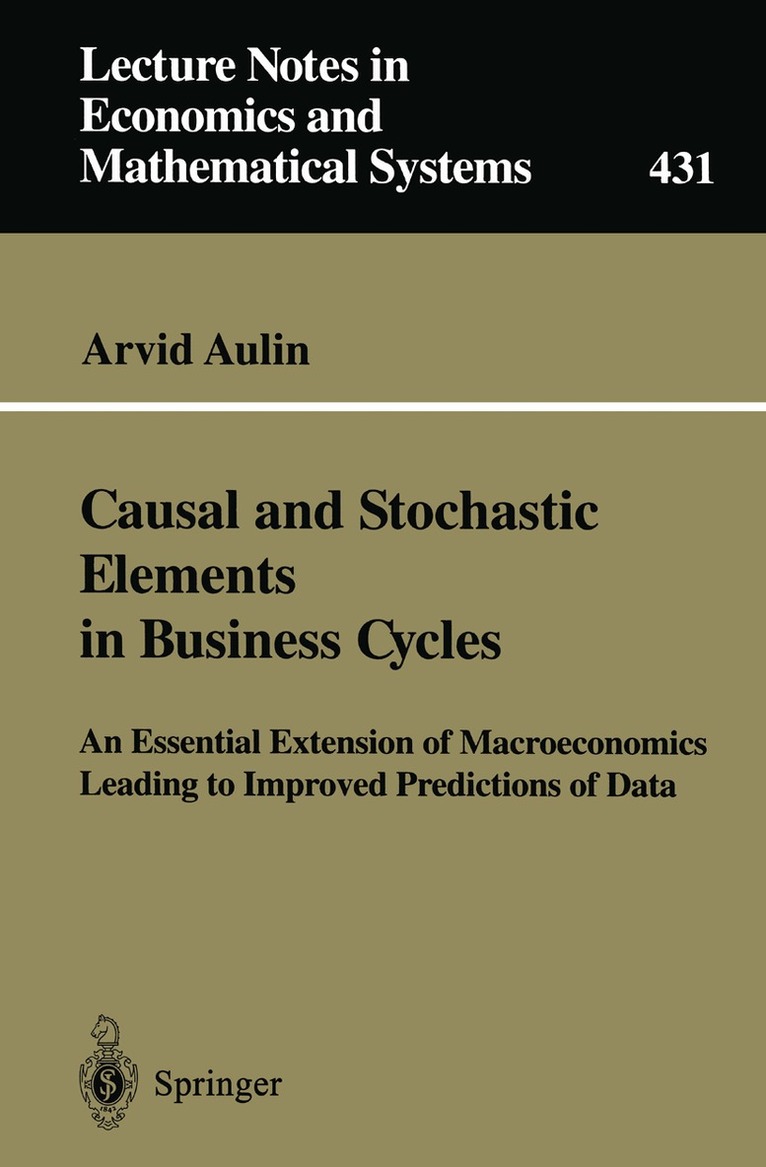
Del 431 - Lecture Notes in Economics and Mathematical Systems
Causal and Stochastic Elements in Business Cycles
An Essential Extension of Macroeconomics Leading to Improved Predictions of Data
Häftad, Engelska, 1996
566 kr
Skickas inom 10-15 vardagar
1. Facts: A leisure term with an unbounded value function, when added to utility in the Lucas (1988) 'mechanics of economic development', expands enormously the range of data covered by the theory. To explain this we have to ask two questions. First: why leisure would be so much desired? Perhaps because leisure is one's own time and such a leisure term means an unbounded value of individual freedom. But why leisure is economically productive, as implied by the results obtained in this study? Perhaps because cognitive innovations often occur during the time which in economics is registered as leisure? Then an unbounded leisure term would also make room for an unbounded creation of knowledge, as distinguished from the mere transmission of knowledge in education and training. In any case the leisure term seems to act as if it where the'hole' through which strong nonmaterial values affect economics. The ensuing 'extended mechanics' is derived in Chapters 4-6 and proves to involve an extension of growth theory as well as a theory of the causal part of business cycles. Their empirical verification is given by showing (i) that the existence of the two Basic Growth Paths derived from this theory, defining its Growth Type 1 and Growth Type 2, respectively, is verified already by the statistics collected by Solow (1957) but ignored so far (see Chapter 5 of the present study); one of them, viz.
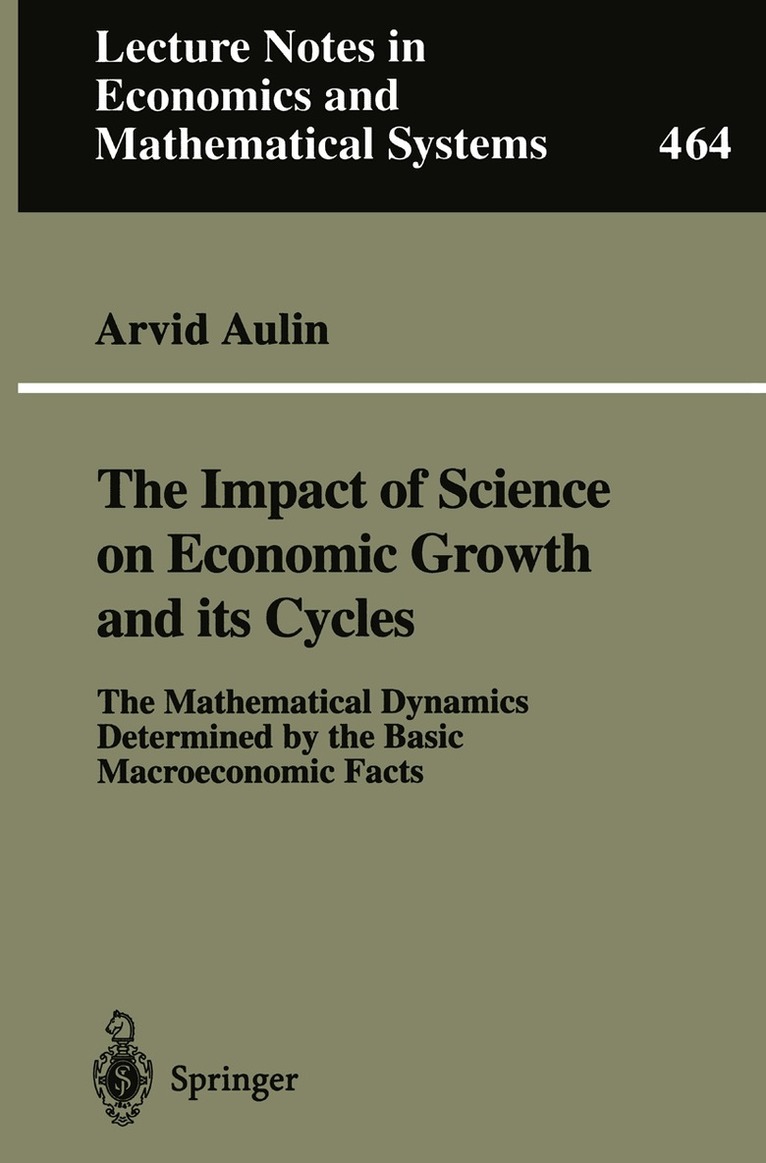
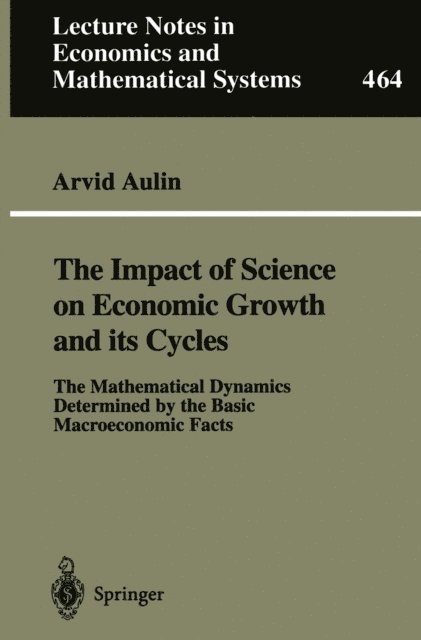
Del 464 - Lecture Notes in Economics and Mathematical Systems
Impact of Science on Economic Growth and its Cycles
The Mathematical Dynamics Determined by the Basic Macroeconomic Facts
Häftad, Engelska, 1998
566 kr
Skickas inom 10-15 vardagar
The author shows that the enormous gap between theory and facts in modern macroeconomics can only be eliminated by nonlinear macroeconomic dynamics with the following special characteristics: First of all, only certain group-theoretical invariants generate the correct growth cycles with irregularly varying lengths, not any stochastic process as usually applied for this purpose. Furthermore, a special extended value function and generalized human capital are needed for a correct representation of scientific and technological innovation. Finally, the correct nonlinear macroeconomic dynamics are not reducible to microeconomics, for both of the above mentioned reasons.
E-bok
PDF, Engelska, 2012708 kr
Läs direkt efter köp
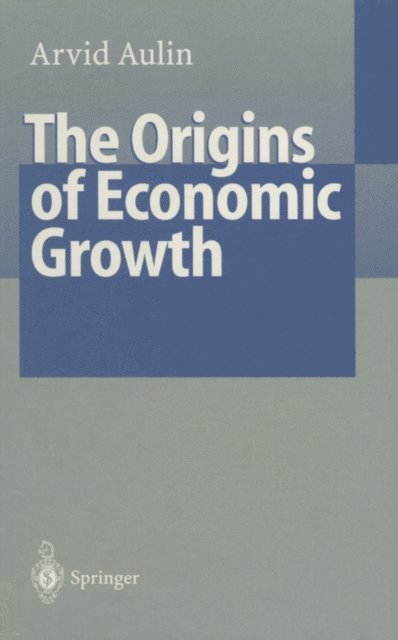
This book deals with factors affecting economic growth in knowledge-based societies. It is shown that the interaction between material and nonmaterial values is the ultimate source of all economic growth including business cycles. The model developed predicts the quantitative facts concerning the business cycles better than the conventional real-cycle models. It also produces, besides the balanced-growth path, another growth path whose existence is verified by empirical facts. The results give strong evidence of the economic relevance of nonmaterial values. They also prompt a new vision of the stochastic elements in the business cycles. Nonmaterial values are analysed, and their interaction with economic growth is also illustrated in terms of an entropy formalism of historical analysis.
Häftad, Engelska, 2011
566 kr
Skickas inom 10-15 vardagar
This book deals with factors affecting economic growth in knowledge-based societies. It is shown that the interaction between material and nonmaterial values is the ultimate source of all economic growth including business cycles. The model developed predicts the quantitative facts concerning the business cycles better than the conventional real-cycle models. It also produces, besides the balanced-growth path, another growth path whose existence is verified by empirical facts. The results give strong evidence of the economic relevance of nonmaterial values. They also prompt a new vision of the stochastic elements in the business cycles. Nonmaterial values are analysed, and their interaction with economic growth is also illustrated in terms of an entropy formalism of historical analysis.
E-bok
PDF, Engelska, 2012708 kr
Läs direkt efter köp
DYNAMIC ECONOMICS with increasing returns is extended tocope with economic growth, the business cycles and theirregular swings in the long-term development as differentaspects of the same dynamical system, the economic system"as a whole".HUMAN CAPITAL emerges as the seminal concept: economicgrowth is in this dynamics causally reduced to the growth ofhuman capital and thus to the growth of exact scientificknowledge. An analysis of this knowledge shows that qualityeducation in hard sciences must be a prime target of futureeconomic policies.A CAUSAL STRUCTURE, new in economics, underlies the extendeddynamics. To enable students to study and to improve it, adetailled introduction to nonlinear causality is given,emphasizing the points relevant to this causal structure.NATIONAL ACCOUNTING and input-output dynamics are suggestedto be extended to include also the production prices andproduction of human capital and of human time, by using amethod of calculation indicated in detail in the book.
Häftad, Engelska, 2011
566 kr
Skickas inom 10-15 vardagar
DYNAMIC ECONOMICS with increasing returns is extended tocope with economic growth, the business cycles and theirregular swings in the long-term development as differentaspects of the same dynamical system, the economic system"as a whole".HUMAN CAPITAL emerges as the seminal concept: economicgrowth is in this dynamics causally reduced to the growth ofhuman capital and thus to the growth of exact scientificknowledge. An analysis of this knowledge shows that qualityeducation in hard sciences must be a prime target of futureeconomic policies.A CAUSAL STRUCTURE, new in economics, underlies the extendeddynamics. To enable students to study and to improve it, adetailled introduction to nonlinear causality is given,emphasizing the points relevant to this causal structure.NATIONAL ACCOUNTING and input-output dynamics are suggestedto be extended to include also the production prices andproduction of human capital and of human time, by using amethod of calculation indicated in detail in the book.
E-bok
PDF, Engelska, 2012708 kr
Läs direkt efter köp
1. Facts: A leisure term with an unbounded value function, when added to utility in the Lucas (1988) ''mechanics of economic development'', expands enormously the range of data covered by the theory. To explain this we have to ask two questions. First: why leisure would be so much desired? Perhaps because leisure is one''s own time and such a leisure term means an unbounded value of individual freedom. But why leisure is economically productive, as implied by the results obtained in this study? Perhaps because cognitive innovations often occur during the time which in economics is registered as leisure? Then an unbounded leisure term would also make room for an unbounded creation of knowledge, as distinguished from the mere transmission of knowledge in education and training. In any case the leisure term seems to act as if it where the''hole'' through which strong nonmaterial values affect economics. The ensuing ''extended mechanics'' is derived in Chapters 4-6 and proves to involve an extension of growth theory as well as a theory of the causal part of business cycles. Their empirical verification is given by showing (i) that the existence of the two Basic Growth Paths derived from this theory, defining its Growth Type 1 and Growth Type 2, respectively, is verified already by the statistics collected by Solow (1957) but ignored so far (see Chapter 5 of the present study); one of them, viz.
E-bok
PDF, Engelska, 2012708 kr
Läs direkt efter köp
The author shows that the enormous gap between theory and facts in modern macroeconomics can only be eliminated by nonlinear macroeconomic dynamics with the following special characteristics: First of all, only certain group-theoretical invariants generate the correct growth cycles with irregularly varying lengths, not any stochastic process as usually applied for this purpose. Furthermore, a special extended value function and generalized human capital are needed for a correct representation of scientific and technological innovation. Finally, the correct nonlinear macroeconomic dynamics are not reducible to microeconomics, for both of the above mentioned reasons.