Auke Jan Ijspeert – författare
Visar alla böcker från författaren Auke Jan Ijspeert. Handla med fri frakt och snabb leverans.
4 produkter
4 produkter
Häftad, Engelska, 2004
562 kr
Skickas inom 10-15 vardagar
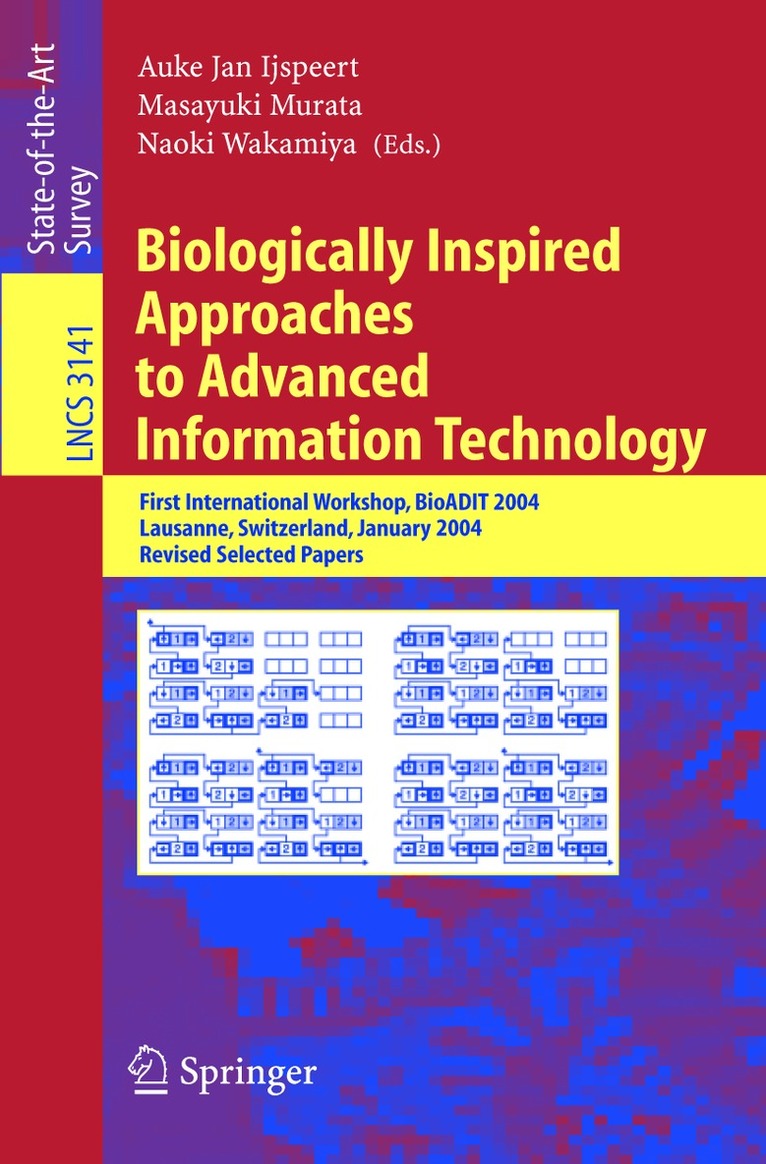
The evolution of the Internet has led us to the new era of the information infrastructure. As the information systems operating on the Internet are getting larger and more complicated, it is clear that the traditional approaches based on centralized mechanisms are no longer meaningful. One typical example can be found in the recent growing interest in a P2P (peer-to-peer) computing paradigm. It is quite different from the Web-based client-server systems, which adopt essentially centralized management mechanisms. The P2P computing environment has the potential to overcome bottlenecks in Web computing paradigm, but it introduces another difficulty, a scalability problem in terms of information found, if we use a brute-force flooding mechanism. As such, conventional information systems have been designed in a centralized fashion. As the Internet is deployed on a world scale, however, the information systems have been growing, and it becomes more and more difficult to ensure fau- free operation. This has long been a fundamental research topic in the field. A complex information system is becoming more than we can manage. For these reasons, there has recently been a significant increase in interest in biologically inspired approaches to designing future information systems that can be managed efficiently and correctly.
E-bok
PDF, Engelska, 2004708 kr
Läs direkt efter köp
The evolution of the Internet has led us to the new era of the information infrastructure. As the information systems operating on the Internet are getting larger and more complicated, it is clear that the traditional approaches based on centralized mechanisms are no longer meaningful. One typical example can be found in the recent growing interest in a P2P (peer-to-peer) computing paradigm. It is quite different from the Web-based client-server systems, which adopt essentially centralized management mechanisms. The P2P computing environment has the potential to overcome bottlenecks in Web computing paradigm, but it introduces another difficulty, a scalability problem in terms of information found, if we use a brute-force flooding mechanism. As such, conventional information systems have been designed in a centralized fashion. As the Internet is deployed on a world scale, however, the information systems have been growing, and it becomes more and more difficult to ensure fau- free operation. This has long been a fundamental research topic in the field. A complex information system is becoming more than we can manage. For these reasons, there has recently been a significant increase in interest in biologically inspired approaches to designing future information systems that can be managed efficiently and correctly.
Häftad, Engelska, 2006
562 kr
Skickas inom 10-15 vardagar
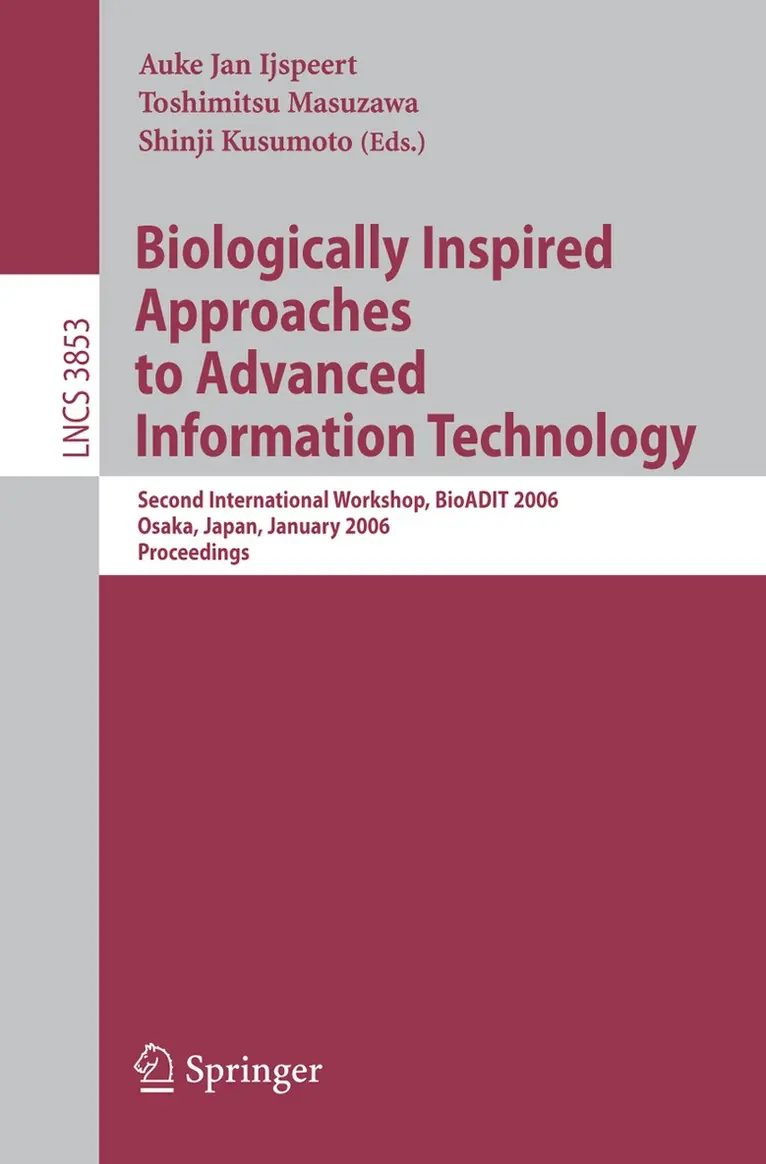
This book contains 30 articles and three abstracts of invited talks presented at The Second International Workshop on Biologically Inspired Approaches for Advanced Information Technology (Bio-ADIT 2006) held at Senri Life Science Center, Osaka, Japan, on January 26–27, 2006. Bio-ADIT 2006 follows the s- cess of the ?rst workshop Bio-ADIT 2004, held at the Swiss Federal Institute of Technology, Lausanne (EPFL), Switzerland, in January 2004. The workshop is intended to provide an e?ective forum for original research results in the ?eld of bio-inspired approaches to advanced information technologies. It also serves to foster the connection between biological paradigms and solutions to building the next-generation information systems. In particular, the aim of the workshop is to explore and discuss how biologically inspired approaches can help in - signing the next generation of information systems which, like their biological counterparts, will be capable of adaptation, self-organization, replication, and self-repair. Wewerehonoredtohavetheparticipationasinvitedspeakersofthreeleading researchers in this ?eld: James C. Liao, Rolf Pfeifer, and Toshio Yanagida. The invitedtalksdealtwiththeveryinterestingsubjectsofbio-inspiredapproachesto information systems, and provided stimulating ideas to the workshop attendees to pursue further research in this exciting ?eld. The articles cover a large range of topics including networking, robotics, evolutionary computation, neural computation, biochemical networks, recon- urable hardware, and machine vision. The contributions range from basic - search in biology and in information technology, to more application-oriented developments in software and in hardware.
E-bok
PDF, Engelska, 2005734 kr
Läs direkt efter köp
This book contains 30 articles and three abstracts of invited talks presented at The Second International Workshop on Biologically Inspired Approaches for Advanced Information Technology (Bio-ADIT 2006) held at Senri Life Science Center, Osaka, Japan, on January 26–27, 2006. Bio-ADIT 2006 follows the s- cess of the ?rst workshop Bio-ADIT 2004, held at the Swiss Federal Institute of Technology, Lausanne (EPFL), Switzerland, in January 2004. The workshop is intended to provide an e?ective forum for original research results in the ?eld of bio-inspired approaches to advanced information technologies. It also serves to foster the connection between biological paradigms and solutions to building the next-generation information systems. In particular, the aim of the workshop is to explore and discuss how biologically inspired approaches can help in - signing the next generation of information systems which, like their biological counterparts, will be capable of adaptation, self-organization, replication, and self-repair. Wewerehonoredtohavetheparticipationasinvitedspeakersofthreeleading researchers in this ?eld: James C. Liao, Rolf Pfeifer, and Toshio Yanagida. The invitedtalksdealtwiththeveryinterestingsubjectsofbio-inspiredapproachesto information systems, and provided stimulating ideas to the workshop attendees to pursue further research in this exciting ?eld. The articles cover a large range of topics including networking, robotics, evolutionary computation, neural computation, biochemical networks, recon- urable hardware, and machine vision. The contributions range from basic - search in biology and in information technology, to more application-oriented developments in software and in hardware.