Aurnague Michel Aurnague – författare
Visar alla böcker från författaren Aurnague Michel Aurnague. Handla med fri frakt och snabb leverans.
2 produkter
2 produkter
E-bok
Engelska, 20191 305 kr
Läs direkt efter köp
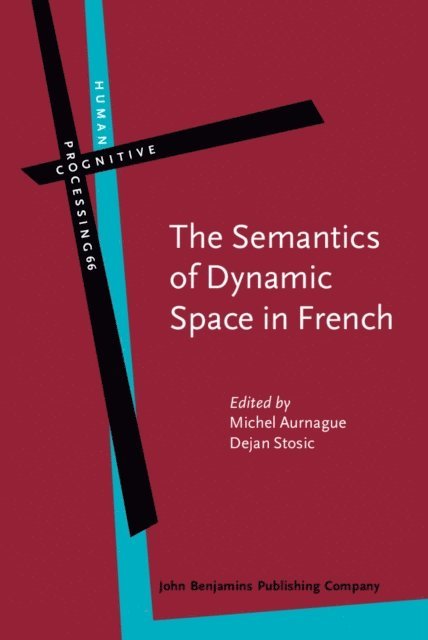
Research on the semantics of spatial markers in French is known mainly through Vandeloise's (1986, 1991) work on static prepositions. However, interest in the expression of space in French goes back to the mid-1970s and focused first on verbs denoting changes in space, whose syntactic properties were related to specific semantic distinctions, such as the opposition between "e;movement"e; and "e;displacement"e;. This volume provides an overview of recent studies on the semantics of dynamic space in French and addresses important questions about motion expression, among which "e;goal bias"e; and asymmetry of motion, the status of locative PPs, the expression of manner, fictive or non-actual motion. Descriptive, experimental and formal or computational analyses are presented, providing complementary perspectives on the main issue. The volume is intended for researchers and advanced students wishing to learn about both spatial semantics in French and recent debates on the representation of motion events in language and cognition.
E-bok
PDF, Engelska, 20071 588 kr
Läs direkt efter köp
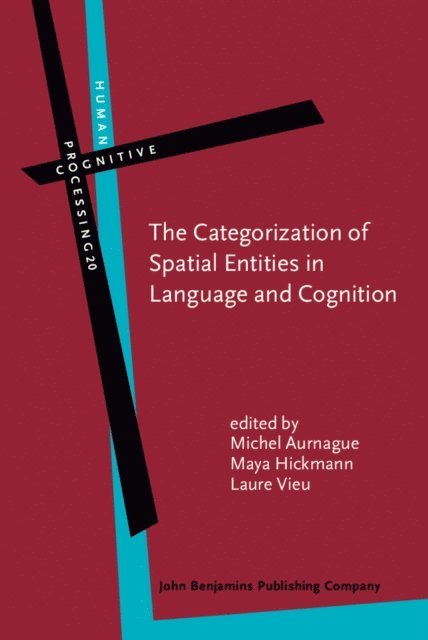
Despite a growing interest for space in language, most research has focused on spatial markers specifying the static or dynamic relationships among entities (verbs, prepositions, postpositions, case markings...). Little attention has been paid to the very properties of spatial entities, their status in linguistic descriptions, and their implications for spatial cognition and its development in children. This topic is at the center of this book, that opens a new field by sketching some major theoretical and methodological directions for future research on spatial entities. Brought together linguistic descriptions of spatial systems, formal accounts of linguistic data, and experimental findings from psycholinguistic studies, all couched within a wide cross-linguistic perspective. Such an interdisciplinary approach provides a rich overview of the many questions that remain unanswered in relation to spatial entities, while also throwing a new light on previous research focusing on related topics concerning space and/or the relation between language and cognition.