A.V. Bolsinov - Böcker
Visar alla böcker från författaren A.V. Bolsinov. Handla med fri frakt och snabb leverans.
4 produkter
4 produkter
2 625 kr
Skickas inom 10-15 vardagar
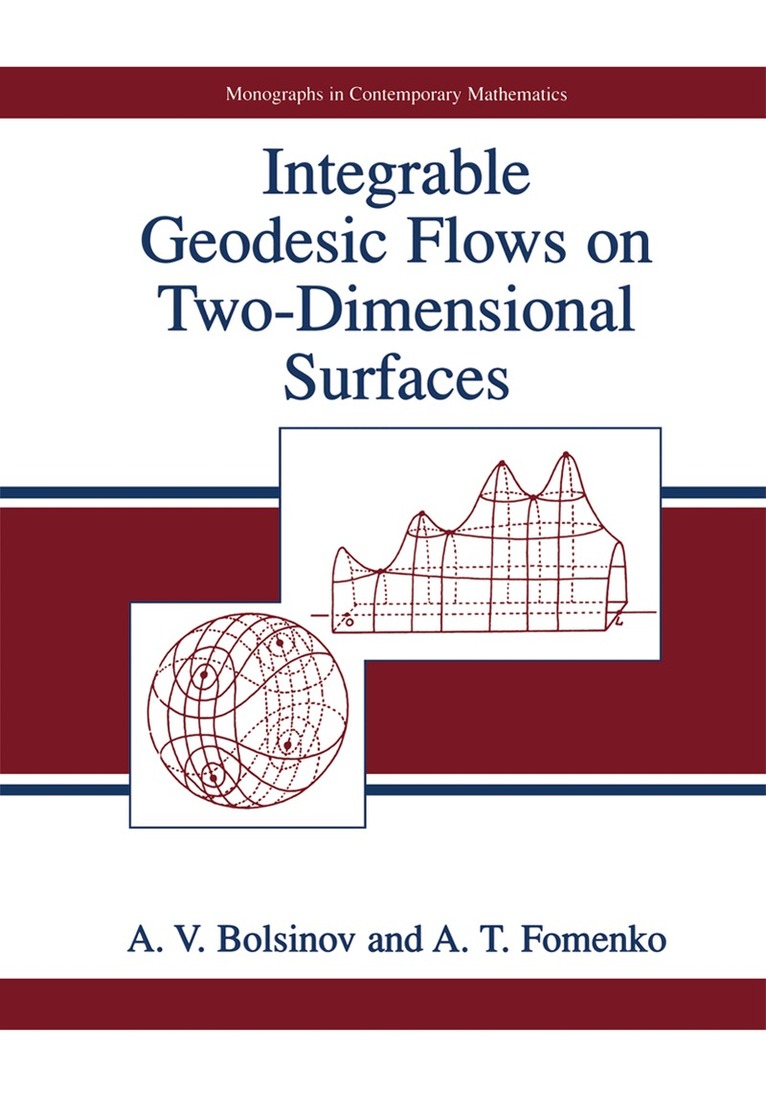
Presenting a new approach to qualitative analysis of integrable geodesic flows based on the theory of topological classification of integrable Hamiltonian systems, this book applies this technique systematically to a wide class of integrable systems. The first part of the book provides an introduction to the qualitative theory of integrable Hamiltonian systems and their invariants (symplectic geometry, integrability, the topology of Liouville foliations, the orbital classification theory for integrable nondegenerate Hamiltonian systems with two degrees of freedom, obstructions to integrability, for example). In the second part, the class of integrable geodesic flows on two-dimensional surfaces is discussed both from the classical and contemporary point of view. The authors classify them up to different equivalence relations such as an isometry, the Liouville equivalence, the trajectory equivalence (smooth and continuous), and the geodesic equivalence. A new technique, which provides the possibility to classify integrable geodesic flows up to these kinds of equivalences, is presented together with applications.
928 kr
Skickas inom 10-15 vardagar
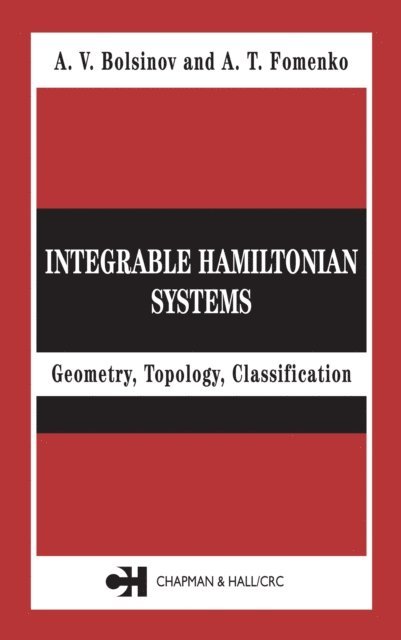
Integrable Hamiltonian systems have been of growing interest over the past 30 years and represent one of the most intriguing and mysterious classes of dynamical systems. This book explores the topology of integrable systems and the general theory underlying their qualitative properties, singularites, and topological invariants.The authors, both of whom have contributed significantly to the field, develop the classification theory for integrable systems with two degrees of freedom. This theory allows one to distinguish such systems up to two natural equivalence relations: the equivalence of the associated foliation into Liouville tori and the usual orbital equaivalence. The authors show that in both cases, one can find complete sets of invariants that give the solution of the classification problem.The first part of the book systematically presents the general construction of these invariants, including many examples and applications. In the second part, the authors apply the general methods of the classification theory to the classical integrable problems in rigid body dynamics and describe their topological portraits, bifurcations of Liouville tori, and local and global topological invariants. They show how the classification theory helps find hidden isomorphisms between integrable systems and present as an example their proof that two famous systems--the Euler case in rigid body dynamics and the Jacobi problem of geodesics on the ellipsoid--are orbitally equivalent.Integrable Hamiltonian Systems: Geometry, Topology, Classification offers a unique opportunity to explore important, previously unpublished results and acquire generally applicable techniques and tools that enable you to work with a broad class of integrable systems.
2 692 kr
Skickas inom 10-15 vardagar
Integrable Hamiltonian systems have been of growing interest over the past 30 years and represent one of the most intriguing and mysterious classes of dynamical systems. This book explores the topology of integrable systems and the general theory underlying their qualitative properties, singularites, and topological invariants.The authors, both of whom have contributed significantly to the field, develop the classification theory for integrable systems with two degrees of freedom. This theory allows one to distinguish such systems up to two natural equivalence relations: the equivalence of the associated foliation into Liouville tori and the usual orbital equaivalence. The authors show that in both cases, one can find complete sets of invariants that give the solution of the classification problem.The first part of the book systematically presents the general construction of these invariants, including many examples and applications. In the second part, the authors apply the general methods of the classification theory to the classical integrable problems in rigid body dynamics and describe their topological portraits, bifurcations of Liouville tori, and local and global topological invariants. They show how the classification theory helps find hidden isomorphisms between integrable systems and present as an example their proof that two famous systems--the Euler case in rigid body dynamics and the Jacobi problem of geodesics on the ellipsoid--are orbitally equivalent.Integrable Hamiltonian Systems: Geometry, Topology, Classification offers a unique opportunity to explore important, previously unpublished results and acquire generally applicable techniques and tools that enable you to work with a broad class of integrable systems.
2 625 kr
Skickas inom 10-15 vardagar
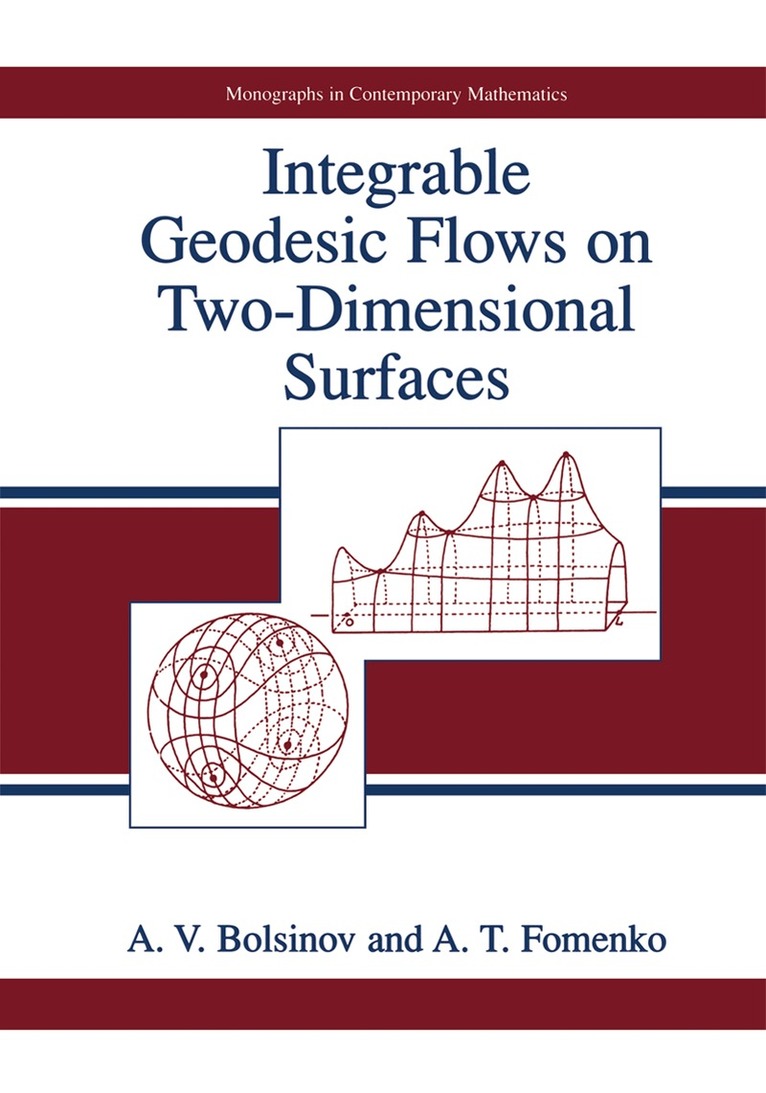
Geodesic flows of Riemannian metrics on manifolds are one of the classical objects in geometry. A particular place among them is occupied by integrable geodesic flows. We consider them in the context of the general theory of integrable Hamiltonian systems, and in particular, from the viewpoint of a new topological classification theory, which was recently developed for integrable Hamiltonian systems with two degrees of freedom. As a result, we will see that such a new approach is very useful for a deeper understanding of the topology and geometry of integrable geodesic flows. The main object to be studied in our paper is the class of integrable geodesic flows on two-dimensional surfaces. There are many such flows on surfaces of small genus, in particular, on the sphere and torus. On the contrary, on surfaces of genus 9 > 1, no such flows exist in the analytical case. One of the most important and interesting problems consists in the classification of integrable flows up to different equivalence relations such as (1) an isometry, (2) the Liouville equivalence, (3) the trajectory equivalence (smooth and continuous), and (4) the geodesic equivalence. In recent years, a new technique was developed, which gives, in particular, a possibility to classify integrable geodesic flows up to these kinds of equivalences. This technique is presented in our paper, together with various applications. The first part of our book, namely, Chaps.