Ayodele Asekomeh – författare
Visar alla böcker från författaren Ayodele Asekomeh. Handla med fri frakt och snabb leverans.
5 produkter
5 produkter
Inbunden, Engelska, 2022
494 kr
Skickas inom 10-15 vardagar
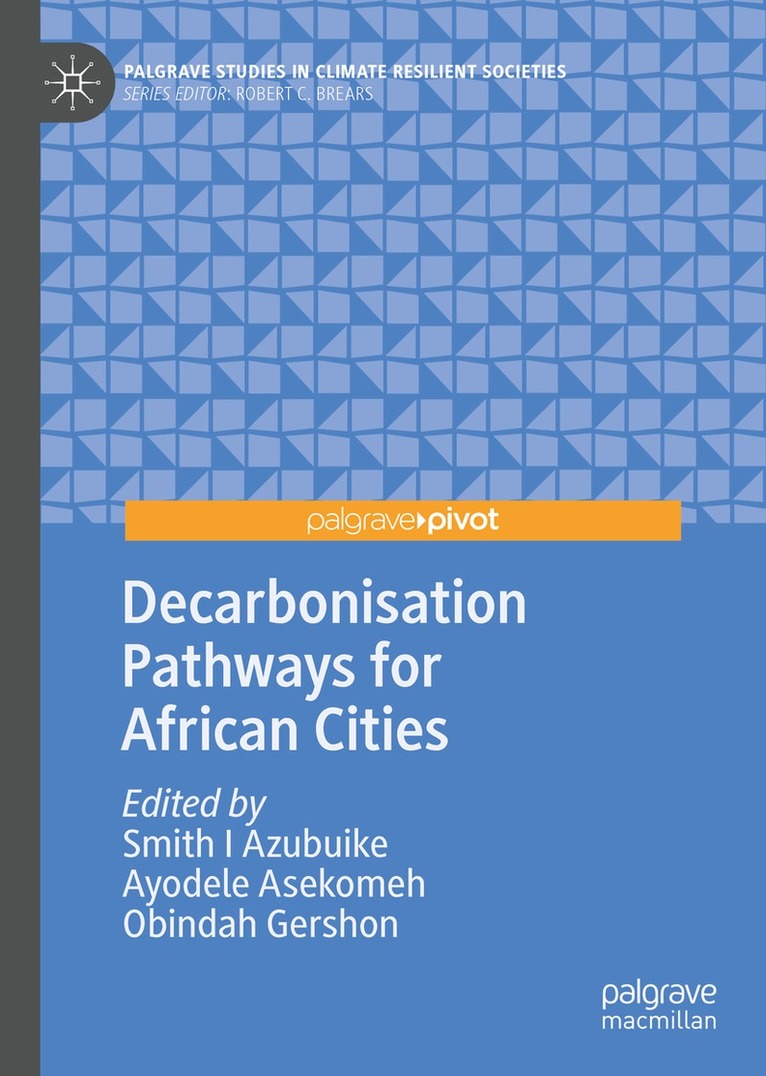
This book examines the pathways to decarbonising African cities, structured around strategies and applications in renewable energy, waste management, healthcare, telecommunication, education and governance reconfigurations for Petro-cities. Throughout the book the authors highlight infrastructural, governance and policy approaches to drive decarbonisation. Opening with chapters focused on propositions for solar urban planning and scope for decarbonisation in waste management the book then moves on to examine innovative strategies for a low-carbon healthcare sector. The authors then discuss the use of hybrid power systems at remote telecommunication sites, their deployment on university campuses, and how this can be optimised to reduce carbon emissions. Further chapters explore government, private sector and civil society actions for decarbonising Kenyan cities and an overview of the political economic choices for decarbonising Petro-cities. Finally, closing chapters propose mechanisms for translating COP26 takeaways to decarbonisation policies and a low-carbon framework for African cities.
E-bok
Engelska, 2022611 kr
Läs direkt efter köp
This book examines the pathways to decarbonising African cities, structured around strategies and applications in renewable energy, waste management, healthcare, telecommunication, education and governance reconfigurations for Petro-cities. Throughout the book the authors highlight infrastructural, governance and policy approaches to drive decarbonisation. Opening with chapters focused on propositions for solar urban planning and scope for decarbonisation in waste management the book then moves on to examine innovative strategies for a low-carbon healthcare sector. The authors then discuss the use of hybrid power systems at remote telecommunication sites, their deployment on university campuses, and how this can be optimised to reduce carbon emissions. Further chapters explore government, private sector and civil society actions for decarbonising Kenyan cities and an overview of the political economic choices for decarbonising Petro-cities. Finally, closing chapters propose mechanisms for translating COP26 takeaways to decarbonisation policies and a low-carbon framework for African cities.

Engelska, 2022
625 kr
Skickas inom 5-8 vardagar
Inbunden, Engelska, 2026
2 461 kr
Skickas inom 10-15 vardagar
This handbook provides a comprehensive guide to the economics, law and governance of carbon pricing in Africa. It explores carbon trading in Africa and sets the agenda for its adoption through robust economic policies, effective governance, contextualised policies and regulations. The specific challenges to carbon trading in Africa, the market mechanisms, laws and regulatory policies required to foster sustainable development within the continent are highlighted, with a particular focus on the energy, manufacturing and forestry sectors. The economic context underpinning carbon trading, the inclusion of Africa within global carbon trading schemes, forestry economics, the legal requirements of carbon trading, and the political economy of carbon pricing are also discussed.This book offers a practical framework for emission trading and the green transition within Africa, which brings together ideas and approaches from across economics, law, and finance. It will be relevant to students, researchers, and policymakers interested in environmental and development economics.Chapter “15” is available open access under a Creative Commons Attribution 4.0 International License via link.springer.com.
E-bok
Engelska, 20263 137 kr
Läs direkt efter köp
This handbook provides a comprehensive guide to the economics, law and governance of carbon pricing in Africa. It explores carbon trading in Africa and sets the agenda for its adoption through robust economic policies, effective governance, contextualised policies and regulations. The specific challenges to carbon trading in Africa, the market mechanisms, laws and regulatory policies required to foster sustainable development within the continent are highlighted, with a particular focus on the energy, manufacturing and forestry sectors. The economic context underpinning carbon trading, the inclusion of Africa within global carbon trading schemes, forestry economics, the legal requirements of carbon trading, and the political economy of carbon pricing are also discussed.This book offers a practical framework for emission trading and the green transition within Africa, which brings together ideas and approaches from across economics, law, and finance. It will be relevant to students, researchers, and policymakers interested in environmental and development economics.Chapter “15” is available open access under a Creative Commons Attribution 4.0 International License via link.springer.com.