Azzam Tamimi - Böcker
Visar alla böcker från författaren Azzam Tamimi. Handla med fri frakt och snabb leverans.
4 produkter
4 produkter
1 409 kr
Skickas inom 5-8 vardagar
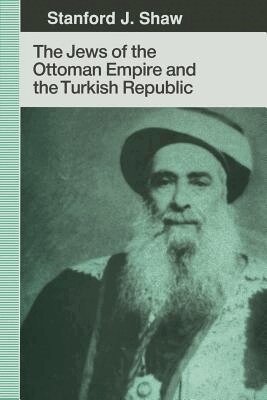
Shaw's excellent treatise is a must for anyone researching roots in Turkey or the Ottoman Empire . . . well organized. . . . [and] impressively researched. DorotShaw points out many interesting facts of the symbiosis between Jews and Muslims as he traces the relationship of more than 600 years. ChoiceEspecially recommended for college-level students of Jewish history and culture. The BookwatchOver the course of the last 600 years, the existence of the Jews of western Europe was continually threatened. While many took refuge in the Eastern regions of Europe, particularly in Poland and Lithuania, many more found shelter in the dominions of the Ottoman empire and in the Middle East, where their reception was far more congenial.This remarkable history, written by one of the world's foremost scholars of Turkish history, is the definitive account of Jewish life and history in this region. It is the story of the ideological and religious differences, and the hazardous but often successful cohabitation that characterized the life of the Jews of the Ottoman empire and, later, of Turkey.Examining the economic, cultural, and religious contributions of the Ottoman Jewish community, Stanford J. Shaw, a master of Turkish history, here documents the role of Ottoman Jews in the early Zionist movement, in World War I, and in the Turkish War for Independence. His analysis of the structures of different Jewish communities, the relations between them, and the relations between Jews, Christians, and Muslims in this unique circumstance is engaging and incisive. As Shaw sifts through the centuries, it becomes apparent that the fortunes of the Ottoman Jews directly paralleled those of the Ottoman empire.Shaw's extensive research in Ottoman, British, and French archives, as well as sources in Hebrew and Ladino, is supplemented by personal interviews with such major players as Haim Nahum Efendi, the last Grand Rabbi of the Ottoman empire, Rabbi David Asseo, Chief Rabbi of Turkey, and a number of prominent Turkish-Jewish scholars and businessmen.
1 409 kr
Skickas inom 5-8 vardagar
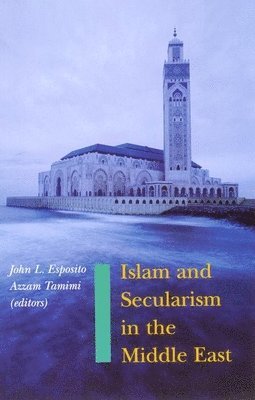
Western civilization tends to view secularism as a positive achievement. From this perspective, benefits of secularizing trends include the separation of church and state, the rule of law, and freedom from organized religion. In the Arab Middle East, however, Islamist intellectuals increasingly cite Western-inspired secularism as the source of the region's social dislocation and political instability. While secularism in the West led to the spread of democratic values, in the Muslim world it has been associated with dictatorship, the violation of human rights, and the abrogation of civil liberties. Islam and Secularism in the Middle East examines the origins and growth of the movement to abolish the secularizing reforms of the past century by creating a political order guided by Shariah law. Contributors explain the Islamic rejection of secularism as a failed Western Christian ideal and also discuss how secularization was pioneered by those who thought Muslims could only advance politically by emulating Western practices, including the renunciation of religion.
450 kr
Skickas inom 5-8 vardagar
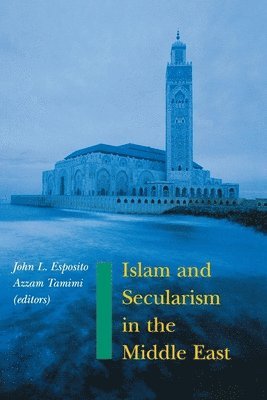
Western civilization tends to view secularism as a positive achievement. From this perspective, benefits of secularizing trends include the separation of church and state, the rule of law, and freedom from organized religion. In the Arab Middle East, however, Islamist intellectuals increasingly cite Western-inspired secularism as the source of the region's social dislocation and political instability. While secularism in the West led to the spread of democratic values, in the Muslim world it has been associated with dictatorship, the violation of human rights, and the abrogation of civil liberties. Islam and Secularism in the Middle East examines the origins and growth of the movement to abolish the secularizing reforms of the past century by creating a political order guided by Shariah law. Contributors explain the Islamic rejection of secularism as a failed Western Christian ideal and also discuss how secularization was pioneered by those who thought Muslims could only advance politically by emulating Western practices, including the renunciation of religion.
267 kr
Skickas inom 7-10 vardagar
Hamas won an overwhelming electoral victory in January 2006, overturning many assumptions regionally and globally. Branded as terrorist by Israel and the West, it is the largest Palestinian militant Islamist organization, formed fifteen years ago at the beginning of the first intifada. Its short-term objective is to drive Israeli forces from the West Bank and Gaza, an aim it hopes to realize through attacks on Israeli troops and settlers in the Occupied Territories and - more controversially - civilians. It also has the long-term aim of establishing an Islamic state on all of historic Palestine. In the post-Oslo world, Hamas gained power and influence as Israel steadily destroyed the power structure of the avowedly secular Yasser Arafat and his Palestinian Authority. A grass-roots organization that commands wide respect among Palestinians for its incorruptibility, Hamas is divided into two main sections, one responsible for establishing schools, hospitals and religious institutions, the other for military action and terror attacks carried out by its armed underground wing the Izzedine al-Qassam Brigades. This book charts the origins of Hamas among the Muslim Brotherhood, details the influence of its exiled leadership in Syria and elsewhere, and sets out its internal structure and political objectives. This new edition includes an additional chapter covering events since the book's original publication in November 2006.