B. Marincek – författare
Visar alla böcker från författaren B. Marincek. Handla med fri frakt och snabb leverans.
8 produkter
8 produkter
E-bok
PDF, Tyska, 2013538 kr
Läs direkt efter köp
Häftad, Tyska, 1999
509 kr
Skickas inom 10-15 vardagar
Das Buch stellt OBERON-Programmierwissen kompakt und übersichtlich dar. Es dient als Kurzleitfaden wie auch als Nachschlagewerk, der sich durch hohe Verständlichkeit auszeichnet. Die Beispielorientierung findet ihren Niederschlag in 69 Programmen.
E-bok
PDF, Engelska, 2012708 kr
Läs direkt efter köp
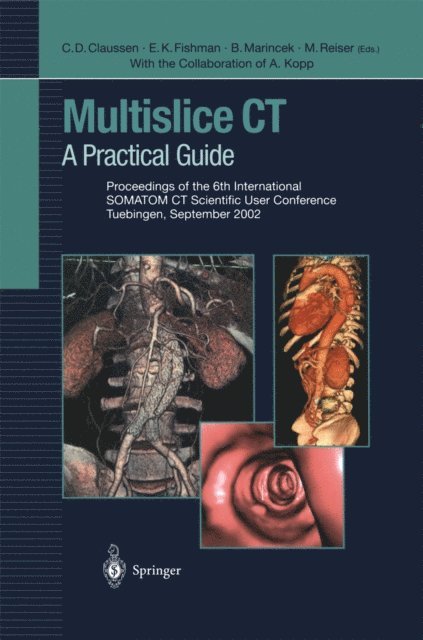
The 6th International SOMATOM CT Scientific User Conference was held in Tiibingen on September 27 and 28, 2002, under the auspices of the Eberhard Karls University Tiibingen, the University Hospital Zurich, the Ludwig Maxi milians University, Munich, and the Johns Hopkins University, Baltimore. Siemens AG Medical Solutions, Forchheim, was again very gracious in spon soring the course and the associated events. There have been remarkable achievements in CT technology, workflow management and applications since the last SOMATOM user conference in Zurich in June 2000. The next generation of multidetector-row CT, now capable of acquiring 16 slices during a single rotation has been introduced. The meeting in Tiibingen was the very first conference where research groups from allover the world were presenting their very first results with this new technology in the various fields of CT imaging. It became obvious that these new technical possi bilities will again have significant impact on the clinical use of CT. Tiibingen offered a special and inspiring atmosphere for the meeting, an atmosphere which has been preserved throughout time. For more than 500 years the university - one of the oldest in Germany - has been a source for new ideas being pursued by famous philosophers, poets and scientists such as H6lderlin, Morike, Hegel, Schelling, Kepler, Butenandt and many more.
E-bok
PDF, Engelska, 20121 408 kr
Läs direkt efter köp
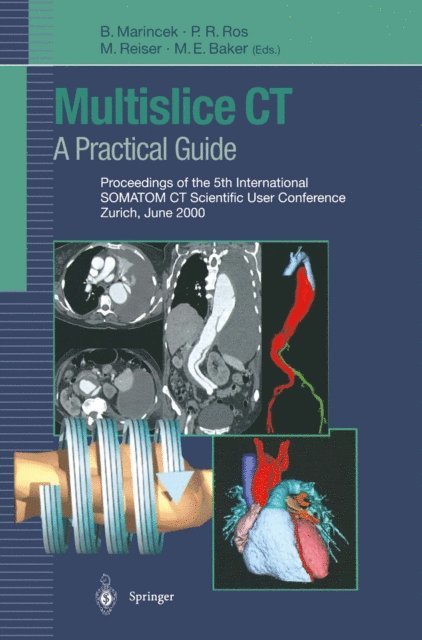
Until recently, CT scanner performance was limited by a series of compromises. With single-detector scanners, one cannot select thin collimation and still maintain the required extent of volumetric coverage. Slow scans cause motion artifacts that impair image quality. The introduction of multidetector CT technology, however, has revolutionized the field. Currently multidetector, multislice CT scanners acquire up to four channels of data from interweaving spirals. The minimum gantry rotation period is as low as half of a second. This increased scan speed allows for thinner collimation and thus higher longitudinal or z-axis resolution in comparison with single-detector CT. The improved image quality with multidetector technology leads to new applications of CT, particularly in cardiac, vascular, and abdominal imaging. On-going clinical studies are evaluating the suitability of this new imaging tool for non-invasive screening and diagnosis of coronary artery disease. A particular advantage to the increased scan speed in vascular imaging is the ability to cut intra venous contrast dosage and still maintain peak enhancement CT throughout the entire acquisition. Thin-section, multiphasic acquisition during optimal arterial-phase and venous-phase enhan cement significantly improves the accuracy for small lesion and vessel detection, and enhances overall classification of abdominal neoplasms. On the other hand, the increasingly large volume data sets force to new ways of looking at, presenting, storing, and trans ferring images. Networking and two- and three dimensional data processing are the key words.
Häftad, Engelska, 2012
561 kr
Skickas inom 10-15 vardagar
The 6th International SOMATOM CT Scientific User Conference was held in Tiibingen on September 27 and 28, 2002, under the auspices of the Eberhard Karls University Tiibingen, the University Hospital Zurich, the Ludwig Maxi milians University, Munich, and the Johns Hopkins University, Baltimore. Siemens AG Medical Solutions, Forchheim, was again very gracious in spon soring the course and the associated events. There have been remarkable achievements in CT technology, workflow management and applications since the last SOMATOM user conference in Zurich in June 2000. The next generation of multidetector-row CT, now capable of acquiring 16 slices during a single rotation has been introduced. The meeting in Tiibingen was the very first conference where research groups from allover the world were presenting their very first results with this new technology in the various fields of CT imaging. It became obvious that these new technical possi bilities will again have significant impact on the clinical use of CT. Tiibingen offered a special and inspiring atmosphere for the meeting, an atmosphere which has been preserved throughout time. For more than 500 years the university - one of the oldest in Germany - has been a source for new ideas being pursued by famous philosophers, poets and scientists such as H6lderlin, Morike, Hegel, Schelling, Kepler, Butenandt and many more.
Häftad, Engelska, 2011
1 115 kr
Skickas inom 10-15 vardagar
Until recently, CT scanner performance was limited by a series of compromises. With single-detector scanners, one cannot select thin collimation and still maintain the required extent of volumetric coverage. Slow scans cause motion artifacts that impair image quality. The introduction of multidetector CT technology, however, has revolutionized the field. Currently multidetector, multislice CT scanners acquire up to four channels of data from interweaving spirals. The minimum gantry rotation period is as low as half of a second. This increased scan speed allows for thinner collimation and thus higher longitudinal or z-axis resolution in comparison with single-detector CT. The improved image quality with multidetector technology leads to new applications of CT, particularly in cardiac, vascular, and abdominal imaging. On-going clinical studies are evaluating the suitability of this new imaging tool for non-invasive screening and diagnosis of coronary artery disease. A particular advantage to the increased scan speed in vascular imaging is the ability to cut intra venous contrast dosage and still maintain peak enhancement CT throughout the entire acquisition. Thin-section, multiphasic acquisition during optimal arterial-phase and venous-phase enhan cement significantly improves the accuracy for small lesion and vessel detection, and enhances overall classification of abdominal neoplasms. On the other hand, the increasingly large volume data sets force to new ways of looking at, presenting, storing, and trans ferring images. Networking and two- and three dimensional data processing are the key words.
E-bok
PDF, Tyska, 2013570 kr
Läs direkt efter köp
Häftad, Tyska, 2012
560 kr
Skickas inom 10-15 vardagar