Barry Sinervo – författare
Visar alla böcker från författaren Barry Sinervo. Handla med fri frakt och snabb leverans.
5 produkter
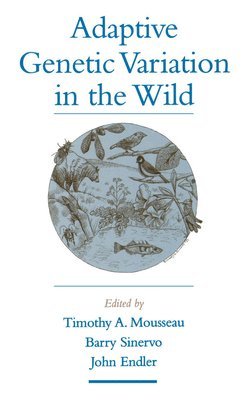
Adaptive Genetic Variation in the Wild
Av Timothy A. Mousseau, Barry Sinervo m. fl.
Inbunden, 2000
3085 kr
Lägg i varukorg
Two of the great mysteries of biology yet to be explored concern the distribution and abundance of genetic variation in natural populations and the genetic architecture of complex traits. These are tied together by their relationship to natural selection and evolutionary history, and some of the …
Adaptive Genetic Variation in the Wild
Av John A. Endler, Barry Sinervo m. fl.
E-bok, 2000
1760 kr
Lägg i varukorg
Two of the great mysteries of biology yet to be explored concern the distribution and abundance of genetic variation in natural populations and the genetic architecture of complex traits. These are tied together by their relationship to natural selection and evolutionary history, and some of the …
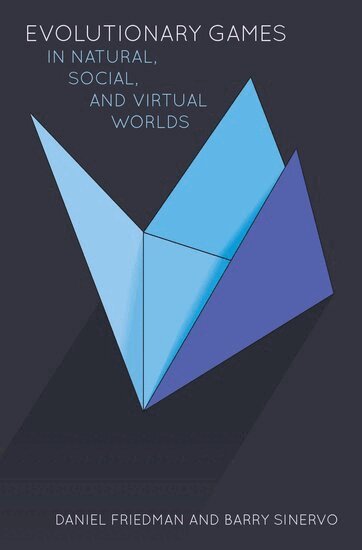
Evolutionary Games in Natural, Social, and Virtual Worlds
Av Daniel Friedman, Barry Sinervo
Inbunden, 2016
1507 kr
Lägg i varukorg
Over the last 25 years, evolutionary game theory has grown with theoretical contributions from the disciplines of mathematics, economics, computer science and biology. It is now ripe for applications. In this book, Daniel Friedman---an economist trained in mathematics---and Barry Sinervo---a …
Evolutionary Games in Natural, Social, and Virtual Worlds
Av Barry Sinervo, Daniel Friedman
E-bok, 2016
1375 kr
Lägg i varukorg
Over the last 25 years, evolutionary game theory has grown with theoretical contributions from the disciplines of mathematics, economics, computer science and biology. It is now ripe for applications. In this book, Daniel Friedman---an economist trained in mathematics---and Barry Sinervo---a …
Evolutionary Games in Natural, Social, and Virtual Worlds
Av Barry Sinervo, Daniel Friedman
E-bok, 2016
1375 kr
Lägg i varukorg
Over the last 25 years, evolutionary game theory has grown with theoretical contributions from the disciplines of mathematics, economics, computer science and biology. It is now ripe for applications. In this book, Daniel Friedman---an economist trained in mathematics---and Barry Sinervo---a …