Benjamin A. Elman - Böcker
Visar alla böcker från författaren Benjamin A. Elman. Handla med fri frakt och snabb leverans.
9 produkter
9 produkter
Del 19 - Studies on China
Education and Society in Late Imperial China, 1600-1900
Inbunden, Engelska, 1994
1 513 kr
Skickas inom 3-6 vardagar
This comprehensive volume integrates the history of late imperial China with the history of education over three centuries, revealing the significance of education in Chinese social, political, and intellectual life. A collaboration between social and intellectual historians, these fifteen essays provide the most wide-ranging study in English on China's education in the centuries before the modern revolution.
817 kr
Skickas inom 7-10 vardagar
In this multidimensional analysis, Benjamin A. Elman uses over a thousand newly available examination records from the Yuan, Ming, and Ch'ing dynasties, 1315-1904, to explore the social, political, and cultural dimensions of the civil examination system, one of the most important institutions in Chinese history. For over five hundred years, the most important positions within the dynastic government were usually filled through these difficult examinations, and every other year some one to two million people from all levels of society attempted them. Covering the late imperial system from its inception to its demise, Elman revises our previous understanding of how the system actually worked, including its political and cultural machinery, the unforeseen consequences when it was unceremoniously scrapped by modernist reformers, and its long-term historical legacy. He argues that the Ming-Ch'ing civil examinations from 1370 to 1904 represented a substantial break with T'ang-Sung dynasty literary examinations from 650 to 1250. Late imperial examinations also made 'Tao Learning', Neo-Confucian learning, the dynastic orthodoxy in official life and in literati culture.The intersections between elite social life, popular culture, and religion that are also considered reveal the full scope of the examination process throughout the late empire.
868 kr
Skickas inom 10-15 vardagar
In On Their Own Terms, Benjamin A. Elman offers a much-needed synthesis of early Chinese science during the Jesuit period (1600-1800) and the modern sciences as they evolved in China under Protestant influence (1840s-1900).By 1600 Europe was ahead of Asia in producing basic machines, such as clocks, levers, and pulleys, that would be necessary for the mechanization of agriculture and industry. In the seventeenth and eighteenth centuries, Elman shows, Europeans still sought from the Chinese their secrets of producing silk, fine textiles, and porcelain, as well as large-scale tea cultivation. Chinese literati borrowed in turn new algebraic notations of Hindu-Arabic origin, Tychonic cosmology, Euclidian geometry, and various computational advances. Since the middle of the nineteenth century, imperial reformers, early Republicans, Guomindang party cadres, and Chinese Communists have all prioritized science and technology. In this book, Elman gives a nuanced account of the ways in which native Chinese science evolved over four centuries, under the influence of both Jesuit and Protestant missionaries. In the end, he argues, the Chinese produced modern science on their own terms.
Del 15 - New Histories of Science, Technology, and Medicine
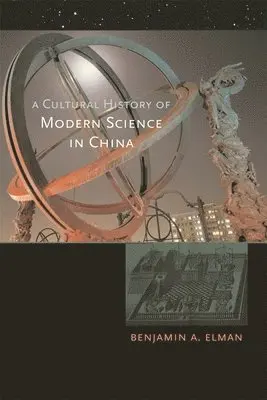
Cultural History of Modern Science in China
Häftad, Engelska, 2009
297 kr
Skickas inom 10-15 vardagar
Historians of science and Sinologists have long needed a unified narrative to describe the Chinese development of modern science, medicine, and technology since 1600. They welcomed the appearance in 2005 of Benjamin Elman's masterwork, On Their Own Terms. Now Elman has retold the story of the Jesuit impact on late imperial China, circa 1600-1800, and the Protestant era in early modern China from the 1840s to 1900 in a concise and accessible form ideal for the classroom. This coherent account of the emergence of modern science in China places that emergence in historical context for both general students of modern science and specialists of China.
590 kr
Skickas inom 10-15 vardagar
Philology—the discipline of making sense of texts—is enjoying a renaissance within academia after decades of neglect. World Philology charts the evolution of philology across the many cultures and historical time periods in which it has been practiced, and demonstrates how this branch of knowledge, like philosophy and mathematics, is an essential component of human understanding.Every civilization has developed ways of interpreting the texts that it produces, and differences of philological practice are as instructive as the similarities. We owe our idea of a textual edition for example, to the third-century BCE scholars of the Alexandrian Library. Rabbinical philology created an innovation in hermeneutics by shifting focus from how the Bible commands to what it commands. Philologists in Song China and Tokugawa Japan produced startling insights into the nature of linguistic signs. In the early modern period, new kinds of philology arose in Europe but also among Indian, Chinese, and Japanese commentators, Persian editors, and Ottoman educationalists who began to interpret texts in ways that had little historical precedent. They made judgments about the integrity and consistency of texts, decided how to create critical editions, and determined what it actually means to read.Covering a wide range of cultures—Greek, Roman, Hebrew, Arabic, Sanskrit, Chinese, Indo-Persian, Japanese, Ottoman, and modern European—World Philology lays the groundwork for a new scholarly discipline.
539 kr
Skickas inom 10-15 vardagar
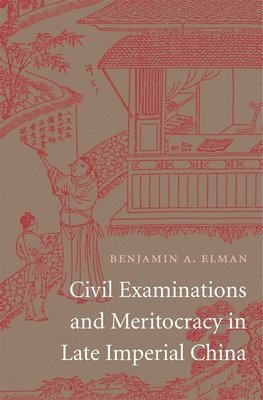
During China's late imperial period (roughly 1400-1900 CE), men would gather by the millions every two or three years outside official examination compounds sprinkled across China. Only one percent of candidates would complete the academic regimen that would earn them a post in the administrative bureaucracy. Civil Examinations assesses the role of education, examination, and China's civil service in fostering the world's first professional class based on demonstrated knowledge and skill.While millions of men dreamed of the worldly advancement an imperial education promised, many more wondered what went on inside the prestigious walled-off examination compounds. As Benjamin A. Elman reveals, what occurred was the weaving of a complex social web. Civil examinations had been instituted in China as early as the seventh century CE, but in the Ming and Qing eras they were the nexus linking the intellectual, political, and economic life of imperial China. Local elites and members of the court sought to influence how the government regulated the classical curriculum and selected civil officials. As a guarantor of educational merit, civil examinations served to tie the dynasty to the privileged gentry and literati classes--both ideologically and institutionally.China did away with its classical examination system in 1905. But this carefully balanced and constantly contested piece of social engineering, worked out over the course of centuries, was an early harbinger of the meritocratic regime of college boards and other entrance exams that undergirds higher education in much of the world today.
Del 10 - Leiden Series in Comparative Historiography
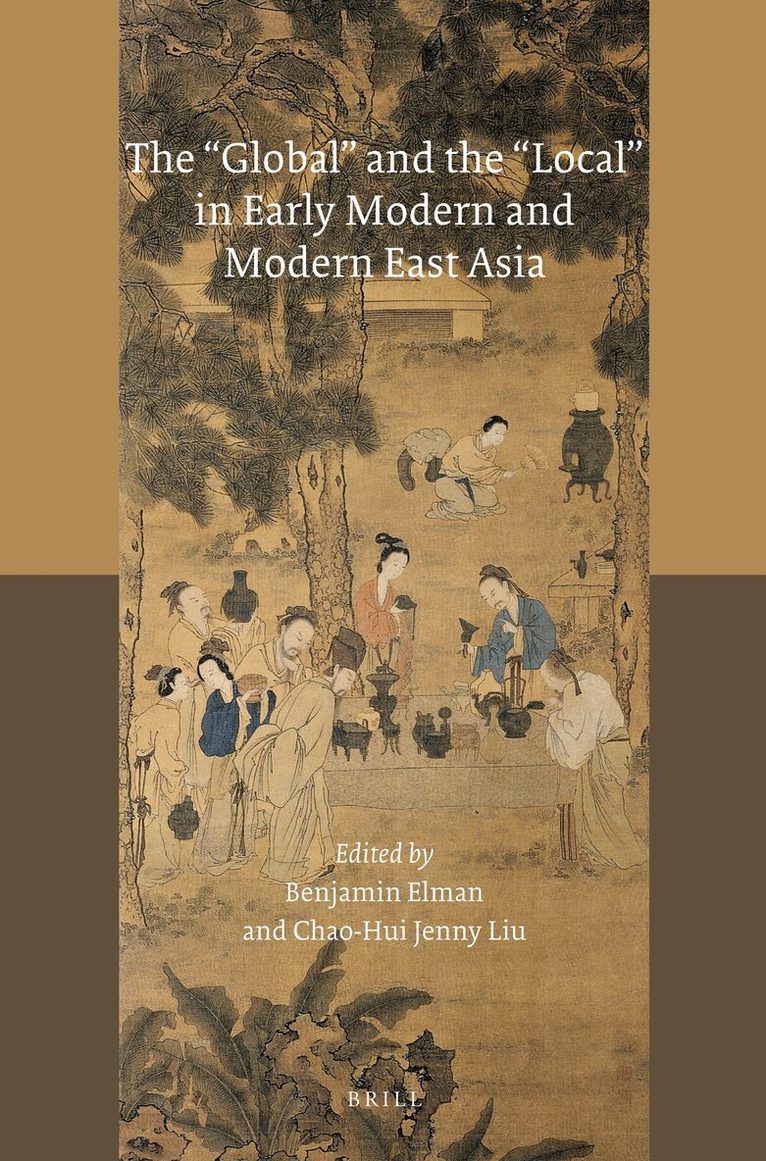
'Global' and the 'Local' in Early Modern and Modern East Asia
Inbunden, Engelska, 2017
1 968 kr
Skickas inom 5-8 vardagar
The “Global” and the “Local” in Early Modern and Modern East Asia presents a unique set of historical perspectives by scholars from two important universities in the East Asian region—The University of Tokyo (Tōdai) and Fudan University, along with East Asian Studies scholars from Princeton University. Two of the essays address the international leanings in the histories of their respective departments in Todai and Fudan. The rest of the essays showcase how such thinking about the global and local histories have borne fruit, as the scholars of the three institutions contributed essays, arguing about the philosophies, methodologies, and/or perspectives of global history and how it relates to local stories.Authors include Benjamin Elman, Haneda Masashi, and Ge Zhaoguang.
768 kr
Skickas inom 5-8 vardagar
The “Global” and the “Local” in Early Modern and Modern East Asia presents a unique set of historical perspectives by scholars from two important universities in the East Asian region—The University of Tokyo (Tōdai) and Fudan University, along with East Asian Studies scholars from Princeton University. Two of the essays address the international leanings in the histories of their respective departments in Todai and Fudan. The rest of the essays showcase how such thinking about the global and local histories have borne fruit, as the scholars of the three institutions contributed essays, arguing about the philosophies, methodologies, and/or perspectives of global history and how it relates to local stories. Authors include Benjamin Elman, Haneda Masashi, and Ge Zhaoguang.
1 967 kr
Skickas inom 5-8 vardagar
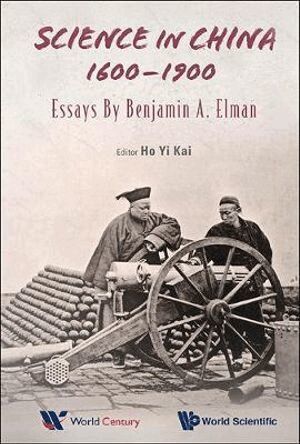
Distinguished historian Benjamin A Elman's collective volume on the history of science in imperial China, brings together over 30 years of historical literature on the subject. With updates to the literature and new material including transcripts of podcasts and translated interview articles, Science in China takes the reader on a journey starting in the early 17th century with the missionary efforts of the Jesuits in China, and ending with the Protestant missions in the 19th century. These two milestone encounters brought Western sciences to local Chinese scholars with great success in shaping modern Chinese science. Elman studies the interaction between Western and Chinese sciences through philological research and evidence, and treats the two encounters not as separate events but as a continuum of creative exchange of scientific knowledge and discourse.