Bettelou Los - Böcker
Visar alla böcker från författaren Bettelou Los. Handla med fri frakt och snabb leverans.
10 produkter
10 produkter
930 kr
Skickas inom 5-8 vardagar
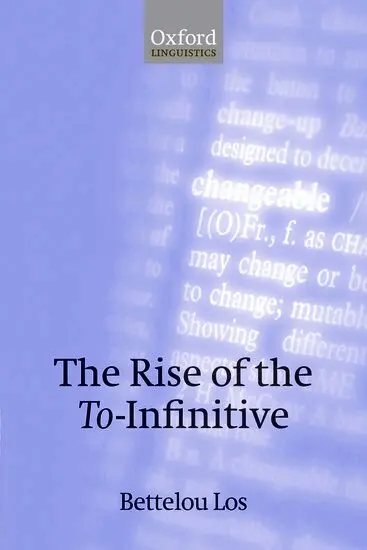
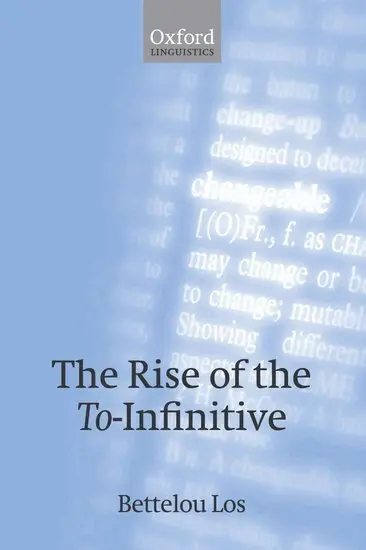
This book describes the historical emergence and spread of the to-infinitive in English. It shows that to + infinitive emerged from a reanalysis of the preposition to plus a deverbal nominalization, which spread first to purpose clauses, then to other nonfinite environments. The book challenges the traditional reasoning that infinitives must have been nouns in Old English because they inflected for dative case and can follow prepositions. Dr Los shows that, even as early as Old English, the to-infinitive was established in most of the environments in which it is found today. She argues that its spread was largely due to competition with subjunctive that-clauses, which it gradually replaced. Later chapters consider Middle English developments. The author provides a measured evaluation of the evidence that to undergoes a period of degrammaticalization. She concludes that the extent to which to gains syntactic freedom in Middle English is due to the fact that speakers began to equate it with the modal verbs and therefore to treat it syntactically as a modal verb. The exposition is clear and does not assume an up-to-date knowledge of generative theory. The book will appeal to the wide spectrum of scholars interested in the transformation from Old to Middle English, as well as those studying the processes and causes of syntactic change more generally.
3 066 kr
Skickas inom 5-8 vardagar
This book describes the historical emergence and spread of the to-infinitive in English. It shows that to + infinitive emerged from a reanalysis of the preposition to plus a deverbal nominalization, which spread first to purpose clauses, then to other nonfinite environments. The book challenges the traditional reasoning that infinitives must have been nouns in Old English because they inflected for dative case and can follow prepositions. Dr Los shows that as early as Old English the to-infinitive was established in most of the environments in which it is found today. She argues that its spread was largely due to competition with subjunctive that-clauses, which it gradually replaced.Later chapters consider Middle English developments. The author provides a measured evaluation of the evidence that to undergoes a period of degrammaticalization. She concludes that the extent to which to gains syntactic freedom in Middle English is due to the fact that speakers began to equate it with the modal verbs and therefore to treat it syntactically as a modal verb.The exposition is clear and does not assume an up-to-date knowledge of generative theory. The book will appeal to the wide spectrum of scholars interested in the transformation of Old to Middle English as well as those studying the processes and causes of syntactic change more generally.
1 253 kr
Skickas inom 5-8 vardagar
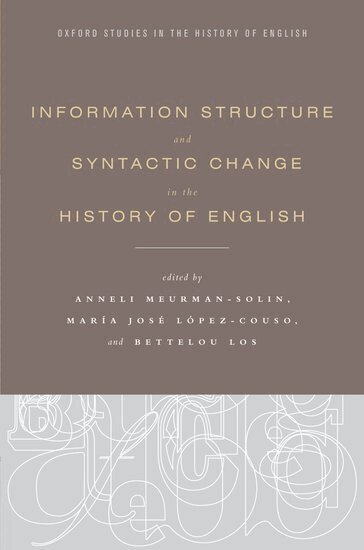
Information Structure and Syntactic Change in the History of English is the first book to apply information structure as it relates to language change to a corpus-based analysis of a wide range of features in the evolution of English syntax and grammars of prose in long diachrony. Its unifying topic is the role of information structure, broadly conceived, as it interacts with the other levels of linguistic description, syntax, morphology, prosody, semantics and pragmatics. The volume comprises twelve chapters by leading scholars who take a variety of theoretical and methodological approaches. Their work affirms, among other things, that motivations for selecting a particular syntactic option vary from information structure in the strict sense to discourse organization, or a particular style or register, and can also be associated with external forces such as the development of a literary culture.
1 936 kr
Tillfälligt slut
511 kr
Skickas inom 3-6 vardagar
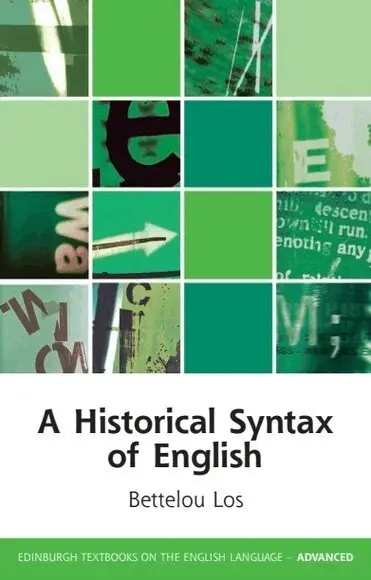
This book discusses a number of approaches to charting the major developments in the syntax of English, addressing key issues of interpretation and focus for the benefit of students of the topic. It does not assume any knowledge of Old or Middle English or of formal syntax, although students should be familiar with traditional syntactic concepts such as verbs and nouns, subjects and objects, and a general knowledge of linguistic concepts such as morphology or case.Drawing on explanations from both formal and functional approaches, Los explores how syntactic changes are the product of the interaction of many factors, external (the product of a certain sociolinguistic constellation of language or dialect contact) and internal (e.g. the loss of morphology, pressure from analogy).The book will strike a balance between theoretical explanation and accessibility to readers who have not had any training in formal syntax.
Del 134 - Cambridge Studies in Linguistics
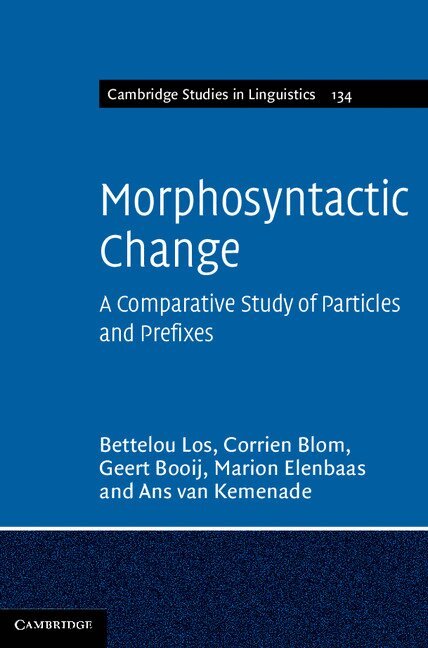
Morphosyntactic Change
A Comparative Study of Particles and Prefixes
Inbunden, Engelska, 2012
848 kr
Skickas inom 7-10 vardagar
Particle verbs (combinations of two words but lexical units) are a notorious problem in linguistics. Is a particle verb like look up one word or two? It has its own entry in dictionaries, as if it is one word, but look and up can be split up in a sentence: we can say He looked the information up and He looked up the information. But why can't we say He looked up it? In English look and up can only be separated by a direct object, but in Dutch the two parts can be separated over a much longer distance. How did such hybrid verbs arise and how do they function? How can we make sense of them in modern theories of language structure? This book sets out to answer these and other questions, explaining how these verbs fit into the grammatical systems of English and Dutch.
Del 134 - Cambridge Studies in Linguistics
Morphosyntactic Change
A Comparative Study of Particles and Prefixes
Häftad, Engelska, 2016
441 kr
Skickas inom 7-10 vardagar
Particle verbs (combinations of two words but lexical units) are a notorious problem in linguistics. Is a particle verb like look up one word or two? It has its own entry in dictionaries, as if it is one word, but look and up can be split up in a sentence: we can say He looked the information up and He looked up the information. But why can't we say He looked up it? In English look and up can only be separated by a direct object, but in Dutch the two parts can be separated over a much longer distance. How did such hybrid verbs arise and how do they function? How can we make sense of them in modern theories of language structure? This book sets out to answer these and other questions, explaining how these verbs fit into the grammatical systems of English and Dutch.
634 kr
Skickas inom 7-10 vardagar
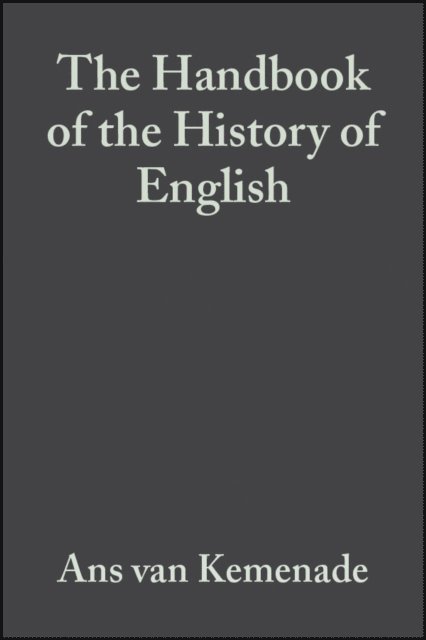
The Handbook of the History of English is a collection of articles written by leading specialists in the field that focus on the theoretical issues behind the facts of the changing English language. organizes the theoretical issues behind the facts of the changing English language innovatively and applies recent insights to old problemssurveys the history of English from the perspective of structural developments in areas such as phonology, prosody, morphology, syntax, semantics, language variation, and dialectologyoffers readers a comprehensive overview of the various theoretical perspectives available to the study of the history of English and sets new objectives for further research
1 942 kr
Skickas inom 3-6 vardagar
Edinburgh (now the Angus McIntosh Centre for Historical Linguistics), such as eLALME (the electronic version A Linguistic Atlas of Late Medieval English), LAEME (A Linguistic Atlas of Early Middle English) and LAOS (A Linguistic Atlas of Older Scots), this volume illustrates how traditional methods of historical dialectology can benefit from new methods of data-collection to test out theoretical and empirical claims. In showcasing the results that these resources can yield in the digital age, the book highlights novel methods for presenting, mapping and analysing the quantitative data of historical dialects, and sets the research agenda for future work in this field.Bringing together a range of distinguished researchers, the book sets out the key corpus-building strategies for working with regional manuscript data at different levels of linguistic analysis including syntax, morphology, phonetics and phonology. The chapters also show the ways in which the geographical spread of phonological, morphological and lexical features of a language can be used to improve our assessment of the geographical provenance of historical texts.
611 kr
Skickas inom 3-6 vardagar
Edinburgh (now the Angus McIntosh Centre for Historical Linguistics), such as eLALME (the electronic version A Linguistic Atlas of Late Medieval English), LAEME (A Linguistic Atlas of Early Middle English) and LAOS (A Linguistic Atlas of Older Scots), this volume illustrates how traditional methods of historical dialectology can benefit from new methods of data-collection to test out theoretical and empirical claims. In showcasing the results that these resources can yield in the digital age, the book highlights novel methods for presenting, mapping and analysing the quantitative data of historical dialects, and sets the research agenda for future work in this field.Bringing together a range of distinguished researchers, the book sets out the key corpus-building strategies for working with regional manuscript data at different levels of linguistic analysis including syntax, morphology, phonetics and phonology. The chapters also show the ways in which the geographical spread of phonological, morphological and lexical features of a language can be used to improve our assessment of the geographical provenance of historical texts.